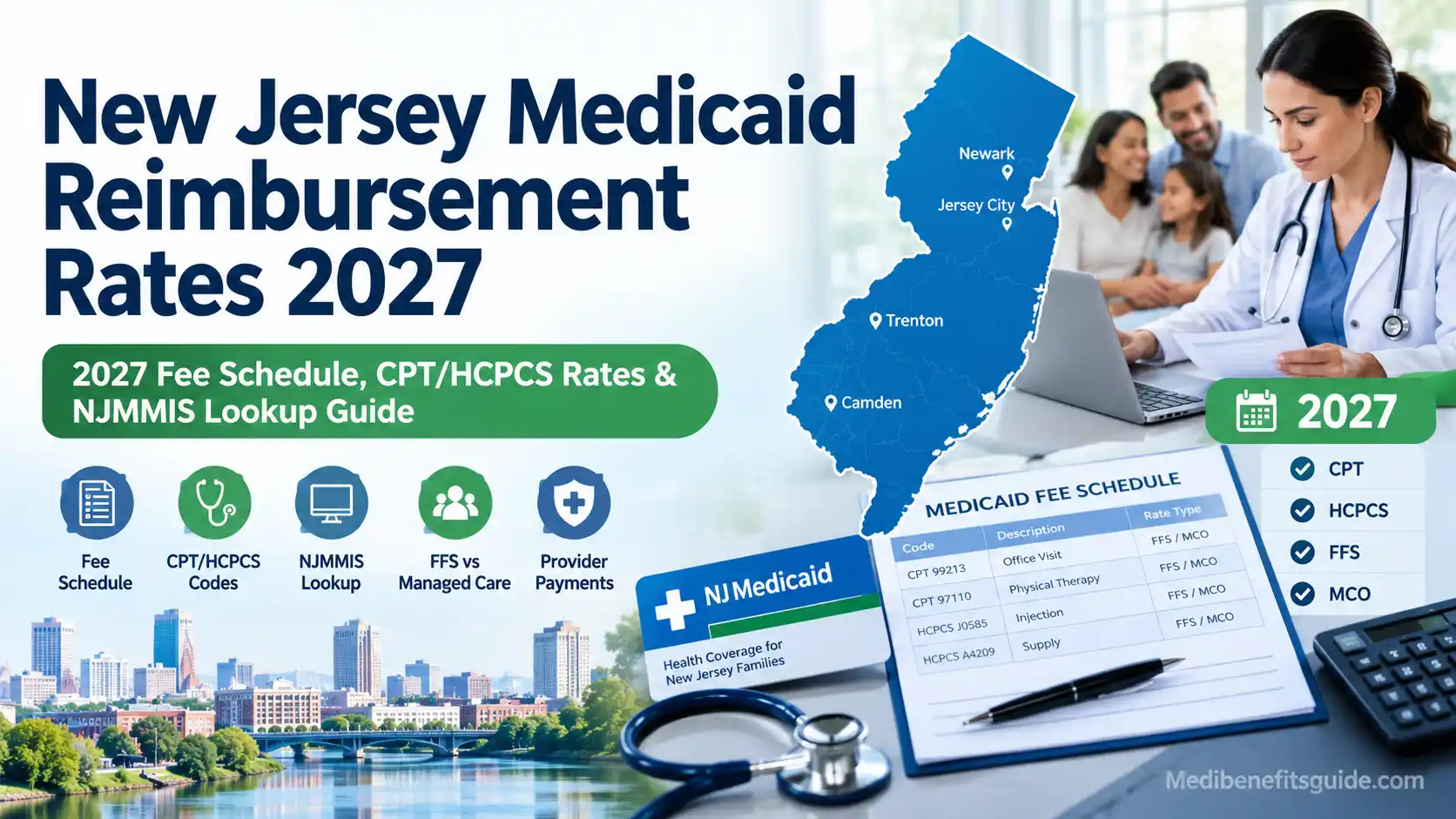
New Jersey Medicaid reimbursement rates for 2027 vary by service, procedure code, provider type, effective date, and payment arrangement. NJMMIS Rate and Code Information is the official place to start. Some services follow separate schedules, managed-care contracts, provider-specific rates, or supplemental payment methodologies.
Hoping to find one statewide Medicaid reimbursement number? Save yourself the time. It doesn’t exist. Physicians, hospitals, nursing facilities, home health agencies, behavioral health providers, dentists, DME suppliers and transportation providers are all paid under their own rules. If you want to see how other states compare, here’s a breakdown of Medicaid reimbursement rates by state.
What Are New Jersey Medicaid Reimbursement Rates for 2027?
Think of a Medicaid reimbursement rate as the program’s payment for a covered service delivered to an eligible NJ FamilyCare member. Whether a person qualifies is a separate matter, covered in our guide to New Jersey Medicaid income limits.
The payment itself can rest on any of these:
- CPT or HCPCS procedure code
- CDT dental code
- Revenue code
- Per diem
- Unit rate
- Provider-specific rate
- Minimum or maximum fee allowance
- Prospective payment methodology
- Supplemental or add-on payment
- Managed-care contract
Modifiers, units, place of service, provider type, effective date and prior authorization all shift the number. So does the claim type: Fee-for-Service (FFS) or managed care.
Where to Find the NJ Medicaid Fee Schedule for 2027
NJMMIS is the primary operational source. It’s the fiscal-agent system for New Jersey Medicaid. Its website has a Rate and Code Information area, plus provider resources, billing supplements, forms, manuals and claims information.
Old third-party fee schedules? Skip them. For any CPT or HCPCS lookup, go directly to the applicable NJMMIS rate information.
This is the order that works:
- Identify the CPT, HCPCS, CDT or revenue code.
- Identify the provider and service category.
- Open the applicable NJMMIS Rate and Code Information resource.
- Confirm the effective date.
- Check modifiers, units and place-of-service requirements.
- Determine whether the claim is FFS or managed care.
- Check coverage and prior-authorization requirements.
- If managed care applies, verify the applicable MCO contract or provider manual.
Eight steps beats one Google search for “NJ Medicaid rate” every time.
New Jersey Medicaid FFS vs Managed Care Rates
For years, New Jersey has been moving Medicaid beneficiaries away from traditional Fee-for-Service coverage and into managed care. NJ FamilyCare now contracts with five Medicaid managed-care organizations:
- Aetna Better Health of New Jersey
- Fidelis Care
- Horizon NJ Health
- UnitedHealthcare Community Plan
- Wellpoint
A published FFS rate won’t automatically match what an MCO pays you. That gap is the whole reason the split matters.
| Fee-for-Service Medicaid | Managed Care |
|---|---|
| State-published rate schedules are important | MCO contracts and payment terms may apply |
| NJMMIS is a key lookup source | MCO manuals are also important |
| Procedure-specific rates are common | Contract-specific payment arrangements may apply |
| State plan rules govern applicable services | State-directed payments may supplement payments |
| Public rate information is available for many services | Contractual details may differ |
Behavioral health and other contracted providers, read your MCO provider manuals closely. Requirements for claims, reimbursement, credentialing and prior authorization are all in there.
Does New Jersey Have One Medicaid Fee Schedule?
No. Reimbursement is divided across service and provider categories, each with its own logic.
Physician and Professional Services
CPT code, modifier, provider type, place of service and the payment methodology in play all shape what a physician is paid. Specific state or federal payment programs can also touch primary care and specialty services.
Dental Services
Dental reimbursement in NJ Medicaid runs on CDT and other applicable procedure codes. Verify the applicable schedule and managed-care requirements before you bill. A general medical CPT rate doesn’t apply here, so don’t assume it does.
Behavioral Health
Behavioral health claims can touch several payers at once: DMAHS, the Division of Mental Health and Addiction Services, FFS arrangements and MCO payment structures. Pull the current rate chart, your contract and the billing requirements for the exact service you deliver before you submit anything.
Home Health
Separate rates exist for physical therapy, professional therapy, speech therapy, skilled nursing, medical social services and home health aide services.
NJMMIS also publishes statewide and specific-provider home health rate information. Your provider identifier can decide which payment applies. That’s worth knowing before you pull a number.
DME and DMEPOS
For durable medical equipment, payment turns on HCPCS codes, modifiers, units, rental versus purchase status and other coverage requirements.
Nursing Facilities
New Jersey keeps a dedicated fiscal-year resource for Nursing Home Rates for FFS Residents. The state’s FY2027 resource covers nursing-home FFS rates and the Nursing Facility Quality Incentive Payment Program (NF QIPP).
Nursing facilities show exactly why one broad fee schedule can’t cover every provider category.
Hospital Services
Inpatient and outpatient methodologies, revenue codes, diagnosis-related systems, supplemental payments and state-directed payments all play a role. You can’t reduce hospital reimbursement to a simple CPT-rate table.
What Changed for New Jersey Medicaid in 2027?
State Fiscal Year 2027 runs from July 1, 2026, through June 30, 2027. Calendar year 2027 runs January 1 through December 31, 2027. Mixing them up is one of the most common mistakes when people compare rate files and public notices.
New Jersey issued separate SFY2027 Medicaid notices covering:
- Assisted living
- Private duty nursing
- Adult day health
- Nursing facility reimbursement
- Graduate Medical Education
- GME-Trauma
- GME-Supplemental
- Hospital charity care
- PACE-related payment methodology
A “2027” label on a rate doesn’t mean it changed on January 1, 2027.
State-Directed Payments and Supplemental Reimbursement
State-directed payments are the other big piece of New Jersey Medicaid payment policy. They move through managed care and can deliver supplemental payments to certain provider classes, subject to federal requirements and CMS approval.
For FY2027, New Jersey has state-directed payment arrangements covering nursing facilities and primary care. Hospital outpatient payments carry a significant state-directed payment methodology of their own.
None of it shows up in the standard CPT or HCPCS fee schedule. It sits on top, as a separate layer:
base Medicaid payment + applicable supplemental/add-on payment = overall payment methodology
The exact calculation depends on the approved program.
How to Verify an NJ Medicaid Reimbursement Rate
Before a rate goes into billing, contracting or financial analysis, confirm the full payment context. Record each of these:
| What to verify | Why it matters |
|---|---|
| Procedure code | Identifies the service |
| Code description | Confirms the service |
| Provider type | Rates may differ by provider |
| Rate amount | Identifies the published payment |
| Unit | Prevents incorrect calculations |
| Effective date | Avoids using an outdated rate |
| Modifier | May change payment |
| Place of service | Can affect reimbursement |
| FFS or MCO | Determines the payment pathway |
| Prior authorization | May affect claim payment |
| Source document | Provides an audit trail |
Get strict about this when you’re comparing a current NJ Medicaid fee schedule against an older PDF, spreadsheet or third-party database. That’s where bad numbers sneak in.
Why the Actual Medicaid Payment May Differ From the Fee Schedule
Your remittance rarely matches the published rate to the penny. Plenty of things sit in between:
- Eligibility on the date of service
- Coverage rules
- Prior authorization
- Coding
- Modifiers
- Units
- Provider enrollment
- NPI information
- Claim edits
- Coordination of benefits
- MCO contracts
- Contracted payment rates
- Supplemental payments
- State-directed payment rules
Take a published rate, multiply it by the number of services, and you may still miss the final claim payment. Don’t bank on the math working out.
Does NJ Medicaid Pay the Same as Medicare?
Not necessarily. Medicaid and Medicare run on different payment systems and methodologies.
A New Jersey Medicaid rate comes from state Medicaid policy, a specific fee schedule, a payment methodology or an approved supplemental arrangement. Medicare rates are a useful comparison point. Treat them as the NJ Medicaid rate only when the applicable New Jersey methodology references Medicare directly.
What About MCO Reimbursement Rates?
NJ FamilyCare managed-care payment depends on the health plan, the provider agreement and applicable state requirements. On any managed-care claim, pull the MCO’s current provider manual, contract information and reimbursement guidance.
Do it without fail where the state has set minimum payment requirements or a state-directed payment arrangement.
New Jersey Medicaid Rates by County
Medicaid reimbursement is governed at the state and program level. Newark, Jersey City, Paterson, Trenton and Camden don’t each have a separate basic fee schedule.
Geography still turns up in certain payment programs. New Jersey’s County Option Hospital Fee Program publishes county-specific fee and expenditure reports for SFY2027. That’s where geography enters the picture. The base Medicaid program is statewide, but hospital and special payment methodologies can still carry a geographic element.
FAQs About New Jersey Medicaid Reimbursement Rates
What are the New Jersey Medicaid reimbursement rates for 2027?
No single statewide rate exists. Procedure, provider type, service category, effective date and payment arrangement all move the number. NJMMIS is the primary starting point for rate and code information.
Where can I find the NJ Medicaid fee schedule?
Go to the NJMMIS website and open its Rate and Code Information resources. Nursing facilities and specialized programs publish their own official rate resources.
How do I look up an NJ Medicaid CPT code?
Identify the CPT code, choose the right NJMMIS rate resource, and confirm the effective period. After that, check modifiers, units, provider type, place of service and whether the claim is FFS or managed care.
How do I look up an NJ Medicaid HCPCS code?
Same process as CPT. Verify the HCPCS code, rate schedule, effective date, provider category, modifiers, units and coverage requirements.
Does NJ Medicaid have one fee schedule?
No. New Jersey uses multiple rate schedules and payment methodologies across professional services, hospitals, nursing facilities, home health, DME, dental, behavioral health and other services.
Does NJ FamilyCare managed care use the Medicaid fee schedule?
Not necessarily as the final payment amount. Your MCO contract, minimum payment requirements, state-directed payments and other contractual rules decide what you’re actually paid.
Are NJ Medicaid rates the same for every provider?
No.
Some services have statewide rates. Others carry provider-specific rates or specialized payment methodologies.
How often does New Jersey Medicaid update reimbursement rates?
Rates change through annual fiscal-year updates, calendar-year updates, public notices, state-plan amendments, provider bulletins and other policy updates. Confirm the effective date every time.
What are the NJ Medicaid nursing facility rates for 2027?
New Jersey publishes a dedicated FY2027 nursing-home FFS rate resource. NF QIPP and managed-care/state-directed payment setting also factor into nursing facility reimbursement.
What are NJ Medicaid private duty nursing rates for 2027?
New Jersey published an SFY2027 Private Duty Nursing rate notice. Check the price against the current NJMMIS schedule for your specific service and provider circumstances.
What are New Jersey Medicaid house health rates?
Home health isn’t priced as one service. Skilled nursing, physical therapy, occupational therapy, speech therapy, medical social services and home health aide services each carry their own rate, and the schedule plus the provider decide which one lands on your claim.
Why can the actual Medicaid payment differ from the fee schedule?
Eligibility, coding, modifiers, units, prior authorization, claim edits, other insurance, MCO contracts and supplemental or state-directed payment rules all affect the final payment.
Can I search New Jersey Medicaid rates by CPT code?
Yes. NJMMIS provides rate and code information for procedure-code reimbursement. Check the effective date and other claim conditions each time.
Conclusion
New Jersey Medicaid reimbursement rates for 2027 don’t come as a price list. They’re a patchwork of rate schedules and payment methodologies, and no single document covers the whole thing.
Begin with NJMMIS. Start with the code, whether that’s CPT, HCPCS, CDT or a revenue code. Then confirm the provider type, the effective date, and FFS versus managed care. Anything specialized goes deeper: DMAHS public notices, the provider manual, the state plan or SPA, CMS approval, supplemental payment methodology. Skip those and you’re guessing.
Get in the habit of checking the source document before you trust a number. It’s the quickest way to stop outdated rates from costing you, and it gives members and caregivers a straighter picture of how providers actually get paid.
Official Resources
- Check Current NJ Medicaid Rates — NJMMIS
- Verify Payment Policy Updates — NJ Division of Medical Assistance and Health Services
- See How NJ FamilyCare Coverage Works — NJ FamilyCare
- Get Federal Medicaid Guidance — Medicaid.gov (CMS)
Disclaimer: Don’t treat this page as the final word. Medicaid reimbursement rules and rates change, so check the current NJMMIS, NJ Department of Human Services/DMAHS, MCO and CMS information before any billing, contracting or financial decision.

About Naseer
Naseer has 10+ years of experience creating informative content and researching medicare topics. He focuses on simplifying Medicaid and benefits details to support readers find clear, reliable, and easy-to-understand guidance.