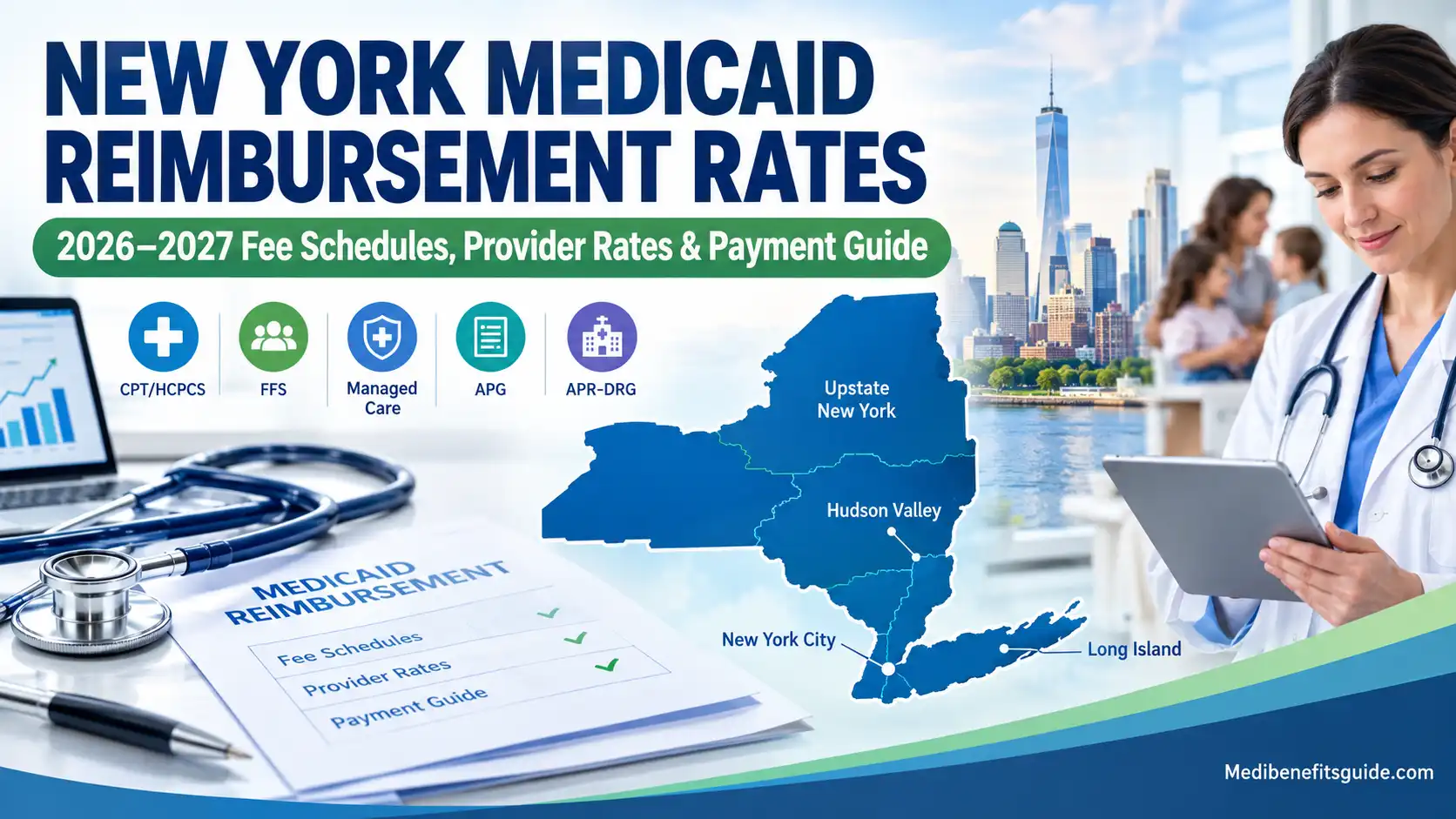
Hunting for a single New York Medicaid rate won’t get you far, because one doesn’t exist. New York Medicaid reimbursement rates are the dollar amounts and payment methods the state uses to pay healthcare providers and facilities for covered Medicaid services.
The amount you get depends on many things. The type of provider matters. So does the service, the code (CPT, HCPCS, CDT or rate code), the modifier, the units, the place of service and the effective date. The payment method counts too, and so does whether the claim goes through Medicaid fee-for-service (FFS) or Medicaid Managed Care.
That is why one dollar figure won’t help you. Find the right official schedule, the right code, the right payment system and the right dates instead.
NYSDOH and eMedNY post fee schedules for just about every kind of provider: professional services, hospitals, dental, DME, behavioral health, nursing homes, home care and more. Behind that, NYSDOH splits its payment work four ways. FFS, managed care, mental hygiene and long-term care each get their own group.
Rates change a lot from state to state. To compare New York with other programs, see our guide to Medicaid reimbursement rates by state.
Does New York Medicaid Have One Fee Schedule?
No. New York uses several schedules and payment methods.
Nursing homes get facility-specific rates. Hospital inpatient stays can be paid under APR-DRG or exempt methods. Hospital outpatient care uses the Ambulatory Patient Group (APG) method. Physicians use a professional fee schedule.
A rate from one schedule can’t be used for another type of provider. Don’t swap them.
Common New York Medicaid reimbursement categories
Provider or service| Typical reimbursement approach
Physicians and practitioners| Professional fee schedule
Dentists| Dental fee schedule
DME and supplies| DME/HCPCS schedules
Laboratory| Laboratory fee schedules
Hospital outpatient| APG methodology
Hospital inpatient| APR-DRG/exempt methodologies
FQHCs| FQHC-specific methodology
Nursing homes| Facility-specific Medicaid rates
Behavioral health| Specialized OMH/OASAS and Medicaid schedules
Home care and HCBS| Service-specific rates
Transportation| Transportation-specific schedules
Pharmacy| NYRx/NDC-based reimbursement
Health Homes| Rate-code-based schedules
How to Look Up a New York Medicaid Reimbursement Rate
Follow these five steps to find the current NY Medicaid reimbursement rate for a service.
- Identify the provider and service category. Is it professional, dental, DME, hospital, behavioral health, nursing home or home care? Start here.
- Find the applicable NYSDOH or eMedNY schedule. The general physician fee schedule does not cover facilities or specialized services.
- Search the correct code. It may be a CPT, HCPCS, CDT, NDC, revenue code or New York Medicaid rate code.
- Check billing conditions. Look at modifiers, units, place of service and provider qualifications. Also check any coverage or prior-authorization rules.
- Confirm the effective date. An old spreadsheet or PDF may show a rate that has since changed.
Step five matters most. New York updates each category at a different time.
New York Medicaid Physician Reimbursement Rates
Doctors and other practitioners are generally paid under the New York Medicaid physician fee schedule and related professional schedules.
New York set Medicaid FFS pay at 90% of Medicare for FY2026. This covers selected non-facility practitioner services and emergency visit codes only. It does not cover every service. The April 2026 Medicaid Update lists the exact services and codes.
Some mental-health services also got a boost. NYSDOH reported increases of up to 26% for certain licensed-practitioner mental-health services. The cap is 100% of the applicable Medicare rate for specified CPT codes.
So how much does NY Medicaid pay for CPT 99213? Check the professional fee schedule. Match the date, the code and the billing details. A single statewide number won’t be right.
Dental, DME and Laboratory Rates
Dental care is paid using CDT procedure codes and a separate dental fee schedule. DME and medical supplies use HCPCS codes and Medicaid pricing rules. Lab services have their own resources too.
Before you trust a rate in any of these areas, check:
- The exact procedure or supply code
- Modifier requirements
- Units
- Provider type
- Place of service
- Prior authorization
- Effective date
- Whether the claim is FFS or managed care
Third-party databases can help with research. For the exact amount you will be paid, use the official NYSDOH or eMedNY source.
Hospital Medicaid Reimbursement: APG and APR-DRG
Hospital payment is not a simple CPT fee. It works differently for outpatient and inpatient care.
Hospital outpatient APG rates
For outpatient services, New York uses Ambulatory Patient Groups (APGs). NYSDOH posts APG base rates, capital add-ons and other payment details. These cover hospitals, diagnostic and treatment centers and ambulatory surgery centers. The APG fee schedules were updated for July 1, 2026.
An APG payment can include grouping, packaging, weights, discounts and modifiers.
Hospital inpatient APR-DRG rates
For inpatient stays, payment can follow APR-DRG and exempt methods. NYSDOH posts separate details for Medicaid FFS and Medicaid Managed Care. These include effective dates and payment-calculation materials.
A search for one “NY Medicaid hospital rate” will mislead you. The real amount depends on the facility, the diagnosis-related grouping, the rate period and other factors.
FQHC and Provider-Specific Medicaid Rates
Federally Qualified Health Centers (FQHCs) have their own Medicaid payment rules. They do not just use the standard physician fee schedule.
Some New York Medicaid rates are set for one facility or one program. That makes provider-specific details important.
Nursing homes are a clear example. NYSDOH posts 2026 nursing-home rates by county, facility, operating certificate and facility type. The schedule has separate Medicaid rate fields and was revised in September 2026. You can’t guess a nursing facility’s Medicaid payment from a statewide average.
Behavioral Health, Home Care and Specialized Services
Behavioral health and long-term services use special payment systems. These are the main groups involved:
- Office of Mental Health (OMH)
- Office of Addiction Services and Supports (OASAS)
- Office for People With Developmental Disabilities (OPWDD)
- Home and Community-Based Services (HCBS)
- Health Homes
- Personal Care
- CDPAP
- Nursing Home Transition and Diversion services
NYSDOH’s rate-setting structure names mental hygiene, nursing home, home care and other special payment areas.
Location can change the rate too. The April 2026 Health Home fee schedule lists separate Upstate and Downstate rates for certain services.
Eligibility rules vary by state in the same way. See the New Mexico Medicaid income limits for a very different example.
New York Medicaid FFS vs Managed Care
Many providers mix up Medicaid Fee-for-Service (FFS) and Medicaid Managed Care (MMC). Don’t.
An FFS fee schedule is not always what a managed-care plan will pay you. NYSDOH posts separate FFS and managed-care rate details for some hospital services.
Members in managed care add more rules. You may need to follow the plan’s contract, billing rules, authorization rules and payment terms. This is often why a published Medicaid rate and the real payment on a claim don’t match.
Why Can the Final Medicaid Payment Differ From the Published Rate?
A published fee is not the same as the final claim payment.
Many things can change the amount:
- Provider type
- CPT, HCPCS, CDT or rate code
- Modifier
- Number of units
- Place of service
- Coverage rules
- Prior authorization
- Payment methodology
- Effective date
- FFS versus managed care
- Facility-specific adjustments
- Claim-editing and adjudication rules
For hospitals and facilities, the payment method often matters more than any single procedure fee.
2026–2027 New York Medicaid Rate Changes
New York Medicaid rates are updated all the time. They do not stay fixed for the calendar year.
So far in 2026, there have been professional fee changes, targeted mental-health increases, APG updates and facility-specific rate updates. NYSDOH keeps posting new and revised materials through the year.
For 2027, don’t rely on a guessed statewide percentage increase. Use one only if an official source names the service and the effective date. When you know your 2027 service date, check each fee schedule, Medicaid Update, provider bulletin or rate notice that applies.
Official Sources for New York Medicaid Rates
Begin your research with these sources:
- NYSDOH Medicaid Rates for statewide rate-setting resources
- eMedNY for provider manuals, fee schedules and billing resources
- NYSDOH Medicaid Update for policy and reimbursement changes
- OMH, OASAS and OPWDD for specialized behavioral-health and developmental-disability services
- CMS and Medicaid State Plan resources for federal approval and State Plan changes
State Plan materials also show approved or proposed payment changes. The 2026 materials include nursing-home and OPWDD-related rate actions. A proposed change is not final until it is approved.
Common NY Medicaid Rate-Lookup Mistakes
These errors come up again and again:
- Using an outdated fee schedule
- Confusing FFS with managed care
- Applying a physician rate to a facility service
- Ignoring modifiers or units
- Ignoring the effective date
- Treating a third-party database as the official source
- Assuming every New York Medicaid rate is statewide
- Using a nursing-home average instead of the facility-specific rate
- Assuming a published rate guarantees the final claim payment
You can avoid all of them with one routine. Identify the service, find the official schedule, verify the code, check billing conditions and confirm the effective date.
FAQs About Medicaid Reimbursement Rates
What are New York Medicaid reimbursement rates?
They are the fees or payment methods used to pay eligible providers and facilities for covered Medicaid services. They change by service, provider type, code, method and effective date.
Is there one New York Medicaid fee schedule?
No. New York uses many schedules and methods for professional services, dental, DME, hospitals, nursing homes, behavioral health, home care and other services.
How do I find a NY Medicaid CPT reimbursement rate?
Find the right professional fee schedule, then look up the CPT code. Check the effective date, modifiers, units and other billing rules.
Does the NY Medicaid FFS rate apply to managed care?
Not always. FFS and managed care can follow different payment arrangements, so check the plan’s own rules.
What is an APG rate in New York Medicaid?
APG means Ambulatory Patient Group. It is a payment method for certain outpatient services, not a plain payment by standard physician fee.
What is an APR-DRG rate?
It is an inpatient hospital payment method. New York posts APR-DRG and exempt rate details for Medicaid FFS and managed-care services.
Are New York Medicaid nursing-home rates the same everywhere?
No. NYSDOH posts rates for each facility, with details like county, facility type and operating certificate.
Why did my Medicaid claim pay a different amount than the fee schedule?
The published rate is not the final payment. Managed-care contracts, modifiers, units, authorization, payment method, provider details and claim review can all change it.
How often does New York Medicaid update reimbursement rates?
There is no one update date. Each provider category and payment method has its own dates and update cycle.
Conclusion
There’s no single statewide price list for New York Medicaid. What you really have is a stack of fee schedules, rate codes and payment methods, and which one applies depends on who you are. Hospitals, nursing homes, FQHCs and specialized services get paid by method, and a flat fee rarely settles it. On a managed-care claim, don’t count on the FFS fee showing up in your payment.
Before you bill, open the current official schedule and match it to your exact code and date. It takes a few minutes and can save you weeks of fixing claims.
Official Resources
- Check Current NY Medicaid Fee Schedules — eMedNY
- Find Hospital APG Rates by Facility — NYSDOH
- See the Latest Medicaid Rate Changes — NYSDOH Medicaid Update
- Get Fee Schedule Update Alerts — eMedNY LISTSERV
Disclaimer: Medicaid changes fast. Use this article as a starting point, nothing more. Before you bill or plan around a specific claim, look up what NYSDOH, eMedNY or the managed care plan on that claim currently says.

About Naseer
Naseer has 10+ years of experience creating informative content and researching medicare topics. He focuses on simplifying Medicaid and benefits details to support readers find clear, reliable, and easy-to-understand guidance.