They’re no single New Jersey Medicaid income limits. That’s the first thing to understand, and it trips up more people than you’d expect. The number that applies to you depends on your age, your household size, whether you’re pregnant, whether you have a disability, and which NJ FamilyCare category you actually fall into.
For most adults ages 19–64, the 2026 threshold sits at 138% of the Federal Poverty Level (FPL). Kids and pregnant applicants get more room — higher income ceilings apply to both. Seniors, people with disabilities, and anyone applying for long-term care follow a different set of rules entirely.
Important: New Jersey’s updated 2026 income standards are effective retroactively from January 1, 2026. Meeting an income guideline doesn’t guarantee approval — other eligibility requirements still apply.
New Jersey Medicaid Income Limits for 2026
Here’s where the major NJ FamilyCare categories land:
| Eligibility Group | 2026 Income Standard | Example |
|---|---|---|
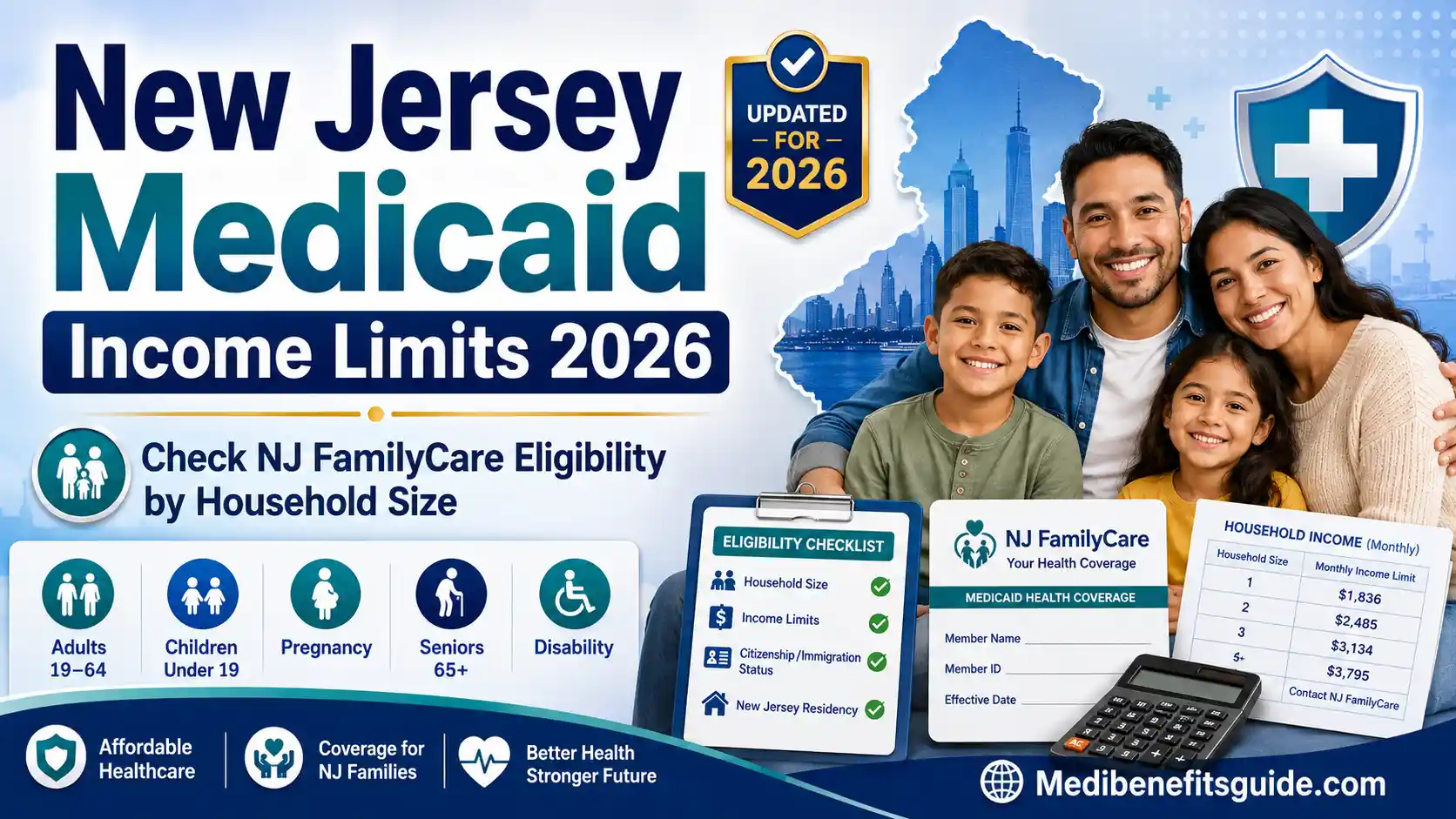
| Adults ages 19–64 | Up to 138% FPL | $1,836/month for 1 person; $3,795 for family of 4 |
| Children under 19 | Up to 355% FPL | $9,763/month for family of 4 |
| Pregnant individuals | Up to 205% FPL | $5,638/month for family of 4 |
| Seniors and certain blind/disabled applicants | Varies | Different income and resource rules may apply |
| Long-term care applicants | Varies | Specialized financial rules may apply |
The adult, child, and pregnancy standards come from NJ FamilyCare’s published guidance for 2026.
You can also See Medicaid Income Limits for Every State
What Is NJ FamilyCare?
NJ FamilyCare is New Jersey’s public health coverage program. It folds in Medicaid and CHIP-related coverage for residents who qualify, and it’s run through the New Jersey Department of Human Services along with the Division of Medical Assistance and Health Services (DMAHS).
A few things factor into eligibility:
- Household income
- Household size
- Age
- Pregnancy
- Disability or blindness
- Immigration or citizenship requirements
- Resources or assets for certain programs
- The type of Medicaid coverage being requested
Adult Medicaid Income Limit in New Jersey
Most New Jersey adults ages 19 through 64 fall under the ACA Medicaid expansion standard.
2026 adult income examples:
- One person: $1,836 per month
- Family of four: $3,795 per month
- General income standard: Up to 138% FPL
These numbers apply to the general adult category NJ FamilyCare describes.
Can I Get NJ FamilyCare If I Work?
Yes — having a job doesn’t disqualify you automatically. What matters is whether your household income and circumstances meet the requirements for your specific program. Workers with disabilities may also have access to specialized pathways like NJ WorkAbility, depending on their situation.
New Jersey Medicaid Income Limits for Children
Kids get a much wider window than adults do. For 2026, children under 19 can qualify at up to 355% of the Federal Poverty Level under NJ FamilyCare. For a family of four, that works out to $9,763 per month.
Worth knowing: a parent can be ineligible while their child still qualifies. Families shouldn’t assume everyone in the household rises or falls together — that’s just not how it works.
New Jersey Medicaid Income Limits for Pregnant Individuals
Pregnancy comes with a higher income ceiling than most adult categories. For 2026, the standard generally runs up to 205% FPL. For a family of four, that’s $5,638 per month.
NJ FamilyCare pregnancy coverage applies to New Jersey residents who meet the income and other requirements for the category.
If You Don’t Qualify for Standard NJ FamilyCare
A few other paths worth checking:
- Get Covered New Jersey Marketplace coverage
- Medical Emergency Payment Program (MEPP), where applicable
- NJ Supplemental Prenatal and Contraceptive Program
- Federally Qualified Health Centers
- Charity Care
- Private health insurance
Parents and Caretakers
Don’t assume the standard adult income limit is the only rule in play. Household composition, dependent children, and the specific NJ FamilyCare category can all shift how eligibility gets evaluated.
The smart move here is submitting accurate household and income information through the official application — not trying to reverse-engineer a final answer from an online chart.
Seniors, Blind and Disabled Applicants
If you’re age 65 or older, blind, or disabled, you may qualify through New Jersey’s Aged, Blind and Disabled (ABD) Medicaid programs. And that 138% FPL adult figure? It doesn’t apply to you.
Unlike most MAGI-based categories, ABD programs can weigh:
- Countable income
- Resources
- Assets
- Living arrangements
- Disability status
- Other program-specific financial rules
NJ FamilyCare runs separate ABD programs for seniors and for people determined blind or disabled by the Social Security Administration or the State of New Jersey.
Do Assets Matter for NJ Medicaid?
Sometimes. For most MAGI-based categories — children, pregnant individuals, many adults under 65 — eligibility follows income rules, not a traditional asset test.
But assets and resources matter quite a bit for:
- ABD programs
- Medicaid-only programs
- Long-term care Medicaid applications
New Jersey’s Medical Emergency Payment Program guidance, for instance, lists separate financial standards — income and resources both — for people 65+ or determined blind or disabled. Those figures aren’t universal. Don’t apply them elsewhere.
New Jersey Long-Term Care Medicaid Rules
Long-term care Medicaid runs on a different track than standard ACA adult Medicaid entirely. If you’re applying for coverage tied to nursing home care, long-term services and supports, home and community-based services, or other specialized long-term care programs, expect separate financial and resource rules.
These cases can get complicated fast, touching on countable assets, income allocation, spousal resources, living arrangements, and medical eligibility all at once. One more time, because it matters: don’t use the standard $1,836 adult income figure for long-term care eligibility. It won’t hold up.
MAGI vs. Non-MAGI: Why the Rules Are Different
Here’s the real reason people find conflicting numbers online — Medicaid doesn’t use the same financial methodology for every applicant.
MAGI Medicaid
Modified Adjusted Gross Income (MAGI) applies to groups like:
- Children
- Pregnant individuals
- Parents and caretaker relatives
- Many adults ages 19–64
This methodology leans heavily on household income and tax-related household rules.
Non-MAGI Medicaid
Non-MAGI rules apply more to:
- Seniors
- Blind applicants
- Disabled applicants
- Long-term care applicants
These programs often factor in resources and assets too.
The Key Question
Before you ask “What’s the New Jersey Medicaid income limit?” — ask this instead: “Which NJ FamilyCare eligibility category applies to me?”
That question gets you to the right number faster than any chart will.
Why You May See Different New Jersey Medicaid Income Limits Online
Different sites, different numbers. Usually for one of these reasons.
1. Different eligibility groups — an adult, a child, a pregnant applicant, and a senior all follow separate standards.
2. Different years — Federal Poverty Level guidelines shift annually.
3. Monthly vs. annual income — some sites publish monthly figures, others go annual.
4. 133% vs. 138% terminology — Medicaid expansion discussions sometimes cite both numbers because of how the statutory standard and the effective threshold get discussed.
5. MAGI vs. non-MAGI — some programs focus on MAGI income alone; others weigh income and resources together.
6. Medicaid vs. CHIP vs. Marketplace coverage — each runs its own eligibility rules and financial thresholds.
How to Know Which NJ Medicaid Income Limit Applies to You
Walk through this in order.
Step 1: Are you under age 19? Check the children’s NJ FamilyCare income standard.
Step 2: Are you pregnant? Check the pregnancy eligibility standard.
Step 3: Are you an adult ages 19–64? Start with the 138% FPL adult standard, then confirm against your household circumstances.
Step 4: Are you age 65+, blind, or disabled? Review the applicable ABD or non-MAGI rules.
Step 5: Applying for long-term care? Use the specialized financial and resource rules built for long-term services and supports.
Step 6: Apply for an official determination. Online charts are useful for screening. The final call comes from the eligibility agency — not a webpage.
How to Apply for NJ FamilyCare
Eligible residents can apply through official state coverage channels. Have this ready before you start:
- Household members
- Income
- Employment
- Residency
- Current health coverage
- Citizenship or immigration status, where applicable
- Resources or assets when the program requires it
There’s no traditional annual open enrollment window here — eligible residents can generally apply for NJ FamilyCare year-round.
NJ FamilyCare vs. Get Covered New Jersey
Income too high for Medicaid? You may still have solid coverage options.
| NJ FamilyCare | Get Covered New Jersey |
|---|---|
| Public Medicaid/CHIP coverage | Health insurance Marketplace |
| Eligibility based on NJ FamilyCare rules | Private plan eligibility and financial assistance rules |
| Designed for qualifying Medicaid populations | Helps residents shop for Marketplace coverage |
| Available year-round for eligible applicants | Enrollment rules can vary by circumstances |
The state application process can tell you whether you’re looking at NJ FamilyCare eligibility, Marketplace financial assistance, or both.
Medicaid Help Near Me in New Jersey
The income limits themselves are statewide. Living in Newark, Jersey City, Paterson, Trenton, Camden, or Elizabeth doesn’t change the math.
Local assistance access is a different story, though. For “Medicaid help near me” searches, look toward:
- County Social Services Agencies
- Hospitals
- Federally Qualified Health Centers
- Enrollment assistance organizations
- NJ FamilyCare customer support
Provider access and managed-care participation both vary by county.
What Happens if Your Income Is Too High?
Being over the limit for one category doesn’t mean you’re out of options. Consider:
- Another NJ FamilyCare category — children or pregnancy coverage may open at a higher limit.
- Get Covered New Jersey — Marketplace coverage and financial assistance may apply.
- Federally Qualified Health Centers — often offer sliding-fee services.
- Charity Care — can help eligible patients with hospital bills.
- Specialized programs — pregnancy-related or disability-related pathways.
Important NJ FamilyCare Changes for 2026 and 2027
Federal changes are coming, and they’ll affect certain NJ FamilyCare members. Starting October 1, 2026, some non-citizen immigrants may lose eligibility under the revised federal rules.
Starting January 1, 2027, certain adults ages 19–64 may need to meet community engagement requirements — and face six-month renewal cycles instead of annual ones. Plenty of people will be exempt from the activity requirement, so this won’t touch everyone.
For adults who may be affected, current guidance points to 80 hours per month of approved activities: employment, education, job training, or volunteering.
Common Mistakes to Avoid
- Using the 138% FPL adult limit for everyone
- Checking an outdated 2025 income chart
- Ignoring household size
- Confusing Medicaid with Marketplace subsidies
- Assuming working automatically disqualifies you
- Assuming parents and children must qualify together
- Ignoring asset rules for senior or disability-related programs
- Using a standard Medicaid chart for long-term care eligibility
FAQs About New Jersey Medicaid Income Limits
What Is the Income Limit for Medicaid in New Jersey in 2026?
For most adults ages 19–64, it’s up to 138% FPL — $1,836/month for one person, $3,795 for a family of four. Children and pregnant individuals get higher limits.
What Is the NJ Medicaid Income Limit for a Family of Four?
Depends on the category. For 2026: $3,795/month for many adults, $9,763 for children, $5,638 for pregnant individuals.
Can I Get NJ FamilyCare If I Work?
Yes. Employment alone doesn’t disqualify you — income, household circumstances, and category all factor in.
Can My Child Qualify for NJ FamilyCare If I Don’t?
Yes. Children qualify under a much higher income standard than most adults.
Does NJ Medicaid Check Bank Accounts?
Depends on the category. Resources matter for certain senior, blind, disabled, and long-term care programs — not for most others.
Is NJ FamilyCare Free?
Costs and benefits vary by program and category. Many qualifying members get comprehensive coverage with limited out-of-pocket costs.
What If I Make Too Much for Medicaid in New Jersey?
You may still qualify under another NJ FamilyCare category, or through Get Covered New Jersey, or through assistance programs like sliding-fee community health services.
Can Seniors Use the Regular 138% Medicaid Income Limit?
No. Seniors typically qualify through ABD or other pathways that run on different income and resource rules.
Conclusion
If you take one thing away from this: stop looking for a single number. New Jersey Medicaid doesn’t work that way, and no chart — including this one — replaces an actual application.
Figure out your category first. Age, pregnancy status, disability status, household size — that’s what determines which standard applies to you, not a guess based on what a family member or neighbor qualified for. Once you know your category, the right number becomes obvious, and the application itself will tell you the rest.
Official Resources
- Apply for NJ FamilyCare — NJ FamilyCare
- Check Your Eligibility for Get Covered NJ — Get Covered New Jersey
- Verify Current Federal Poverty Guidelines — U.S. Department of Health & Human Services
- Find County Social Services Assistance — NJ Department of Human Services
Disclaimer: This article is intended for general informational information only and does not represent an official NJ FamilyCare or Medicaid eligibility decision. Income guidelines and program policies may change, so always confirm your individual conditions using the latest guidance from the New Jersey Department of Human Services before making healthcare coverage decisions.

About Naseer
Naseer has 10+ years of experience creating informative content and researching medicare topics. He focuses on simplifying Medicaid and benefits details to support readers find clear, reliable, and easy-to-understand guidance.