
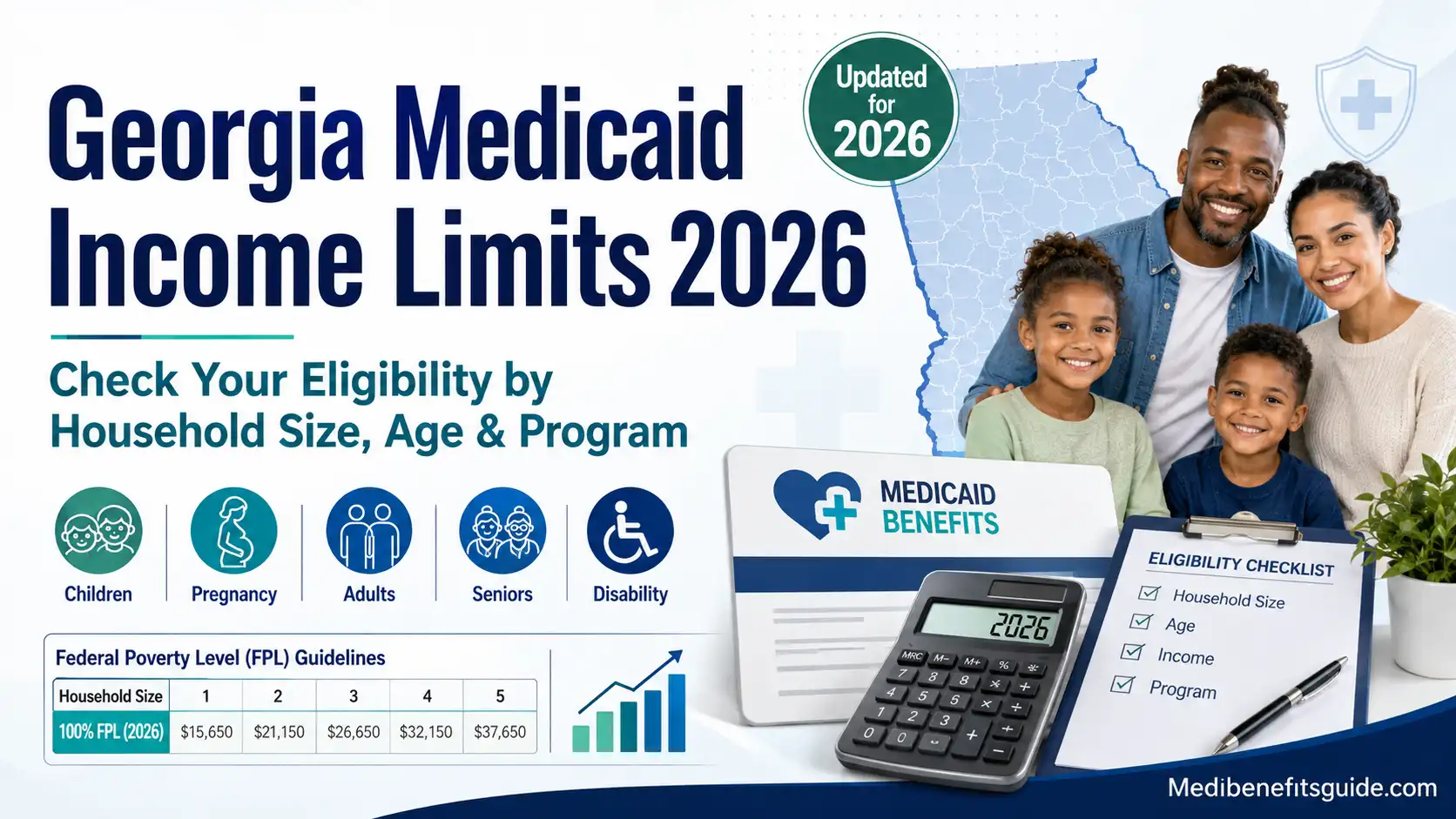
There’s no single Georgia Medicaid income limit. That’s the first thing to understand, and it trips up more applicants than almost anything else. What you can earn and still qualify depends on your eligibility category, your household size, your age, whether you’re pregnant, whether you have a disability, and which specific program you’re applying under.
Georgia’s official 2026 financial-limit documents split all of this out — children, pregnant women, parents and caretakers, PeachCare for Kids, Pathways, aged/blind/disabled applicants, and more each get their own standard.
Quick Answer
Georgia Medicaid income limits in 2026 vary by program. Children have different limits based on age. Pregnant women generally use a 220% FPL standard. PeachCare for Kids reaches 247% FPL. Georgia Pathways serves eligible adults up to 100% FPL, with additional requirements attached.
2026 Georgia Medicaid Income Limits at a Glance
These figures come from Georgia’s 2026 Financial Limits document. Different programs have different effective dates and eligibility methodologies — so find the category that actually applies to your applicant rather than treating any single number as Georgia’s universal Medicaid limit.
| Program / applicant | Income standard | Family of 1 | Family of 2 | Family of 3 | Family of 4 |
|---|---|---|---|---|---|
| Children ages 6–18 | 133% FPL | $1,769/mo | $2,399/mo | $3,028/mo | $3,657/mo |
| Children ages 1–5 | 149% FPL | $1,981/mo | $2,688/mo | $3,392/mo | $4,097/mo |
| Infants under 1 | 205% FPL | $2,726/mo | $3,698/mo | $4,667/mo | $5,637/mo |
| Pregnant women | 220% FPL | — | $3,968/mo | $5,009/mo | $6,050/mo |
| PeachCare for Kids | 247% FPL | $3,285/mo | $4,455/mo | $5,624/mo | $6,792/mo |
| Planning for Healthy Babies | 211% FPL | $2,806/mo | $3,806/mo | $4,804/mo | $5,802/mo |
| Parent/caretaker with child under 19 | Program-specific | $310/mo | $457/mo | $551/mo | $653/mo |
Georgia’s table also includes annual equivalents and additional household-size figures beyond what’s shown here.
Important: these numbers aren’t interchangeable. A family of four could have one limit for a child, a completely different one for a pregnant woman, another for PeachCare, and a much lower one for a parent or caretaker seeking coverage. Same household, four different answers.
Also See Medicaid Income Limits by State — Complete 2026 Guide
Which Georgia Medicaid Income Limit Applies to You?
Work through this in order:
- Are you pregnant? Start with pregnancy Medicaid/RSM rules — they override the general categories.
- Is the applicant a child under 19? Check the child’s age. Georgia uses different standards for infants, ages 1–5, and older kids.
- Are you an adult ages 19–64 without traditional Medicaid eligibility? Look at Georgia Pathways to Coverage.
- Are you 65 or older, blind, or disabled? You’re in aged, blind and disabled (ABD) territory — SSI-related, Medicare Savings, or long-term-care rules apply.
- Is your child above the Medicaid limit? PeachCare for Kids might still work, if the child meets its own requirements.
- Do you need nursing-home or community-based care? Different income and resource rules kick in here.
Georgia itself advises applying even when you’re not sure you qualify. Eligibility depends on the specific program, and some income or resources may not even count toward the limit.
Georgia Medicaid Income Limit for Children
Kids don’t share one income limit. For 2026, Georgia’s official table splits them three ways:
- Infants under age 1: 205% FPL
- Children ages 1–5: 149% FPL
- Children ages 6–18: 133% FPL
The threshold drops as the child gets older. That matters because a kid’s eligibility can shift over time without anything else in the household changing — just their birthday.
Georgia’s Family Medicaid program covers children through the month of their 19th birthday, assuming the applicable eligibility requirements are still met.
What if My Child Earns Too Much for Medicaid?
Don’t assume that’s the end of the road. PeachCare for Kids — Georgia’s CHIP program — can cover eligible uninsured children whose household income sits above the Medicaid threshold but still within PeachCare’s range. Georgia’s 2026 table puts PeachCare at 247% FPL.
The path looks like this: Child Medicaid → income too high → check PeachCare for Kids → compare other coverage if that doesn’t work either.
Georgia Pregnancy Medicaid Income Limits
Pregnancy Medicaid is its own animal, and it’s a big reason there’s no universal Georgia Medicaid number. Georgia’s Family Medicaid rules let pregnant women qualify under a 220% FPL ceiling. That coverage includes medical care through labor and delivery, plus postpartum care.
For a family of four, the 2026 financial-limit document lists a monthly pregnancy limit of $6,050 — $72,600 annually in the published table. Pregnancy can also change how household size gets calculated. Don’t just count heads currently living in the home; check the applicable Medicaid rules first.
Can a Single Adult Get Medicaid in Georgia?
Yes — but not automatically just because income is low. Georgia doesn’t hand out traditional Medicaid to every low-income adult on income alone.
The main route is Georgia Pathways to Coverage. Georgia Medicaid describes it as coverage for adults ages 19–64 who don’t otherwise qualify for traditional Medicaid, have household income up to 100% of FPL, meet other requirements, and document qualifying activities.
Qualifying activities include employment, education, job-readiness programs, community service, vocational training, and a handful of other approved options. Georgia also added parents and legal guardians of children under six who are enrolled in Medicaid as a qualifying activity, starting October 1, 2025.
Georgia Pathways and the 80-Hour Requirement
The “Georgia Medicaid 80-hour requirement” people search for refers to the qualifying-activity piece tied to Pathways. Worth remembering: Pathways is not the same thing as traditional Family Medicaid. Income eligibility is only one part of what gets you in.
Georgia Pathways was extended through December 31, 2026, under the state’s approved program extension.
Parent and Caretaker Medicaid Has a Much Lower Limit
This is where a lot of confusion comes from. For 2026, Georgia’s monthly income limits for a parent or caretaker with children under 19 look like this:
| Household size | Monthly | Annual |
|---|---|---|
| 1 | $310 | $3,720 |
| 2 | $457 | $5,484 |
| 3 | $551 | $6,612 |
| 4 | $653 | $7,836 |
Those numbers are low — much lower than the child or PeachCare thresholds. It’s entirely possible for a child to qualify for Medicaid or PeachCare while the parent doesn’t qualify for anything under this category at all.
Georgia Medicaid for Seniors and People With Disabilities
People 65 or older, blind, or disabled fall under a different set of financial rules than children and MAGI-based family categories. Georgia’s official 2026 ABD table covers SSI recipients, nursing-home Medicaid, Community Care, Medicare Savings Programs, and more.
A few figures from the 2026 table:
- SSI-related individual income: $994/month
- Nursing home/CCSP individual income: $2,982/month
- QMB individual income: $1,350/month
- SLMB individual income: $1,616/month
- QI-1 individual income: $1,816/month
Resource limits shift by program too — there’s no flat rule here.
Does Georgia Medicaid Have an Asset Limit?
Sometimes. Again, no single rule covers every applicant. MAGI-related family categories generally work differently from ABD and long-term-care programs. Georgia’s 2026 ABD documentation lists specific resource limits for several senior, disability, and long-term-care categories.
For long-term services and supports, applicants need to meet both income and resource requirements — plus factors like age, functional status, medical need, and residency.
What Income Counts for Georgia Medicaid?
Income can include wages and other sources like Social Security or unemployment benefits. How it’s treated depends entirely on the Medicaid category you’re applying under.
Georgia’s eligibility FAQ is clear that eligibility hinges on household size and the specific program in question. Many children’s, pregnancy, and family programs run on MAGI methodology. Other categories — a good chunk of aged, blind, and disabled programs among them — follow different financial rules entirely.
That’s exactly why comparing your paycheck to a flat percentage of the Federal Poverty Level can lead you astray.
Why Do Different Websites Show Different Georgia Medicaid Limits?
Seeing different numbers on different sites doesn’t automatically mean one of them is wrong. It usually comes down to:
- Different Medicaid programs
- Different applicant ages
- Different household sizes
- Different effective dates
- Monthly versus annual presentation
- Rounded calculations
- MAGI versus non-MAGI methodologies
- Pregnancy household rules
- Outdated eligibility tables
Georgia’s own 2026 documents contain multiple program standards and effective dates within them. Identify the applicant’s category first. Then go find the limit that actually applies.
How to Apply for Georgia Medicaid
Online
Georgia Gateway lets you create an account, submit an application, and manage your case from there. It’s the primary application and account-management portal Georgia Medicaid points people toward.
By Phone or in Person
You can also apply by phone or in person at a local Division of Family and Children Services (DFCS) office. Georgia’s statewide Medicaid contact numbers are (404) 657-5468 and (877) 423-4746.
A practical checklist before you start:
- Household information
- Income information
- Social Security information where applicable
- Citizenship or immigration documentation
- Pregnancy information when applicable
- Employer or benefit information
- Current insurance information
- Any documents requested during verification
You don’t need to be certain you qualify before applying.
Georgia Medicaid Help Near You
Georgia Medicaid is a statewide program, but people search locally anyway — Atlanta Medicaid office, Savannah Medicaid assistance, Augusta Medicaid application help, Columbus GA Medicaid office, Fulton County Medicaid, Cobb County Medicaid, Gwinnett County Medicaid, DeKalb County Medicaid, Chatham County Medicaid, Richmond County Medicaid.
Whether you’re in Atlanta, Marietta, Roswell, Sandy Springs, Athens, Macon, Albany, Gainesville, Valdosta, or anywhere else in the state, the eligibility rules don’t change by zip code. Your local DFCS office can help with the application itself and case-specific questions.
Common Georgia Medicaid Mistakes
- Using one income limit for everyone
- Confusing PeachCare with Medicaid
- Assuming all children use 133% FPL
- Ignoring a child’s age
- Using an outdated 2026 table
- Assuming every adult qualifies based solely on income
- Applying an asset rule from an unrelated Medicaid category
- Ignoring Pathways requirements
- Using annual income when the applicable test is monthly
- Relying on a third-party calculator as an official determination
2026 Georgia Medicaid Eligibility Checklist
Before you apply, work through these:
- What Medicaid category am I applying for?
- What is my household size?
- How old is the applicant?
- Is anyone pregnant?
- Is the applicant disabled or age 65+?
- Does the applicant have Medicare?
- What income is countable under this program?
- Are resource limits applicable?
- Could PeachCare be appropriate for a child?
- Could Georgia Pathways apply to an adult?
- Have I gathered the requested documents?
- Have I checked the current Georgia financial-limit document?
When you’re not sure, apply anyway. Georgia Medicaid specifically encourages this — a simplified online chart shouldn’t be the thing that rules you out.
See Georgia Medicaid Reimbursement Rates 2027 — MediBenefitsGuide
FAQs About Georgia Medicaid Income Guidelines
What Is the Georgia Medicaid Income Limit for 2026?
There isn’t one single number. It depends entirely on the applicant’s category — children, pregnant women, parents/caretakers, Pathways adults, seniors, and people with disabilities can all land on substantially different financial standards.
What Is the Medicaid Income Limit for a Family of Four in Georgia?
Depends on who’s applying. For 2026, a child age 6–18 limit sits at $3,657 monthly, pregnancy Medicaid runs $6,050 monthly, and PeachCare reaches $6,792 monthly — same household size, three different ceilings.
Can a Single Adult Get Medicaid in Georgia?
Potentially, yes. Adults ages 19–64 who don’t qualify for traditional Medicaid may get in through Georgia Pathways if they meet the income, qualifying-activity, and other program requirements.
Does Georgia Have Medicaid Expansion?
Not in the traditional sense. Georgia uses Pathways to Coverage for a specific group of adults rather than opening Medicaid to everyone based on low income alone. Pathways comes with its own added requirements.
What Is the Georgia Pathways Income Limit?
Household income up to 100% of the Federal Poverty Level — plus other requirements and documented qualifying activities.
What Is the Georgia Pregnancy Medicaid Income Limit?
220% FPL. For 2026, that’s $6,050 per month for a family of four.
What Is the Child Medicaid Income Limit in Georgia?
It depends on age: 205% FPL for infants under one, 149% FPL for ages 1–5, and 133% FPL for ages 6–18.
What if My Child Is Over the Medicaid Income Limit?
Check PeachCare for Kids. Georgia’s 2026 table lists PeachCare at 247% FPL, though other eligibility rules still apply.
Does Georgia Medicaid Count Social Security as Income?
It can — but how it’s treated depends on the specific Medicaid program and financial methodology involved.
Where Do I Apply for Georgia Medicaid?
Through Georgia Gateway online, by phone, or at a local DFCS office.
Conclusion
Georgia Medicaid doesn’t hand out one number and call it done — and honestly, that’s the whole point of this guide. Age, household size, pregnancy, disability, Medicare status, the specific program you’re eyeing: each one moves the goalpost.
Find your category first. Pull the current 2026 financial-limit tables. Apply through Georgia Gateway if there’s any chance you qualify. If a child comes in over the Medicaid limit, PeachCare is worth a look. If an adult doesn’t fit traditional Medicaid, Pathways might be the door that opens.
Official Resources
- Apply for Medicaid — Georgia Gateway
- Check Georgia Pathways Eligibility — Georgia Medicaid
- Verify PeachCare for Kids Income Limits — Georgia DCH
- Find a DFCS Office Near You — Georgia DHS
Disclaimer: This article is for general informational guidance and is not an official eligibility determination. Medicaid rules, income guidelines and program requirements can change. Always verify your situation with Georgia Medicaid/DFCS or the current official Georgia financial eligibility documents before making coverage decisions.

About Naseer
Naseer has 10+ years of experience creating informative content and researching medicare topics. He focuses on simplifying Medicaid and benefits details to support readers find clear, reliable, and easy-to-understand guidance.