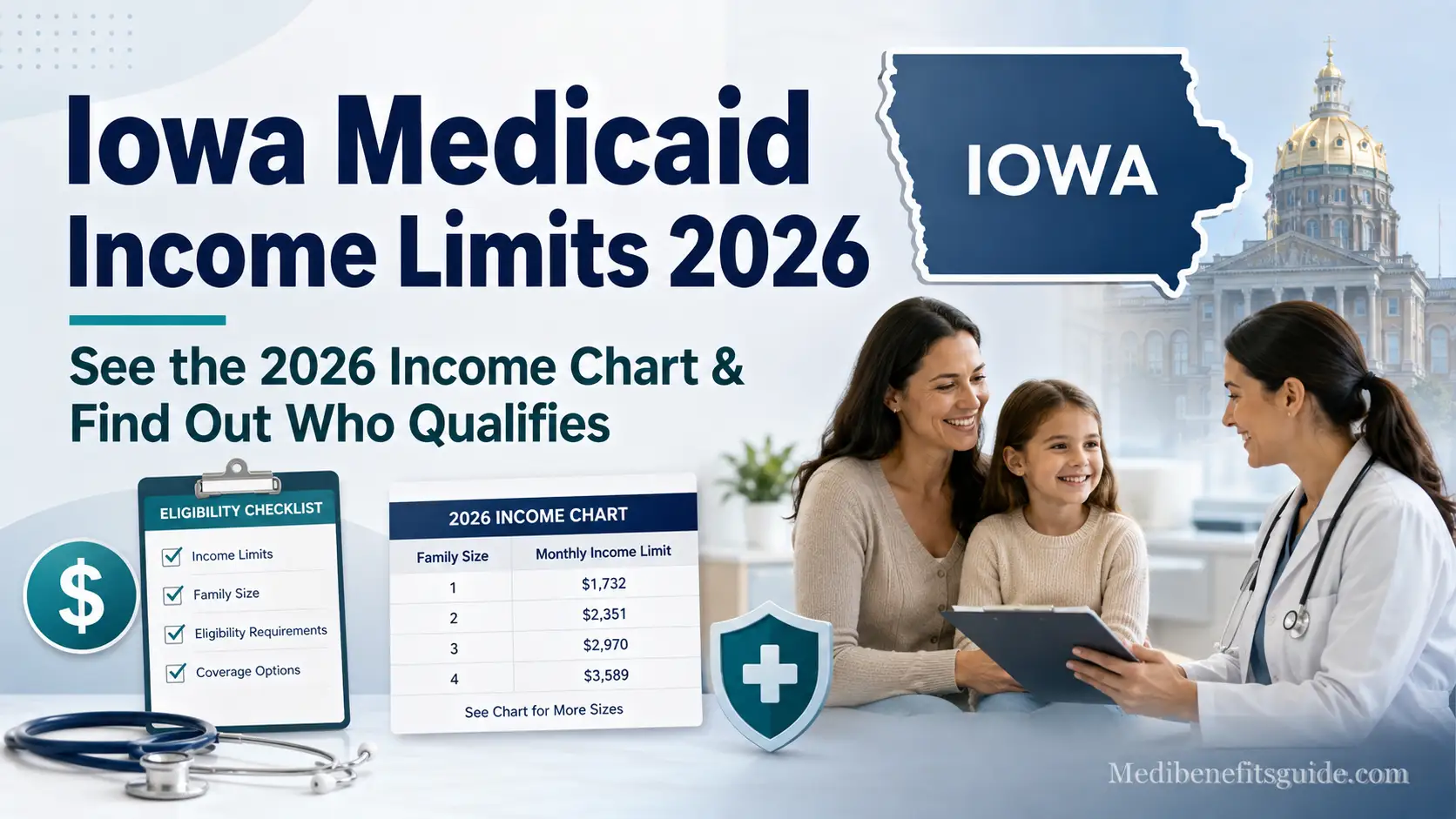
There’s no single income limit that covers every Iowa Medicaid applicant. Your number depends on age, household size, pregnancy status, disability, Medicare status, and which specific program you’re applying under. Iowa HHS’s current income guidelines took effect April 1, 2026.
Here’s what Iowa HHS lists for 2026:
| Eligibility group | Income standard |
|---|---|
| Children ages 1–18 | 167% of Federal Poverty Level |
| Infants under age 1 | 300% FPL |
| Pregnancy & postpartum | 215% FPL |
| Adults ages 19–64 through IHAWP | 133% FPL |
Which one applies to you comes down to which Medicaid coverage group you fall into.
Iowa Medicaid Income Chart 2026
Iowa HHS bases its income guidelines on yearly countable income before taxes. The figures below are effective April 1, 2026.
Children Ages 1–18
Kids can qualify for free Medicaid coverage when household income falls within the limit for their household size.
| Household size | Annual income limit |
|---|---|
| 1 | $26,654 |
| 2 | $36,140 |
| 3 | $45,626 |
| 4 | $55,112 |
| 5 | $64,598 |
| 6 | $74,084 |
| 7 | $83,570 |
| 8 | $93,056 |
Add another household member? Tack on $9,486 for each one beyond eight.
Infants Under Age 1
Babies get a higher standard — 300% FPL, well above what older kids or adults qualify under.
| Household size | Annual income limit |
|---|---|
| 1 | $47,880 |
| 2 | $64,920 |
| 3 | $81,960 |
| 4 | $99,000 |
| 5 | $116,040 |
| 6 | $133,080 |
| 7 | $150,120 |
| 8 | $167,160 |
Each additional household member adds $17,040 under the published chart.
Pregnancy and Postpartum Medicaid
Pregnancy Medicaid runs on a 215% FPL standard. One detail people miss: Iowa HHS says the unborn child counts toward household size.
| Household size | Annual income limit |
|---|---|
| 2 | $43,946 |
| 3 | $55,513 |
| 4 | $67,080 |
| 5 | $78,647 |
| 6 | $90,214 |
| 7 | $101,781 |
| 8 | $113,348 |
For each person beyond that, add $11,567.
What Is the Iowa Medicaid Income Limit for Adults?
Most adults ages 19–64 fall under the Iowa Health and Wellness Plan, or IHAWP. Iowa HHS currently sets IHAWP eligibility at income not exceeding 133% of the Federal Poverty Level, effective April 1, 2026. Its published examples land at roughly $21,227 for a single person and $28,782 for a household of two.
Worth flagging: some third-party sites list Iowa’s adult Medicaid limit as 138% FPL. Don’t assume that’s the official number. Iowa HHS’s current IHAWP page and administrative materials put the adult-group income level at 133% FPL — not 138%.
Why Do Some Websites Say 138%?
The gap usually comes down to how sites describe or calculate the MAGI methodology and income disregard. Small methodology differences, big confusion.
For an actual eligibility decision, go by the applicable Iowa HHS program rules. Skip the generic Medicaid calculator and the outdated third-party chart.
Which Iowa Medicaid Program Applies to You?
A quick framework to narrow it down:
- Under age 1? Check the infant Medicaid standard.
- Age 1–18? Check Children’s Medicaid and Hawki.
- Pregnant or postpartum? Check pregnancy/postpartum Medicaid.
- Age 19–64? Check the Iowa Health and Wellness Plan and other applicable categories.
- Age 65 or older? Other Medicaid, Medicare Savings Program, or long-term-care rules may apply.
- Disabled? Check disability-related Medicaid programs.
- Have Medicare? Medicare Savings Programs and related categories may fit better.
- Income too high? Look at Hawki, Medically Needy, Marketplace coverage, or another program.
Iowa HHS notes that eligibility hinges on both financial and non-financial factors — income, assets, Iowa residency, citizenship or immigration status, and disability where it’s relevant.
Iowa Medicaid, Hawki and Children
If your child’s income puts them over the Medicaid limit, that’s not the end of the road. Iowa’s Healthy and Well Kids in Iowa program — Hawki — is the state’s CHIP program. It covers kids under 19 in families who earn too much for Medicaid but still can’t easily afford private coverage. Take a family of four. Iowa’s 2026 Hawki medical guidelines break down like this:
- Up to $55,110 — children may qualify for free Medicaid
- $55,111–$59,730 — potentially free Hawki
- Higher income ranges may still qualify for Hawki, just with monthly premiums
No family pays more than $40 a month for Hawki medical coverage under the published guidelines.
Does Iowa Medicaid Have an Asset Limit?
Not one that applies across the board. This trips up a lot of applicants. Programs based on MAGI — many categories covering children, pregnant people, and adults — generally run on income methodology rather than a traditional asset test. Other categories, particularly ones involving seniors, disability, or long-term care, can carry different resource and asset rules entirely.
So having money in the bank doesn’t automatically answer the eligibility question. If you’re applying because of age, disability, Medicare, or long-term-care needs, check the rules specific to that category.
How Does Iowa Medicaid Count Income?
The number on your paycheck isn’t always the number Medicaid uses. Depending on the program, Iowa may look at countable income, household income, or Modified Adjusted Gross Income (MAGI). Several questions can shift your eligibility determination:
- Is the income earned or unearned?
- Are you self-employed?
- How often are you paid?
- Has your income recently changed?
- Does a spouse’s income count?
- Does Social Security count?
- What household members get included?
- Are you applying under MAGI or a non-MAGI category?
These rules vary enough by program that a simple take-home-pay calculation won’t give you a reliable answer.
What If You Make Too Much for Iowa Medicaid?
Going over one income limit doesn’t mean you’re out of options. Depending on your situation, there’s usually a next step:
Medicaid → another Medicaid category → Hawki → Medically Needy → Marketplace coverage
Iowa’s Medically Needy program can help people whose income or resources are too high for regular Medicaid but whose medical expenses eat up much of what they have. Some costs may still fall on the individual.
For kids, Hawki is often the right fallback. For people who don’t qualify for Medicaid at all, Marketplace coverage through HealthCare.gov is worth a look.
How to Apply for Iowa Medicaid
If you think you qualify, applying beats trying to settle it from an online chart. Here’s the process:
- Identify your likely program based on age, pregnancy, disability, and Medicare status.
- Determine household size.
- Collect income information — recent earnings and any other applicable income.
- Apply through Iowa HHS.
- Provide requested verification documents.
- Monitor your application and respond to notices.
- Review the eligibility decision carefully.
- Appeal or request assistance if the decision seems wrong.
Iowa HHS provides application resources through its Medicaid and Iowa Health and Wellness Plan pages.
Important Iowa Medicaid Changes for 2026
There’s a major 2026 change that has nothing to do with income limits. Starting December 1, 2026, certain IHAWP members will need to meet monthly Community Engagement Requirements to enroll or stay covered. Qualifying activities include:
- Work
- Job training
- Education
- Community service
- A combination of qualifying activities
The general requirement runs 80 hours a month, subject to applicable rules and exemptions. Iowa HHS exempts certain people with disabilities or serious medical conditions, caregivers, pregnant and postpartum individuals, and others.
This is not an income limit — it’s a separate coverage-maintenance requirement for applicable IHAWP members.
Common Iowa Medicaid Mistakes to Avoid
- Using an old 2025 income chart
- Assuming there’s one income limit for all Medicaid applicants
- Confusing Medicaid with Hawki
- Treating 138% FPL as the official IHAWP figure without checking Iowa HHS
- Using household take-home pay instead of the applicable countable-income methodology
- Assuming every Medicaid category shares the same asset rules
- Forgetting that pregnancy changes household size and eligibility
- Ignoring other programs when income is only slightly too high
- Treating the December 2026 community-engagement rules as an income requirement
Iowa Medicaid Resources Across the State
The income standards apply statewide. There’s no separate Medicaid income limit for Des Moines, Cedar Rapids, Davenport, Sioux City, Iowa City, Waterloo, Ames, Dubuque, Council Bluffs, Ankeny, or anywhere else in Iowa.
That said, people searching for “Iowa Medicaid office near me” or Medicaid help in a specific city may need local application assistance or healthcare-navigation services.
For the most reliable information, start with Iowa Health & Human Services rather than an unofficial local site.
FAQs About Iowa Medicaid Income Limits
What is the income limit for Iowa Medicaid in 2026?
There’s no single limit. Current standards include 167% FPL for children ages 1–18, 300% for infants, 215% for pregnancy/postpartum, and 133% for IHAWP adults.
What is the Iowa Medicaid income limit for a family of four?
For children ages 1–18, Iowa HHS lists $55,112 a year. Infants and pregnant applicants use different standards, so there’s no single family-of-four number.
Can working adults get Medicaid in Iowa?
Yes. A job doesn’t disqualify you. Adults 19–64 may qualify through IHAWP if they meet the applicable income and other requirements.
Can my child get Medicaid if I make too much?
Possibly. If your child is above the Medicaid threshold, Hawki may still cover them if your household meets its separate requirements.
What is Hawki in Iowa?
Iowa’s Children’s Health Insurance Program, or CHIP. It covers kids under 19 whose families earn too much for Medicaid but may still qualify for lower-cost coverage.
Does Iowa Medicaid count assets?
Depends on the category. MAGI-based programs work differently than programs for seniors, people with disabilities, and long-term-care applicants. Don’t assume one rule fits all.
What happens if I am slightly over the income limit?
You likely still have a path. Check another Medicaid category, Hawki, Medically Needy, or Marketplace coverage.
Is Iowa Medicaid free?
Some coverage is free, but costs vary by program and circumstances. IHAWP, for instance, can involve small monthly contributions for some members after their first year.
Do Medicaid income limits change every year?
They can, as federal poverty guidelines and state policy shift. Check the current Iowa HHS guidelines before applying or renewing.
Explore Medicaid Income Limits in Other States
Iowa isn’t the only state running income-based Medicaid rules for 2026 — every state sets its own thresholds, and they shift just as often. If you’re comparing options, moving states, or just want the full national picture, see Medicaid income limits by state for a complete breakdown of eligibility figures across the country.
Conclusion
There’s no shortcut here — Iowa Medicaid income limits 2026 aren’t a single number, and treating them like one is how people end up applying under the wrong program or giving up too early. Figure out the applicant’s age, pregnancy status, Medicare or disability status, and household size first. Match that to the right income standard. And if the number doesn’t work in your favor, don’t stop looking — Hawki, Medically Needy, and Marketplace coverage exist precisely for people in that gap.
Official Resources
- Check Your Eligibility — Iowa HHS Medicaid
- Apply for IHAWP Now — Iowa Health and Wellness Plan
- Get Hawki Coverage for Your Child — Hawki Iowa
- Find Marketplace Plans — HealthCare.gov
Disclaimer: This article is for general information only and is not legal, financial, or benefits-eligibility advice. Medicaid rules can change, so verify your eligibility and current income limits directly with Iowa Health & Human Services before making coverage decisions.

About Naseer
Naseer has 10+ years of experience creating informative content and researching medicare topics. He focuses on simplifying Medicaid and benefits details to support readers find clear, reliable, and easy-to-understand guidance.