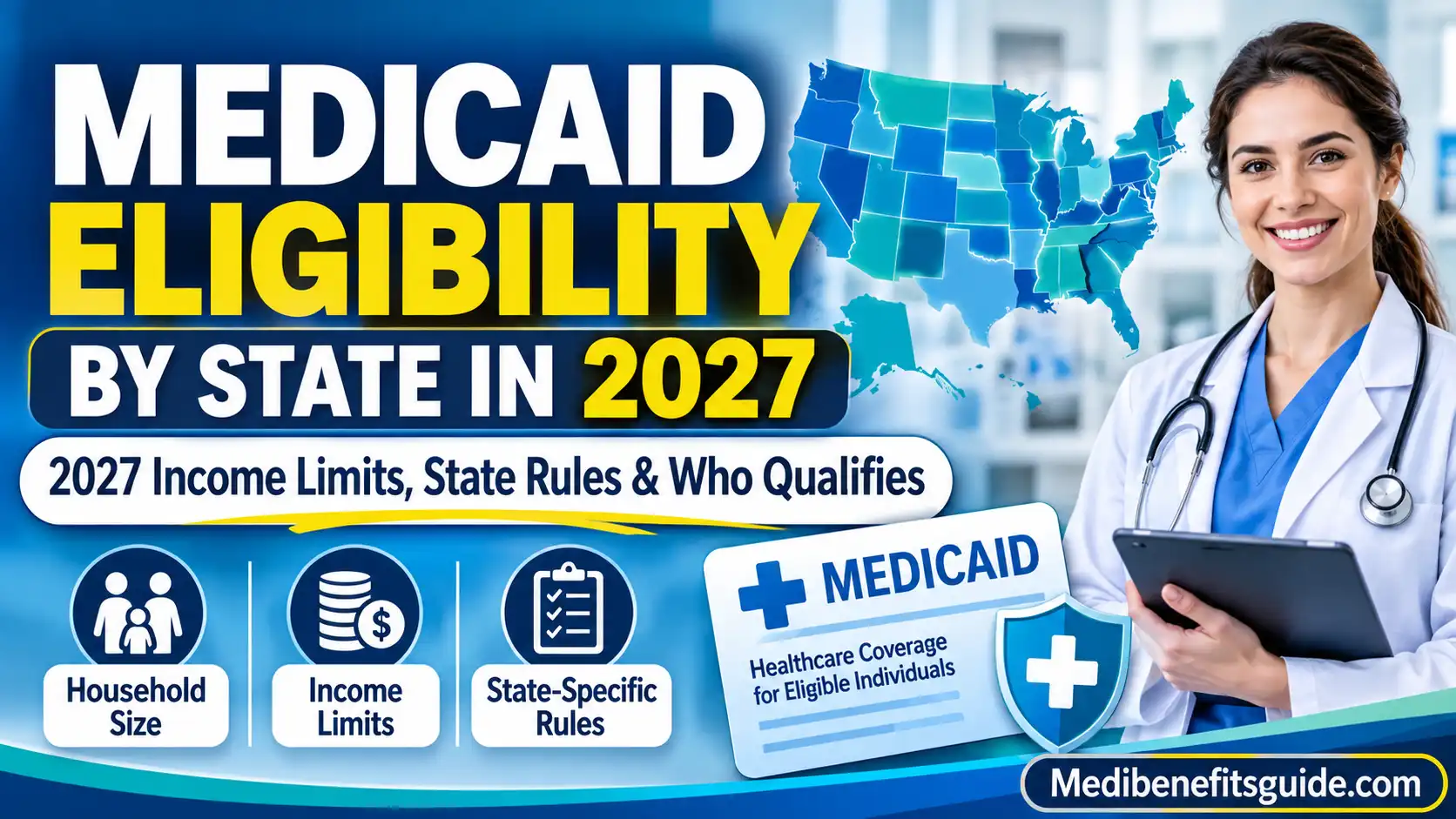
Medicaid helps people with low incomes get health insurance, but who qualifies really depends on a few things: where you live, your age, how much money your household makes, and what group you’re in—like whether you’re an adult, a child, pregnant, a senior, or disabled.
In 2027, one big thing changes for everyone in the country. Starting January 1, 2027, many adults on expansion coverage must meet a work or community engagement requirement. They will also renew their coverage more often.
This guide explains the national rules, how states are different, and what to do next. Right now, the latest poverty guidelines are from 2026. Best bet? Check with your state’s Medicaid office for the most up-to-date info.
How Does Medicaid Eligibility Work by State?
Medicaid is a team effort. The federal government sets the main rules, and each state runs its own program. States choose their own income limits for most groups. They also decide whether to cover low-income adults under the Affordable Care Act (ACA) expansion. Want to compare numbers? Check out our guide to Medicaid income limits by state.
Three main things decide if you qualify:
- Income. Most groups are checked using Modified Adjusted Gross Income (MAGI) and the size of your household.
- Category. Kids, pregnant women, parents, adults, seniors, and people with disabilities each have their own rules.
- Where you live and your status. You usually need to live in the state and meet citizenship or immigration rules.
Seniors and people with disabilities are checked a little differently. Some states also count their savings and property.
Which States Expanded Medicaid?
KFF keeps track of this. Right now, 41 places have adopted expansion, and that includes Washington, D.C. Ten states have not. They are Alabama, Florida, Georgia, Kansas, Mississippi, South Carolina, Tennessee, Texas, Wisconsin, and Wyoming.
Here’s why it matters. In expansion states, adults ages 19 to 64 can qualify if their income is at or below 138% of the federal poverty level (FPL). In non-expansion states, most healthy adults without kids get left out. Parents there often have to earn very little to qualify. Georgia and Wisconsin are in the middle. They cover some adults through special waivers instead of full expansion.
You can see the latest on the KFF Medicaid expansion tracker.
Medicaid Expansion Status for All 50 States
This table shows every state. The starting point is the date expansion coverage began there. The dates come from the KFF tracker, so double-check yours with your state agency. Washington, D.C. also expanded, on January 1, 2014.
| State | Expanded? | Starting Point |
|---|---|---|
| Alabama Medicaid Eligibility | No | N/A |
| Alaska Medicaid Eligibility | Yes | Sept. 1, 2015 |
| Arizona Medicaid Eligibility | Yes | Jan. 1, 2014 |
| Arkansas Medicaid Eligibility | Yes | Jan. 1, 2014 |
| California Medicaid Eligibility | Yes | Jan. 1, 2014 |
| Colorado Medicaid Eligibility | Yes | Jan. 1, 2014 |
| Connecticut Medicaid Eligibility | Yes | Jan. 1, 2014 |
| Delaware Medicaid Eligibility | Yes | Jan. 1, 2014 |
| Florida | No | N/A |
| Georgia | No | N/A |
| Hawaii | Yes | Jan. 1, 2014 |
| Idaho | Yes | Jan. 1, 2020 |
| Illinois | Yes | Jan. 1, 2014 |
| Indiana | Yes | Feb. 1, 2015 |
| Iowa | Yes | Jan. 1, 2014 |
| Kansas | No | N/A |
| Kentucky | Yes | Jan. 1, 2014 |
| Louisiana | Yes | July 1, 2016 |
| Maine | Yes | Jan. 10, 2019 |
| Maryland | Yes | Jan. 1, 2014 |
| Massachusetts | Yes | Jan. 1, 2014 |
| Michigan | Yes | April 1, 2014 |
| Minnesota | Yes | Jan. 1, 2014 |
| Mississippi | No | N/A |
| Missouri | Yes | Oct. 1, 2021 |
| Montana | Yes | Jan. 1, 2016 |
| Nebraska | Yes | Oct. 1, 2020 |
| Nevada | Yes | Jan. 1, 2014 |
| New Hampshire | Yes | Aug. 15, 2014 |
| New Jersey | Yes | Jan. 1, 2014 |
| New Mexico | Yes | Jan. 1, 2014 |
| New York | Yes | Jan. 1, 2014 |
| North Carolina | Yes | Dec. 1, 2023 |
| North Dakota | Yes | Jan. 1, 2014 |
| Ohio | Yes | Jan. 1, 2014 |
| Oklahoma | Yes | July 1, 2021 |
| Oregon | Yes | Jan. 1, 2014 |
| Pennsylvania | Yes | Jan. 1, 2015 |
| Rhode Island | Yes | Jan. 1, 2014 |
| South Carolina | No | N/A |
| South Dakota | Yes | July 1, 2023 |
| Tennessee | No | N/A |
| Texas | No | N/A |
| Utah | Yes | Jan. 1, 2020 |
| Vermont | Yes | Jan. 1, 2014 |
| Virginia | Yes | Jan. 1, 2019 |
| Washington | Yes | Jan. 1, 2014 |
| West Virginia | Yes | Jan. 1, 2014 |
| Wisconsin | No | N/A |
| Wyoming | No | N/A |
Medicaid Income Limits for Adults in Expansion States
In 2026, the federal poverty level sits at $15,960 for a single person and $33,000 for a family of four. These amounts apply to the 48 mainland states plus D.C.
Multiply those by 138% and you get the 2026 income limits for adults in expansion states:
| Household size | Annual limit (138% FPL) |
|---|---|
| 1 | $22,025 |
| 2 | $29,863 |
| 3 | $37,702 |
| 4 | $45,540 |
For one adult, that’s about $1,836 a month. Your state may count income a little differently, and Alaska and Hawaii have higher limits.
Kids and pregnant women have different limits, and they’re usually higher. Each state picks its own. Your state’s Medicaid agency can tell you the exact number.
What Changes for Medicaid Eligibility in 2027?
On July 4, 2025, Congress passed H.R. 1, a law that tweaks a bunch of Medicaid rules covering 2026 through 2028.
New Work and Community Engagement Requirements
Short answer: Starting January 1, 2027, some adults will have to work, volunteer, or take part in similar activities for at least 80 hours each month if they want to qualify for Medicaid or keep their coverage.
Who has to do this? This rule applies to adults between 19 and 64 who aren’t pregnant, aren’t on Medicare, and fall under the standard Medicaid adult group or specific Section 1115 demonstration programs.C. include these groups in their Medicaid coverage, so they’ll need to follow this new requirement. U.S. territories don’t have to. States can start early, and Nebraska already has. You can read the full federal summary in the CMS fact sheet.
There are a few ways to meet the requirement, and you can mix them:
- Work, volunteer, or join a work program for at least 80 hours a month
- Go to school at least half time
- Earn at least 80 times the federal minimum wage each month, which CMS says is $580 in 2026
Who Is Exempt From the Work Requirement?
Some people don’t have to meet it at all. This also covers kids who have aged out of foster care, American Indians and Alaska Natives, and parents or caregivers looking after a child who’s 13 or younger, or someone with a disability. Veterans with a total disability rating and people who are medically frail are included as well. On top of that, people in drug or alcohol treatment, those who are incarcerated, and people who are pregnant or in the postpartum period don’t have to meet these requirements either. So are adults who meet TANF work rules or live in a SNAP household that isn’t exempt from SNAP work rules.
States can offer short-term hardship exceptions for stuff like a hospital stay, living in a disaster area, or being in a county where unemployment is really high. A state doesn’t have to offer them, so they’re different from place to place.
What Happens If You Don’t Meet the Requirement?
If the state can’t confirm you’re following the rule, it has to send you a notice. You then get 30 calendar days to show you meet the requirement or that you’re exempt. If you don’t, your application can be denied or your coverage can end. The good news is you can reapply at any time.
Proof is a bit easier for now. Through December 31, 2027, states may accept your own signed statement, made under penalty of perjury, when no reliable electronic data exists. That works for work and most health-related exemptions. Starting in 2028, states must ask for documents whenever they can reasonably get them.
Six-Month Renewals for Expansion Adults
Right now, most people renew Medicaid once a year. Expansion adults will renew twice a year instead. This kicks in for renewals starting December 31, 2026—or January 1, 2027, depending on your state. So, check your mail, online account, and any texts you get. A lot of people lose coverage just because they miss some paperwork.
Immigrant Eligibility and Retroactive Coverage
Starting October 1, 2026, some immigrant groups lose full Medicaid. This includes refugees, asylees, and trafficking survivors who used to qualify. Lawful permanent residents and some other groups can still be eligible. It depends on your status.
Retroactive coverage pays for medical bills from before you applied. For expansion adults, it shrinks from three months back to one month. So don’t wait to apply when you need care.
Cost Sharing Is Further Out
In October 2028, expansion adults with income above 100% of the poverty level will start paying part of their costs. It has no effect on who qualifies in 2027. It’s just good to know it’s coming.
How the Rules Differ for Non-Expansion States
Most of the new work and renewal rules are built for expansion adults. Non-expansion states don’t have that group. Georgia and Wisconsin are the exceptions. They use waivers, and they will apply work requirements to some of the people they cover.
If you live in a non-expansion state, you could fall into the “coverage gap.” That means you earn too little to get Marketplace help but too much for Medicaid. KFF puts this at about 1.4 million people. Kids, pregnant women, seniors, and people with disabilities may still qualify, so don’t count yourself out.
An Illustrative Example
This example is for illustration only and is not an official case or a guarantee of coverage.
Maria is 34 and single. She lives in an expansion state and has no kids. She works about 25 hours a week at $15 an hour, and her income is under 138% of the poverty level. She passes the income test.
Under the 2027 rules, she also has to show 80 hours of qualifying activity each month. Her job covers that with room to spare. Her state checks at renewal, and she renews every six months. If her hours dropped, she would get 30 days after a notice to show she still meets the rule or qualifies for an exemption.
How to Apply for Medicaid
- Find your state’s Medicaid agency on Medicaid.gov.
- Collect your income, household, and ID information.
- Apply online, by phone, or in person through your state agency or the HealthCare.gov Marketplace.
- Answer any request for more information fast.
Already on Medicaid? Update your address and phone number now so you get the new notices. Doctors and billing staff can also see what states pay for care in our guide to Medicaid reimbursement rates by state.
FAQs About Medicaid Eligibility 2027
What is the Medicaid income limit in 2027?
For 2026, that’s $22,025 for a single person, or $45,540 for a family of four. These numbers might go up when new guidelines come out. Kids and pregnant women usually have higher income limits too.
Do Medicaid work requirements apply in every state?
No. They apply in states that cover the expansion adult group, plus some waiver programs. CMS says 43 states and D.C. must follow them. A state that can’t be ready in time can ask for a limited good-faith exemption, which ends by the close of 2028 at the latest.
Who is exempt from Medicaid work requirements?
Parents of young children, caregivers, people who are medically frail, veterans with a total disability rating, American Indians and Alaska Natives, former foster youth, people who are pregnant or postpartum, and people in treatment programs. Your state decides how you prove it.
How many hours do I need to work to keep Medicaid?
80 hours a month. Work, volunteering, a work program, or half-time school all count, alone or mixed together. You can also meet it by earning at least 80 times the federal minimum wage each month.
How often will I renew Medicaid in 2027?
Every six months if you’re an expansion adult. It used to be every twelve. Kids, seniors, and people with disabilities usually aren’t affected by this change, but your state sets its own timing.
Can I get Medicaid if my state didn’t expand it?
Yes, if you fit a covered group. Kids, pregnant women, some parents, seniors, and people with disabilities can qualify. Healthy adults without kids mostly can’t. If that’s you, look at Marketplace plans.
What happens if I lose Medicaid for not meeting the work requirement?
You can apply again whenever you want, and the state will review your case. If you feel the decision was unfair, reach out to your state agency and request an appeal or a fair hearing.
Does Medicaid look at assets?
Usually not for MAGI-based groups like expansion adults, kids, and pregnant women. Seniors and people with disabilities can face limits on savings and property, depending on the state and program.
Official Resources
- Find Your State’s Medicaid Agency — Medicaid.gov
- Apply for Coverage Today — HealthCare.gov
- See the 2027 Work Rule Details — CMS.gov
- Check Your State’s Expansion Status — KFF
Conclusion
Most people who lose Medicaid in 2027 won’t lose it because they stopped qualifying. They’ll lose it because a letter went to an old address or a form got buried in a pile. Take a few minutes this week to double-check your contact information, and keep an eye out for any messages from your state. Spending just ten minutes now can help you avoid losing your coverage later.
Disclaimer: This article just gives general information—it’s not legal, financial, or medical advice. It also doesn’t promise that you’ll qualify or keep your benefits. Medicaid rules are different in each state and change depending on your situation, so get the latest details from your state Medicaid office.