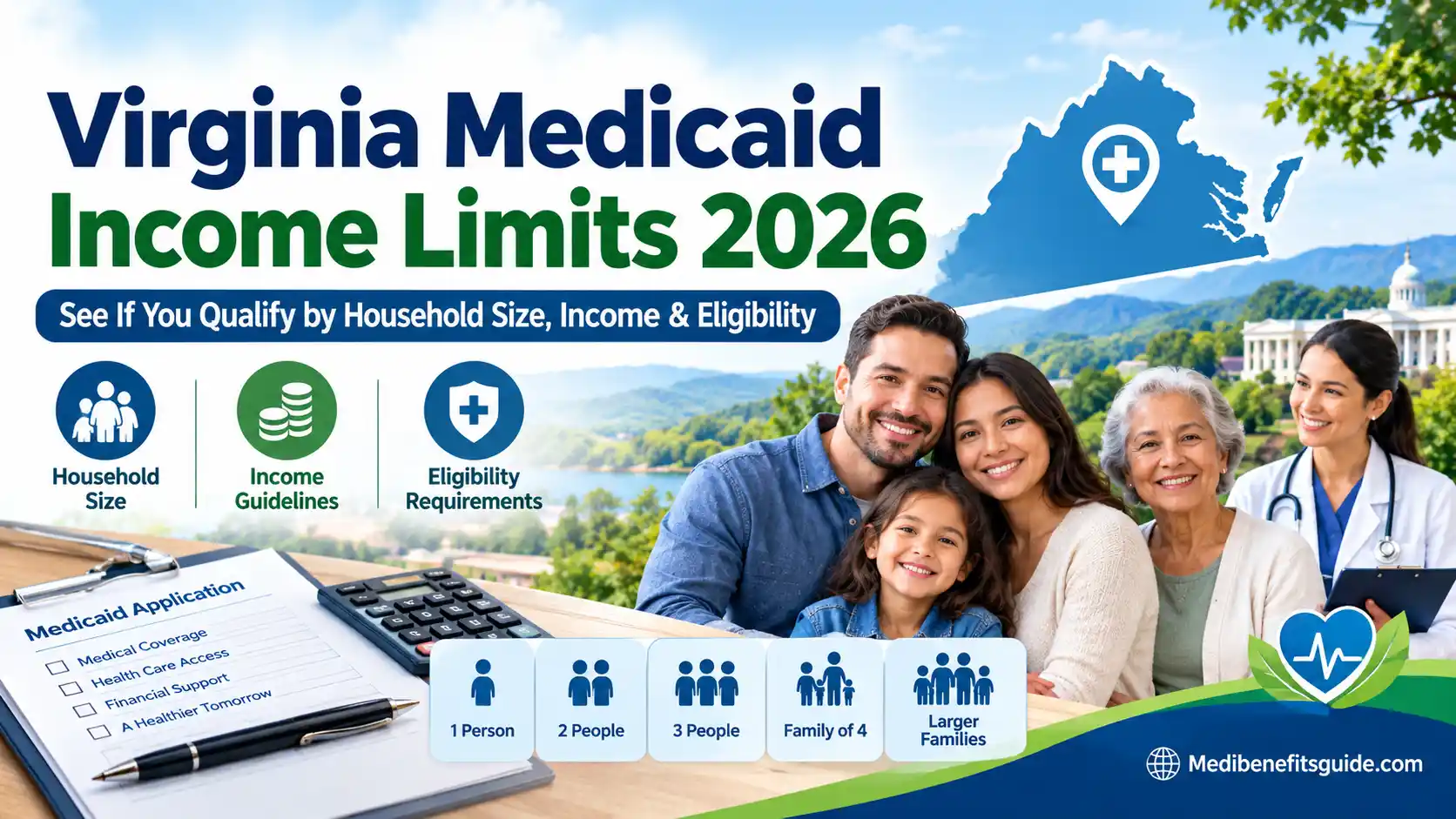
Trying to figure out if you qualify for Medicaid in Virginia? Here’s the first thing you need to know: there’s no single income limit that applies to everyone.If you’re an adult between 19 and 64 applying under Virginia’s Medicaid Expansion, here’s the number that matters: $22,025 a year for one person in 2026. Monthly, that’s $1,836.
Bump it up to a family of four and the ceiling rises to $45,540 a year — $3,795 a month. Those figures kicked in January 13, 2026, and yes, the 5% FPL disregard is already baked in. Kids, pregnant individuals, seniors, people with disabilities — none of them play by this same rulebook.
Virginia Medicaid Income Limits by Household Size
Adults Ages 19–64 — Medicaid Expansion
Household size| Monthly income| Annual income
1| $1,836| $22,025
2| $2,489| $29,864
3| $3,142| $37,702
4| $3,795| $45,540
5| $4,449| $53,379
6| $5,102| $61,217
7| $5,755| $69,056
8| $6,408| $76,894
Each additional person| +$654| +$7,839
This table is for eligible adults 19–64 who don’t qualify for Medicare and meet Virginia’s other Medicaid requirements.
Single adult making around $1,800 a month? You’re likely within range for Medicaid Expansion. Family of four bringing in up to $3,795 a month? Same story.
Income alone won’t decide your case, though. Virginia also looks at household composition, residency, and which Medicaid category actually applies to you.
You can also See How Your State Stacks Up on Medicaid Eligibility
Why Virginia Has Different Medicaid Income Limits
Virginia Medicaid runs on separate eligibility categories, and the biggest split is this: Medicaid Expansion, children’s coverage, pregnancy coverage, FAMIS, and programs for aged, blind, or disabled individuals all work differently.
Program| Main group| 2026 income standard
Medicaid Expansion| Adults 19–64| 138% FPL
Children’s Medicaid| Children under 19| 148% FPL
FAMIS| Children| 205% FPL
Pregnancy Medicaid| Pregnant individuals| 148% FPL
FAMIS MOMS/Prenatal| Pregnant individuals| 205% FPL
Plan First| Eligible adults| Up to 205% FPL
ABD Medicaid| Aged, blind or disabled| Separate rules
That’s exactly why a single “Virginia Medicaid income limit” search leaves people more confused than when they started.
How Virginia Medicaid Calculates Income
For most adults, children, and pregnant individuals, eligibility runs on Modified Adjusted Gross Income (MAGI) rules.
What factors into the calculation:
- Household size
- Countable income
- Tax-related household rules
- The applicable Medicaid category
- The 5% FPL disregard
Don’t assume every Medicaid program calculates income the same way. It doesn’t. And an income table isn’t a simple pass/fail gross-pay test, either. Virginia makes the final call after reviewing your full application.
Virginia Medicaid Income Limits for Children and FAMIS
Kids get more breathing room than adults do under Medicaid Expansion. For 2026, children’s Medicaid in Virginia runs on 148% FPL. FAMIS goes higher, at 205% FPL. Both tables build in the 5% FPL disregard.
Children’s Medicaid
Household size| Monthly| Annual
1| $1,969| $23,621
2| $2,669| $32,028
3| $3,370| $40,434
4| $4,070| $48,840
5| $4,771| $57,247
6| $5,472| $65,653
7| $6,172| $74,060
8| $6,873| $82,466
FAMIS
Household size| Monthly| Annual
1| $2,727| $32,718
2| $3,697| $44,362
3| $4,668| $56,006
4| $5,638| $67,650
5| $6,608| $79,294
6| $7,579| $90,938
7| $8,549| $102,582
8| $9,519| $114,226
Kids also get 12 months of protected, continuous coverage once enrolled — with a few exceptions. So if a family earns too much for children’s Medicaid, FAMIS might still be on the table.
Virginia Pregnancy Medicaid Income Limits
Pregnancy runs on its own eligibility track entirely. For 2026, Medicaid coverage for pregnant individuals uses the 148% FPL children’s table. FAMIS MOMS and FAMIS Prenatal use the higher 205% FPL FAMIS table instead.
Once you’re approved, Medicaid for Pregnant Women covers you through the entire pregnancy. Medicaid for Pregnant Women and FAMIS MOMS both extend 12 months postpartum. FAMIS Prenatal only extends 60 days.
Here’s something a lot of people miss: Medicaid for Pregnant Women can retroactively cover qualifying medical bills from up to three months before you applied. Babies born to Medicaid or FAMIS MOMS members? Automatically eligible and enrolled in Cardinal Care until they turn 1.
Medicaid Income Limits for Seniors and People With Disabilities
If you’re 65 or older, blind, or disabled — don’t use the $22,025 adult Medicaid Expansion figure. It doesn’t apply to you. Virginia runs Aged, Blind and Disabled (ABD) Medicaid on entirely separate rules, including different income and resource tests.
The 2026 ABD monthly income figures from Cover Virginia:
- 1 person: $1,084 per month
- 2 people: $1,463 per month
Medicare Savings Programs and Medicaid Works come with their own numbers, too. Take the 2026 Medicare Savings Program limits: $1,816 a month for one person, $2,455 for two. Medicaid Works runs $1,856 and $2,509 respectively. Resource limits can stack on top of these categories as well. Which is why “Does Virginia Medicaid have an asset limit?” isn’t a yes-or-no question.
Does Virginia Medicaid Have an Asset Limit?
For most MAGI-based groups — Medicaid Expansion adults, for instance — the answer looks nothing like the resource tests used for certain ABD programs. Put plainly: income limit and asset limit are not the same thing. Having a bank account balance, a home, or other property doesn’t mean the ABD resource rules automatically apply to you as a MAGI applicant.
Old ager, people with disabilities, long-term-care applicants, and a few other categories face separate resource requirements. Check the rules for your specific program before assuming anything.
What If Your Income Is Too High for Medicaid?
Slightly over the limit? That doesn’t automatically shut the door. Virginia runs a Medically Needy Spenddown program for people who meet every other eligibility requirement but sit above the standard income line. Medical expenses can count toward the required spenddown amount.
Worth knowing if you’re dealing with significant medical costs. Just don’t confuse this pathway with standard Medicaid Expansion eligibility — they’re not the same thing.
How to Apply for Virginia Medicaid
A few ways to apply:
- Online through Virginia’s CommonHelp system.
- By phone through Cover Virginia.
- By mail.
- Through your local Department of Social Services (DSS).
Before you start, have these ready:
- Names and dates of birth
- Social Security numbers
- Household income
- Employer information
- Pay stubs or other income records
- Immigration documents, when applicable
- Information about other health insurance
Certified enrollment assisters and local DSS offices can help you through the process, too.
How Medicaid Renewal Works
Virginia typically reviews Medicaid eligibility every year under current rules. You can usually renew online, by phone, by mail, or in person.
Don’t ignore renewal notices. If Virginia Medicaid asks for information, get it back to them by the deadline on the notice — missing it can cost you coverage. One more thing: a major change is coming in 2027.
Important Virginia Medicaid Changes in 2026 and 2027
October 1, 2026: Changes for Some Noncitizen Adults
Starting October 1, 2026, certain nonpregnant adults who aren’t U.S. citizens face tighter federal immigration-status requirements for full-benefit Medicaid.
Affected adults generally need to be a U.S. citizen, U.S. national, Lawful Permanent Resident, Cuban-Haitian Entrant, or COFA migrant — on top of meeting Virginia’s other Medicaid requirements. Children and pregnant/postpartum individuals aren’t treated the same way under these changes.
January 1, 2027: Medicaid Work Requirements
Beginning January 1, 2027, certain Medicaid Expansion adults ages 19–64 must meet a federal work or community-engagement requirement, unless they qualify for an exemption or exclusion.
Two main ways to satisfy it:
- Earn at least $580 per month, or
- Complete 80 hours per month of qualifying activities.
Qualifying activities span employment, self-employment, education, job training, volunteering, and community service. Not everyone falls under this. Pregnant/postpartum individuals, people with disabilities, qualifying parents or caregivers, and other exempt groups are handled differently.
January 1, 2027: Six-Month Renewals
Medicaid Expansion members will shift from annual eligibility reviews to six-month reviews starting in 2027. Other Medicaid groups keep their existing renewal schedules.
FAQs About Virginia Medicaid Income Limits
What is the Virginia Medicaid income limit for a person in 2026?
For an eligible adult ages 19–64 under Medicaid Expansion, it’s $22,025 a year, or $1,836 a month.
What is the Medicaid income limit for a whole family?
$45,540 annually, or $3,795 monthly, for Medicaid Expansion adults.
How much can I make and still qualify for Medicaid in Virginia?
Depends entirely on your category and household size. Adults, children, pregnant individuals, seniors, and people with disabilities each work off different limits.
Does Virginia Medicaid count household income?
Yes — household composition and countable income drive eligibility, especially for MAGI-based programs.
What is the Virginia FAMIS income limit in 2026?
FAMIS uses 205% FPL. For a household of four, that’s $67,650 a year, or $5,638 a month.
Can pregnant women qualify for Medicaid in Virginia?
Yes. Virginia runs specific Medicaid and FAMIS pregnancy programs, and postpartum coverage extends 12 months under Medicaid for Pregnant Women and FAMIS MOMS.
What is the Medicaid income limit for seniors in Virginia?
Seniors fall under separate ABD Medicaid rules, not the standard 138% adult expansion table. Resource limits may apply too.
Does Virginia Medicaid have work requirements?
Starting January 1, 2027, certain Medicaid Expansion adults will need to meet work or community-engagement requirements. Exemptions apply.
What happens if my income goes over the Medicaid limit?
You may lose eligibility under your current category, but other options exist — FAMIS, Marketplace coverage, or a Medically Needy Spenddown, depending on your situation.
Conclusion
Virginia Medicaid income limits for 2026 come down to who’s applying, how many people are in the household, and which program actually fits. For Medicaid Expansion adults, that’s $22,025 a year for one person, $45,540 for a family of four.
Children and pregnant individuals get different thresholds. FAMIS opens the door wider. Seniors and people with disabilities follow their own ABD rules, resource requirements included.
If you think you might qualify, apply. Let Virginia sort out the rest — that’s the fastest way to get a real answer, not a guess. Keep your info current, don’t let a renewal notice gather dust in your inbox, and circle October 2026 and January 2027 on your calendar now, while you’re thinking about it. Those dates are going to matter.
Official Resources
- Check Your Eligibility — Cover Virginia
- Apply Now — CommonHelp Virginia
- Find Program Details — Virginia DMAS
- Verify Federal Guidelines — Medicaid.gov
Disclaimer: Medicaid rules and income limits can change. The figures in this guide are based on Virginia’s published 2026 guidance, but eligibility depends on individual circumstances. For the most current determination, apply through Virginia Medicaid/Cover Virginia or contact your local Department of Social Services.

About Naseer
Naseer has 10+ years of experience creating informative content and researching medicare topics. He focuses on simplifying Medicaid and benefits details to support readers find clear, reliable, and easy-to-understand guidance.