Search “Idaho Medicaid income limits 2026” and you’ll find plenty of numbers. What you won’t find as often is the truth: Idaho doesn’t run one income limit for every Medicaid applicant. It runs several.
Which one applies to you depends on the program, your household size, your age, whether you’re pregnant, whether you have a disability, whether you’re on Medicare, and whether the program even uses an income test versus a resource test versus both.
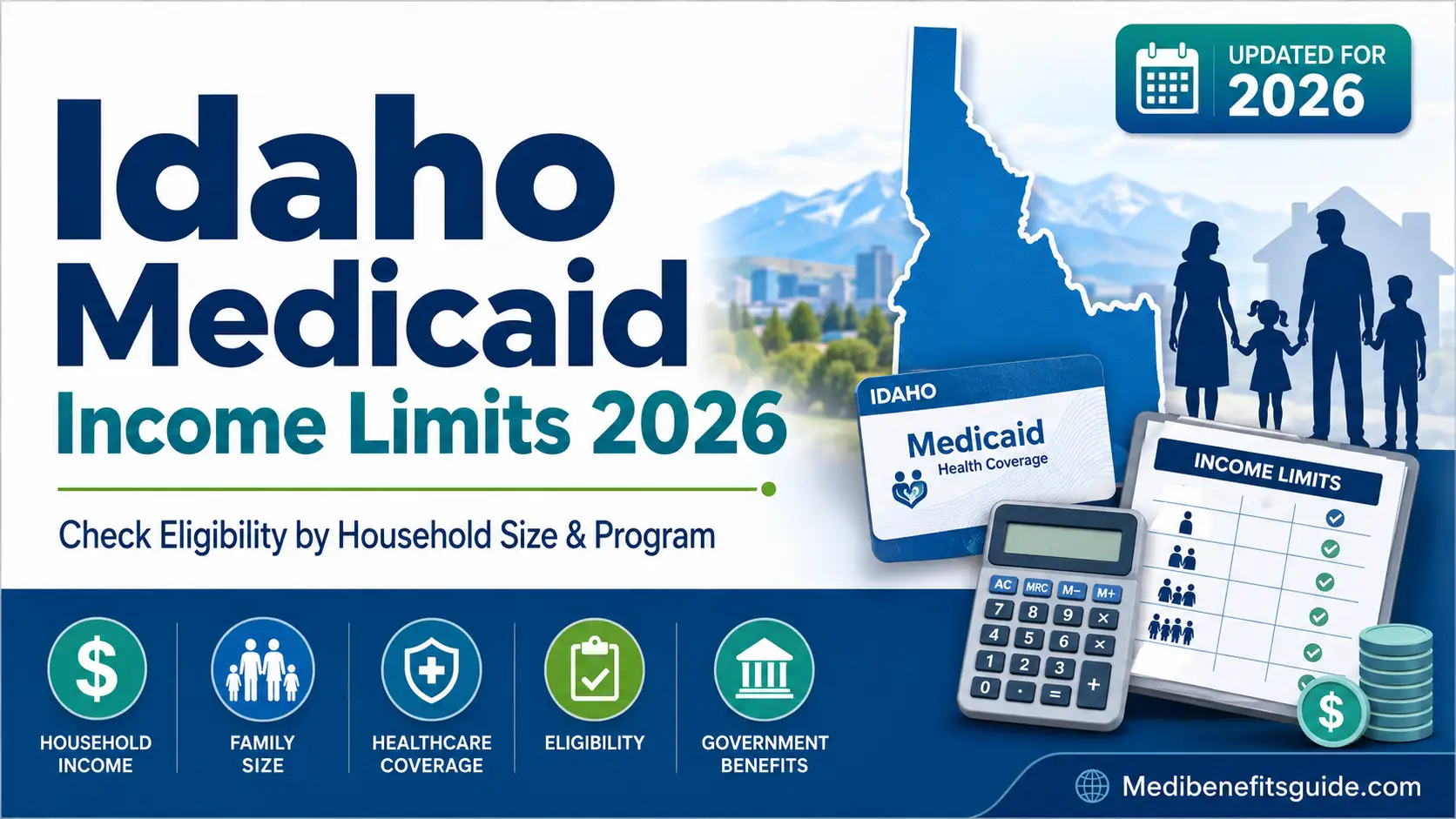
For Adult Medicaid, including Medicaid Expansion, Idaho’s official January 2026 limits are $1,836 per month for one person and $3,795 per month for a household of four.
Idaho Medicaid Income Limits 2026 at a Glance
The Idaho Department of Health and Welfare (IDHW) publishes income standards separately for each program. Below is the 2026 benchmark table for Adult Medicaid, including Expansion.
| Household Size | Monthly Income Limit |
|---|---|
| 1 | $1,836 |
| 2 | $2,489 |
| 3 | $3,142 |
| 4 | $3,795 |
| 5 | $4,449 |
| 6 | $5,102 |
| 7 | $5,755 |
| 8 | $6,408 |
| Each additional person | +$654 |
These are monthly figures, effective January 2026. You’ll sometimes see slightly different annualized numbers on other sites — that’s usually rounding, or a different poverty-guideline calculation method. When in doubt, work from the current IDHW program table. Not someone else’s annual estimate.
Is Idaho Medicaid 138% of the Federal Poverty Level?
For Adult Medicaid and Medicaid Expansion, yes — the threshold is up to 138% of the Federal Poverty Level for eligible adults ages 19–64 who meet the other requirements. But that 138% figure isn’t universal. It doesn’t govern every Idaho Medicaid program.
Children, pregnant applicants, seniors, people with disabilities, and long-term-care applicants all play by different financial rules.
You can also Compare Your State’s Medicaid Rules — Income Limits Guide
Do All Idaho Medicaid Programs Have the Same Income Limit?
No. Idaho Medicaid runs multiple eligibility pathways, and they don’t share a single standard.
Here’s the general path a determination follows:
Applicant → Medicaid category → household size → countable income → resources/assets if applicable → other requirements → eligibility decision
The major categories:
- Adult Medicaid and Medicaid Expansion
- Pregnancy Coverage
- Children’s Medicaid
- CHIP
- Medicaid for seniors and Medicare beneficiaries
- AABD and disability-related Medicaid
- Home and Community-Based Services (HCBS)
- Long-term-care Medicaid
- Medicaid for Workers with Disabilities (MWD)
- Katie Beckett
- YES and other specialized programs
IDHW is explicit that income is only one piece of the puzzle. Many programs also weigh resources, age, or disability status before landing on a decision.
Adult Medicaid Income Limits by Household Size
Adult Medicaid Expansion generally covers eligible Idaho adults ages 19–64 — people who aren’t pregnant, aren’t disabled under another Medicaid pathway, and aren’t already eligible for Medicare or a different Medicaid category.
A few quick examples:
- A single adult earning $1,500 per month sits below the one-person limit.
- A single adult earning $1,900 per month sits above it — that doesn’t mean the door is closed, just that expansion isn’t automatic.
- A family of four earning $3,700 per month comes in under the four-person threshold.
These are screens, not verdicts. An actual eligibility determination weighs more than income alone.
Read the full Idaho Medicaid reimbursement rates guide here
Idaho Pregnancy Medicaid Income Limits
Pregnancy changes the math. Literally — it changes household size. IDHW’s 2026 guidance counts the unborn child (or children) of a pregnant applicant toward household size. That’s why the pregnancy coverage table starts at household size two, not one.
So a pregnant applicant who’d normally be a household of one may actually be evaluated as a household of two. This is exactly why using the standard one-person Adult Medicaid limit for a pregnancy case can lead you astray.
Children’s Medicaid and CHIP Income Limits
Kids don’t automatically follow the Adult Medicaid Expansion income standard. They have their own lane.
Two programs are worth knowing here: children’s Medicaid and CHIP (Children’s Health Insurance Program). CHIP typically picks up coverage for kids whose family income runs too high for traditional children’s Medicaid but still qualifies under CHIP’s own rules.
Don’t assume a child is locked out of coverage just because the household exceeds the Adult Medicaid limit.
Household composition and other program-specific requirements matter just as much as the raw income number.
Medicaid for Seniors and Medicare Beneficiaries
Turning 65 changes your eligibility pathway entirely. A senior’s route through Medicaid looks nothing like a working-age adult applying under Expansion.
Depending on individual circumstances, the relevant program might be:
- AABD-related Medicaid
- Medicare Savings Programs
- Qualified Medicare Beneficiary (QMB)
- Specified Low-Income Medicare Beneficiary (SLMB)
- Qualified Individual (QI)
- Medicaid alongside Medicare
QMB, SLMB, and QI exist specifically to help qualifying Medicare beneficiaries manage Medicare-related costs. So if you’re a senior above the Adult Medicaid income threshold, don’t write off Medicaid assistance entirely — there’s likely still a program built for your situation.
Medicaid Income Limits for People With Disabilities
Idaho runs specialized pathways here too: AABD, HCBS, and Medicaid for Workers with Disabilities among them. Income and resource rules under these programs can look very different from Adult Medicaid Expansion.
This distinction matters most for someone who:
- Receives disability income
- Has significant medical needs
- Requires personal care services
- Needs home-based support
- Has Medicare
- Works while managing a disability
Comparing your monthly earnings against the 138% FPL Adult Medicaid threshold, in these cases, can lead you to the wrong conclusion entirely.
Idaho Long-Term-Care Medicaid Income and Asset Limits
Nursing-home Medicaid runs on its own set of rules. Applicants generally need to clear both income and resource requirements, plus navigate rules on asset transfers, property, and spousal circumstances.
For 2026, the applicable long-term-care/HCBS category shows an individual income figure of $3,002 per month — paired with resource standards that look nothing like Adult Medicaid Expansion.
That’s also why the oft-repeated line “Idaho Medicaid has a $2,000 asset limit” is misleading. A resource limit might apply to certain categories. It shouldn’t be applied across the board.
What About a Qualified Income Trust?
If you’re researching nursing-home Medicaid, you’ll likely run into the terms Qualified Income Trust (QIT) or Miller Trust. These are specialized long-term-care planning tools, and the rules around them get complicated fast. Verify current Idaho requirements before you transfer, gift, or restructure any assets.
How Idaho Counts Household Income
Most adults and families get evaluated under MAGI — Modified Adjusted Gross Income methodology. Household composition matters here, and the specific Medicaid category shapes how income actually gets counted.
What typically factors in:
- Wages
- Self-employment income
- Household members
- Tax-related household relationships
- Pregnancy
- Other countable income sources
The exact calculation shifts depending on the program you’re applying under.
MAGI vs. Asset-Tested Medicaid
| Feature | MAGI Medicaid | Asset-Tested Programs |
|---|---|---|
| Common users | Adults, families, expansion applicants | Seniors, disability/LTC applicants |
| Income methodology | MAGI-based rules | Program-specific rules |
| Assets/resources | Generally not the same type of resource test | Resource limits may apply |
| Household rules | Important | Can differ |
| Examples | Adult Medicaid Expansion | AABD, certain LTC pathways |
This is one of the more important distinctions to grasp when you’re sorting out Idaho Medicaid eligibility.
Do Assets and Savings Count?
Depends on the program — there’s no way around that answer.
Adult Medicaid Expansion doesn’t apply the traditional resource-limit rules used for aged, blind, or disabled programs. Resource limits, on the other hand, matter a great deal for seniors, people with disabilities, and long-term-care applicants.
Countable resources can include:
- Bank accounts
- Cash
- Investments
- Property
- Other financial resources
Exemptions and special rules apply throughout, so having savings in the bank doesn’t automatically disqualify you.
What If Your Income Is Above the Medicaid Limit?
Being above one limit doesn’t mean you’re out of options. Depending on your circumstances, it’s worth checking:
- Another Medicaid category
- Children’s Medicaid or CHIP
- Pregnancy coverage
- Medicare Savings Programs
- Disability-related Medicaid
- HCBS
- Long-term-care Medicaid
- Marketplace coverage or other health insurance options
Which one fits depends on why you’re applying — your household, your age, your disability status, your Medicare status, and your finances all factor in.
How to Apply for Idaho Medicaid
IDHW runs an official application process and outlines exactly what’s needed for an eligibility determination.
Step 1: Identify Your Likely Program
Figure out whether you’re applying as an adult, child, pregnant person, senior, Medicare beneficiary, person with a disability, or long-term-care applicant.
Step 2: Gather Documentation
You’ll likely need:
- Identity
- Idaho residency
- Household members
- Current income
- Expenses
- Resources, when applicable
- Immigration information, if applicable
Step 3: Apply Through the Official Idaho System
Idalink and IDHW’s official application resources are the starting point.
Step 4: Complete Verification
IDHW may come back asking for more information before finalizing anything.
Step 5: Review Your Decision
Disagree with the outcome? Read the notice closely — it spells out your rights and the appeal process.
Step 6: Report Changes
Household, income, or other eligibility-related changes generally need to be reported as they happen.
Real-Life Idaho Medicaid Eligibility Examples
Example 1: Single Adult Earning $1,500
Below the January 2026 one-person limit of $1,836. Still has to clear the other eligibility requirements, though.
Example 2: Single Adult Earning $1,900
Above the one-person Adult Medicaid limit. That’s not the end of the road — another category or coverage option may still apply.
Example 3: Family of Four Earning $3,700
Comes in under the $3,795 four-person threshold. Other household conditions still apply.
Example 4: Pregnant Applicant
Household size shifts because the unborn child counts under Idaho’s pregnancy rules.
Example 5: Medicare Beneficiary
Should look into Medicare Savings Programs and other relevant categories rather than measuring against the Adult Medicaid Expansion threshold alone.
Important Idaho Medicaid Changes Coming in 2027
Idaho Medicaid Expansion is set for a significant overhaul starting January 1, 2027.
Under the current IDHW guidance, expansion recipients will generally need to document 80 hours per month of qualifying work, community service, education, or similar activity — or qualify for an exemption. Earning at least $580 per month satisfies the work component on its own.
There’s also a three-month look-back requirement in the announced rules, and expansion eligibility will be checked every six months going forward. Some people will be exempt — certain pregnant individuals and caregivers among them. Since these rules are still ahead of us, check the latest IDHW guidance before leaning on any older explanation you find, including this one.
Idaho Medicaid Help by Location
Income limits are statewide — there’s no separate table for Boise, Meridian, Nampa, Idaho Falls, Pocatello, Coeur d’Alene, Twin Falls, Caldwell, Lewiston, Rexburg, or Moscow.
That said, searches like “Medicaid office near me,” “Medicaid assistance Boise,” “Medicaid help Twin Falls,” or “Medicaid application Idaho Falls” can be genuinely useful — mostly for finding in-person application help.
The Idaho Department of Health and Welfare’s own application resources remain the right starting point either way.
Common Idaho Medicaid Eligibility Mistakes
Watch for these:
- Using a 2025 income table for a 2026 application
- Assuming every Medicaid program uses 138% FPL
- Confusing Medicaid with CHIP
- Applying Adult Medicaid rules to long-term-care eligibility
- Assuming every Medicaid category has a $2,000 asset limit
- Ignoring pregnancy-related household-size rules
- Comparing annualized figures without checking the underlying monthly standard
- Assuming income alone determines eligibility
- Forgetting to report relevant changes
- Relying on an outdated third-party calculator instead of current IDHW information
FAQs About Idaho Medicaid Income Limits
What Is the Income Limit for Medicaid in Idaho in 2026?
For Adult Medicaid, including Expansion, the January 2026 limit is $1,836 per month for one person and $3,795 per month for four people. Other categories run their own standards.
What Is the Idaho Medicaid Income Limit for One Person?
$1,836 per month, as of January 2026. Eligibility still depends on category and other requirements beyond just this number.
What Is the Idaho Medicaid Income Limit for a Family of Four?
$3,795 per month. Don’t apply this figure to children’s coverage, pregnancy, seniors, or long-term care — those run differently.
Does Idaho Medicaid Use 138% of FPL?
Adult Medicaid Expansion does, for qualifying adults. It’s not the standard for every program in the state.
Does Idaho Medicaid Count Savings?
Depends on the program. MAGI-based Adult Medicaid treats this differently than resource-tested categories do. Don’t assume one asset rule covers every applicant.
Can I Qualify for Medicaid If My Income Is Too High?
Possibly — through another category, CHIP, pregnancy coverage, disability-related Medicaid, a Medicare Savings Program, or long-term-care Medicaid. It comes down to your specific situation.
How Do I Apply for Idaho Medicaid?
Through Idaho’s official application resources, including Idalink. Have your identity, residency, household income, and other relevant details ready.
Does Pregnancy Change Medicaid Household Size?
Yes. Idaho’s 2026 guidance counts the unborn child toward household size for the pregnancy calculation.
Can I Have Medicare and Medicaid in Idaho?
Yes — and you might also qualify for a Medicare Savings Program like QMB, SLMB, or QI on top of that.
What Happens to Idaho Medicaid Expansion in 2027?
Starting January 1, 2027, expansion applicants and recipients face new work/community-engagement requirements — or an applicable exemption — plus eligibility checks every six months instead of the current cadence.
Conclusion
There’s no single number that decides Medicaid eligibility in Idaho. For Adult Medicaid, the January 2026 range runs from $1,836 for one person up to $6,408 for eight, adding $654 per person beyond that. But that’s only one slice of the picture — children, pregnancy, seniors, Medicare beneficiaries, disability programs, and long-term care all run on their own rules.
If your income sits close to a limit, or you’re pregnant, on Medicare, managing a disability, or looking at long-term care — don’t stop at the Adult Medicaid number. Find the program built for your actual situation, then confirm it directly with the Idaho Department of Health and Welfare before you make any coverage decisions.
I’ve got good real URLs to work with. Here’s the section:
Official Resources
- Apply for Medicaid Now — Idaho Department of Health and Welfare
- Check Your Income Limits — Idaho Department of Health and Welfare
- Get Started on Idalink — Idaho’s Official Benefits Portal
- Find Medicaid Provider & Program Contacts — Idaho DHW
Disclaimer: This article is for general informational purposes only and is not an official Medicaid eligibility determination. Idaho Medicaid policies, income standards and program guidelines can change. Always verify your situation with the Idaho Department of Health and Welfare and current official guidance before making coverage decisions.

About Naseer
Naseer has 10+ years of experience creating informative content and researching medicare topics. He focuses on simplifying Medicaid and benefits details to support readers find clear, reliable, and easy-to-understand guidance.