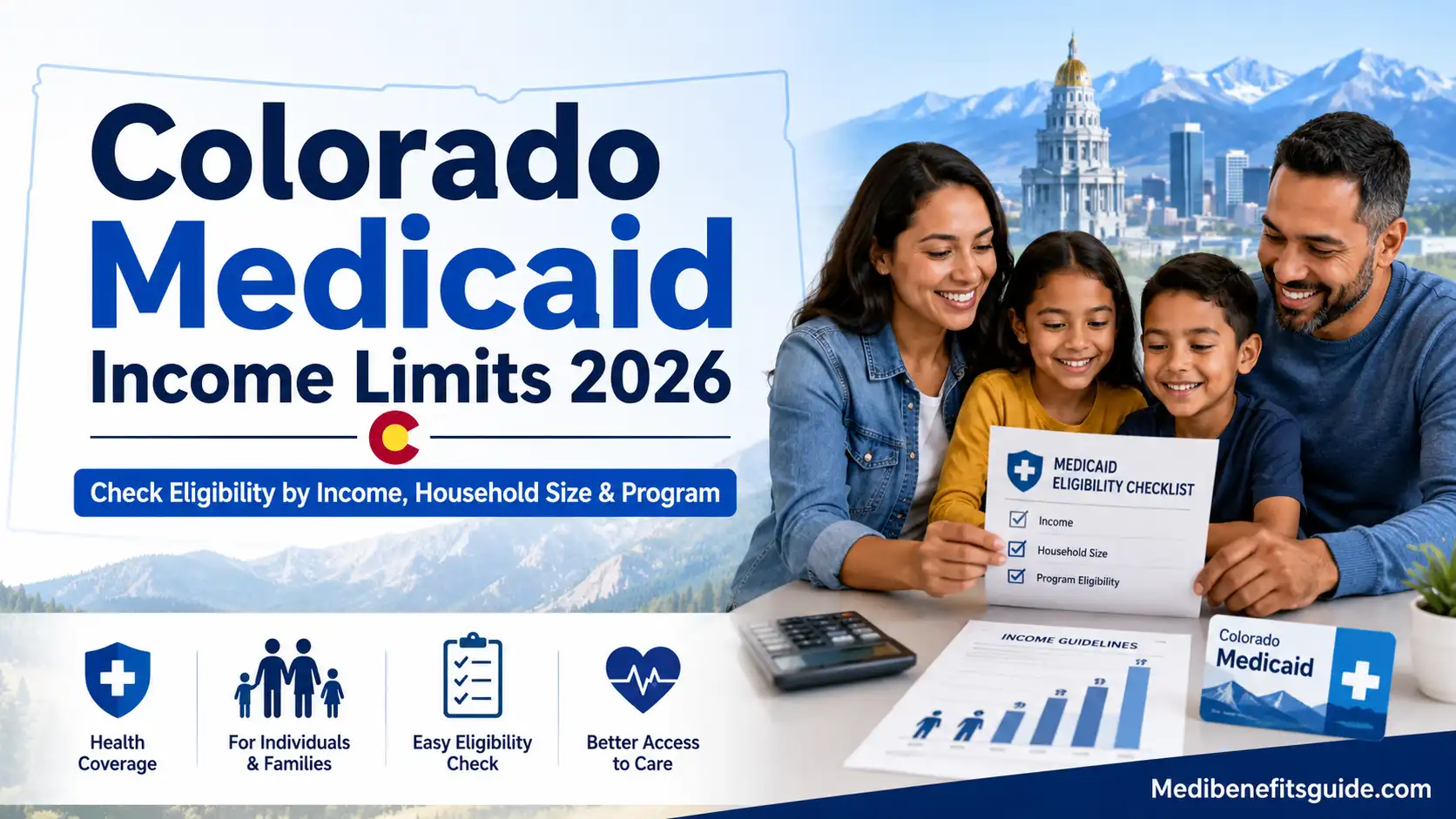
Health First Colorado — the state’s name for Medicaid — looks at three things when deciding if you qualify: household income, household size, and which eligibility category you fall into. The Colorado Department of Health Care Policy & Financing (HCPF) updated its Federal Poverty Level guidelines for 2026, effective April 1.
Most children, pregnant people, parents, and adults get evaluated under Modified Adjusted Gross Income (MAGI) rules. Which income standard applies to you depends entirely on your category.
2026 Colorado Medicaid Income Limits
HCPF publishes its MAGI standards as percentages of the Federal Poverty Level (FPL).
| Household Size | Adults 19–65 | Children 0–18 | Pregnant People | Parents/Caretaker Relatives |
|---|---|---|---|---|
| 1 | 133% FPL | 142% FPL | 195% FPL | 68% FPL |
| 2 | 133% FPL | 142% FPL | 195% FPL | 68% FPL |
| 3 | 133% FPL | 142% FPL | 195% FPL | 68% FPL |
| 4 | 133% FPL | 142% FPL | 195% FPL | 68% FPL |
Those are the published numbers. But MAGI Medicaid also applies a federal 5% income disregard when it affects eligibility — which is why you’ll often see the adult threshold described elsewhere as roughly 138% FPL, and the child threshold as roughly 147% FPL.
Worth knowing before you start comparing charts online. A lot of third-party calculators use the effective number, not the published one, and the two don’t match at first glance.
Here’s an internal linking section using that URL, formatted the same way as your Official Resources block:
You can See also Compare Medicaid Income Limits by State — MediBenefitsGuide
Why You May See 133% vs. 138% FPL
This trips people up constantly.
HCPF’s official chart lists the adult standard at 133% FPL. Full stop. But federal MAGI methodology tacks on a 5% disregard, which can push the effective threshold to around 138% FPL for people it applies to.
Same story with kids:
- Published HCPF standard: 142% FPL
- Effective threshold after the 5% disregard: roughly 147% FPL
Two sources showing different percentages isn’t necessarily a mistake. It usually just means one is citing the raw standard and the other is citing the adjusted one. Check which methodology a source is using before assuming something’s wrong.
Who Can Qualify for Health First Colorado?
Income alone doesn’t determine eligibility here.
Your category depends on a combination of factors:
- Age
- Household size
- Income
- Pregnancy
- Disability
- Medicare status
- Family relationship
- Immigration-related eligibility rules
- Other program-specific requirements
MAGI generally covers children, pregnant people, parents and caretaker relatives, and the ACA adult expansion group. Federal guidance is clear that MAGI is a methodology — a way of calculating countable income and household composition — not just a figure lifted straight off a tax return.
You can also See Colorado Medicaid Reimbursement Rates
Colorado Medicaid Income Limits for Adults
Adults 19–64 can qualify through Colorado’s Medicaid expansion, assuming they meet the requirements.
HCPF publishes 133% FPL as the standard for this category. The federal 5% disregard is why people often talk about an effective threshold closer to 138% FPL.
And having a job doesn’t disqualify you automatically. Plenty of working adults still qualify — it comes down to countable income and the rest of your circumstances.
Colorado Medicaid Income Limits for Children
Kids get a more generous income standard than adults do.
For 2026, HCPF sets the children’s standard (ages 0–18) at 142% FPL. Apply the federal 5% disregard and that can effectively land around 147% FPL.
Which means: a child can qualify for Medicaid even when their parent doesn’t.
If household income lands above the Medicaid cutoff for kids, Child Health Plan Plus — Colorado’s CHIP program — is the next place to look.
Colorado Pregnancy Medicaid Income Limits
Pregnancy comes with its own, substantially higher, income standard.
For 2026, HCPF lists pregnant people at 195% of the Federal Poverty Level under the applicable MAGI category. That’s a big jump from the adult standard, and for good reason.
Pregnancy also changes how household size gets counted. When you apply, Colorado will ask about your due date and how many babies you’re expecting.
If your income is close to the limit, don’t talk yourself out of applying. Let Colorado run the numbers and determine your actual household and category.
Does Colorado Medicaid Count Gross or Net Income?
For MAGI-based Medicaid, eligibility runs on Modified Adjusted Gross Income — not your take-home pay.
MAGI borrows from federal tax concepts, then layers on Medicaid-specific rules. It’s not simply what lands in your bank account each month.
That distinction matters if you:
- Work for an employer
- Have multiple jobs
- Are self-employed
- Have fluctuating income
- Receive taxable income from different sources
- Recently changed employment
If your income shifts significantly, report the update. Don’t try to eyeball eligibility off a single pay stub — it rarely tells the whole story.
Does Colorado Medicaid Have an Asset Test?
For MAGI-based eligibility, no — there’s generally no asset or resource test involved. Federal guidance draws a clear line between MAGI eligibility and other Medicaid categories that use different financial methodologies.
So money sitting in a savings account won’t automatically knock you out of MAGI Medicaid.
That said, don’t assume this applies everywhere. People applying based on age, disability, long-term care needs, or other non-MAGI categories can run into very different income and resource rules.
What If Your Income Is Too High for Medicaid?
Going over one income limit doesn’t mean you’re out of options. It just means you need to look somewhere else.
| Situation | Program to investigate |
|---|---|
| Child over Medicaid limit | CHP+ |
| Pregnant person | Pregnancy Medicaid/CHP+ eligibility |
| Adult over Medicaid limit | Connect for Health Colorado |
| Medicare beneficiary | Medicare Savings Programs |
| Person with disability | Disability-related Medicaid categories |
| Working person with disability | Medicaid Buy-In options |
| Long-term care need | Long-term services and supports Medicaid |
Colorado also runs Connect for Health Colorado, the state’s official insurance marketplace, where you can shop private coverage and see what financial assistance you qualify for.
Medicaid vs. CHP+ vs. Marketplace
Health First Colorado: Medicaid coverage for eligible low-income Coloradans.
CHP+: Colorado’s Children’s Health Plan Plus, for kids and pregnant people who don’t qualify for Medicaid but meet CHP+ requirements.
Marketplace coverage: Private insurance through Connect for Health Colorado, often with financial assistance attached.
Which one fits depends on your household, income, age, pregnancy status, and circumstances — not one number on a chart.
What Happens If Your Income Changes?
This section matters most if your income doesn’t look the same every month. Think:
- Seasonal employment
- Variable hours
- Self-employment
- Overtime
- A recent raise
- A new job
- Unemployment
- Multiple income sources
Here’s the thing — don’t cancel your own Medicaid because you think you’ve crossed a threshold.
Report the change through Colorado’s official systems instead. Let HCPF decide whether you’re still eligible, whether you’ve shifted into a different category, or whether another program fits better now.
How to Apply for Colorado Medicaid
Applications go through Colorado PEAK, the state’s online benefits system. HCPF also uses PEAK for account changes and status checks.
- Gather household and income information.
- Include everyone required for your application and report household size accurately.
- Provide pregnancy information if applicable.
- Enter current income information.
- Submit the application through Colorado PEAK.
- Respond promptly if HCPF or your county requests verification.
- Review your eligibility notice carefully.
In-person help is available too, through your county Department of Human Services or a local application assistance site.
Cover All Coloradans and Immigration Status
There’s an additional coverage pathway worth knowing about: Cover All Coloradans.
Since January 1, 2025, qualifying children age 18 and under, and pregnant people, can receive Health First Colorado or CHP+-look-alike coverage regardless of immigration status.
So immigration status alone shouldn’t stop an eligible child or pregnant person from applying.
2027 Colorado Medicaid Changes
One more thing to keep on your radar if you’re researching this in 2026.
HCPF has confirmed new community-engagement and work requirements will apply to certain ACA expansion adults starting January 1, 2027. Affected individuals will generally need to meet the requirement or qualify for an exemption — HCPF describes an 80-hour-per-month standard covering work, volunteering, education, or some combination of the three.
Expansion adults affected by this will also move to six-month renewal and redetermination cycles.
Don’t confuse these upcoming rules with the 2026 income limits — they’re separate issues on separate timelines.
Colorado Medicaid Help Across the State
Income standards are statewide. Getting help applying is local.
Residents of Denver, Colorado Springs, Aurora, Fort Collins, Lakewood, Thornton, Arvada, Westminster, Pueblo, Boulder, Greeley, Grand Junction, Loveland, and smaller Colorado communities can all reach out to their county human services department or a local application assistance organization.
HCPF specifically points applicants who want in-person help toward those two resources.
Common Colorado Medicaid Mistakes to Avoid
A few things trip people up more than anything else:
- Using an outdated income chart
- Assuming one income limit applies to everyone
- Confusing 133% with the effective 138% MAGI threshold
- Ignoring household size
- Using take-home pay instead of the appropriate MAGI methodology
- Assuming employment automatically prevents Medicaid eligibility
- Assuming bank savings automatically disqualify you
- Forgetting to report income changes
- Ignoring CHP+ when a child is over the Medicaid limit
- Assuming disability and senior Medicaid use the same rules as MAGI Medicaid
Income eligibility and automatic enrollment are two different things. Colorado’s own guidance is straightforward on this: apply and find out, rather than guessing from the sidelines.
FAQs About Colorado Medicaid lncome limits
What is the Colorado Medicaid income limit in 2026?
Colorado’s published standards are 133% FPL for adults, 142% for children, 195% for pregnant people, and 68% for parents/caretaker relatives. The federal 5% disregard can push effective thresholds higher.
How much can a single person make and still qualify for Medicaid in Colorado?
It depends on the category. Most single adults fall under Medicaid expansion, but the official determination weighs more than just an annual income figure.
Can I get Colorado Medicaid if I work?
Yes. Employment doesn’t disqualify you on its own — Colorado looks at your countable income, category, and household circumstances.
Does Colorado Medicaid count money in my bank account?
Not for MAGI Medicaid — there’s no asset test there. Other categories, especially those covering seniors, disability, and long-term care, work differently.
Can my child get Medicaid if I make too much?
Yes. Children’s income standards are separate from adults’. If your child doesn’t qualify for Health First Colorado, CHP+ is the next step to check.
What if my income is slightly above the Colorado Medicaid limit?
Don’t assume you’re out of options. Look into CHP+, Marketplace coverage through Connect for Health Colorado, Medicare Savings Programs, disability-related Medicaid, or other specialized programs depending on your situation.
Does pregnancy change Medicaid eligibility?
Yes — pregnancy has its own income category, set at 195% FPL for 2026. It can also change how your household is counted.
How do I apply for Health First Colorado?
Through Colorado PEAK. County human services departments and local application assistance sites can help too.
What if my income changes after I apply?
Report it, and provide whatever verification gets requested. Let HCPF make the call rather than estimating eligibility yourself.
Conclusion
There’s no single number that decides Colorado Medicaid eligibility, and that’s easy to forget when you’re staring at a chart trying to find your household size. Age, pregnancy, income methodology, disability status, Medicare enrollment — they all pull in different directions depending on your situation.
Start with the April 1, 2026 HCPF standards, figure out your category, and apply through Colorado PEAK. If you land over a limit, don’t stop there — CHP+, the Marketplace, Medicare Savings Programs, and disability pathways all exist for exactly that reason.
Official Resources
- Apply Now — Colorado PEAK
- Check Income Limits — Colorado HCPF
- Find Marketplace Plans — Connect for Health Colorado
- See CHP+ Eligibility — Colorado HCPF
Disclaimer: This article provides general information and is not a determination of Medicaid eligibility or legal/financial advice. Colorado HCPF makes the official eligibility decision, and income standards and program rules can change.

About Naseer
Naseer has 10+ years of experience creating informative content and researching medicare topics. He focuses on simplifying Medicaid and benefits details to support readers find clear, reliable, and easy-to-understand guidance.