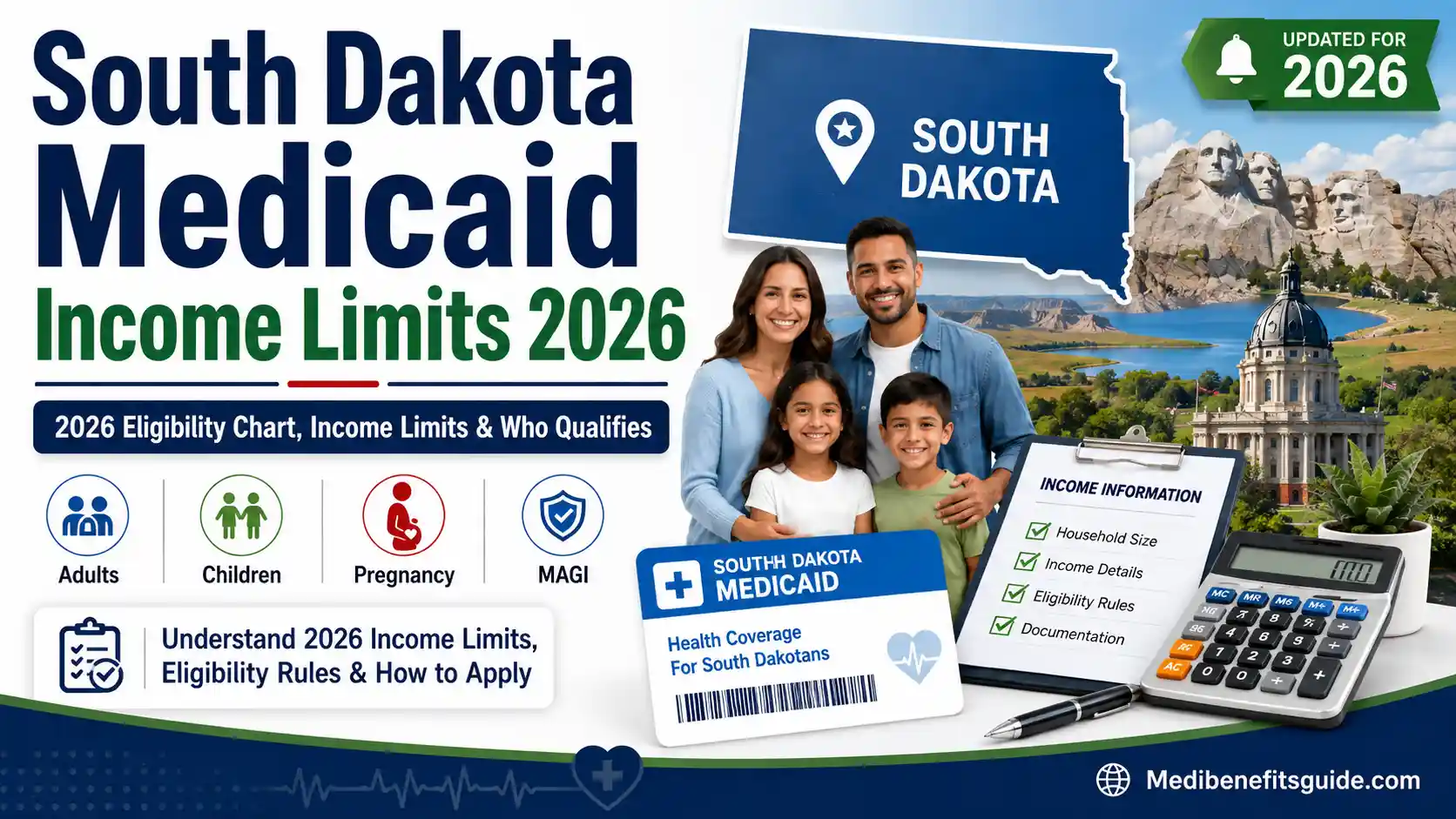
There isn’t one single income number that determines whether you qualify for South Dakota Medicaid. That’s the first thing to understand. The state runs separate rules for adults, kids, pregnant women, seniors, people with disabilities, and anyone applying for long-term care — and mixing those up is where most people get confused.
For Medicaid Expansion adults ages 19–64, the 2026 income limit sits at $1,835 per month for a household of one, climbing to $3,795 for a household of four. These numbers come straight from the South Dakota Department of Social Services (DSS) coverage-group table, and they’re based on gross monthly income — before taxes, before deductions.
South Dakota Medicaid Income Limits by Household Size
Here’s the full breakdown for the Adult Group, covering qualifying adults ages 19 through 64.
| Household Size | Maximum Gross Monthly Income |
|---|---|
| 1 | $1,835 |
| 2 | $2,488 |
| 3 | $3,142 |
| 4 | $3,795 |
| 5 | $4,448 |
| 6 | $5,102 |
| 7 | $5,755 |
| 8 | $6,407 |
These figures reflect the current DSS Medicaid coverage-group table. Falling under the limit doesn’t mean automatic enrollment, though — other eligibility requirements still apply.
Take a household of four earning $3,500 a month. On paper, that fits within the Adult Group limit. DSS still reviews the full application before making a final call.
You can also See Medicaid Income Limits for Every State →
Who Can Qualify for South Dakota Medicaid?
Plenty of working people assume Medicaid is only for the unemployed. Not true. Several programs exist, each built for a different kind of household.
Adults Ages 19–64
The Medicaid Expansion Adult Group covers adults in this age range, and having private insurance already doesn’t automatically knock you out of contention. Meet the income and other requirements, and you’re in. Covered services can stretch across medical care, dental, vision, and more.
Children and CHIP
Kids under 19 might qualify for Medicaid directly, or through the Children’s Health Insurance Program (CHIP). CHIP covers children who already have private insurance and those who don’t — the rules just shift depending on which bucket a child falls into.
For 2026, DSS lists these maximum gross monthly income amounts for CHIP-related coverage:
| Household Size | Child With Private Insurance | Child Without Private Insurance |
|---|---|---|
| 1 | $2,487 | $2,780 |
| 2 | $3,372 | $3,768 |
| 3 | $4,258 | $4,759 |
| 4 | $5,143 | $5,748 |
| 5 | $6,027 | $6,736 |
| 6 | $6,913 | $7,727 |
| 7 | $7,798 | $8,715 |
| 8 | $8,682 | $9,704 |
A child above the regular Medicaid threshold can still land CHIP coverage. Don’t assume being over one limit closes every door.
Medicaid Income Limits for Pregnant Women
Pregnancy coverage runs on its own set of income, resource, and eligibility rules.
| Household Size | Monthly Income Limit |
|---|---|
| 1 | $1,835 |
| 2 | $2,488 |
| 3 | $3,142 |
| 4 | $3,795 |
| 5 | $4,448 |
| 6 | $5,102 |
| 7 | $5,755 |
| 8 | $6,407 |
Coverage doesn’t stop at delivery, either. DSS provides full coverage for a 12-month postpartum period, along with family-planning services, for anyone whose postpartum period begins on or after the applicable date.
What About Newborns?
Here’s a category with no income test at all. A newborn automatically qualifies for South Dakota Medicaid if the mother was eligible for and receiving Medicaid on the date of birth — no income limit, no resource limit.
Coverage runs from the month of birth through the end of the month the child turns one, as long as the child stays a South Dakota resident.
Low-Income Families
A separate coverage group exists for low-income families raising dependent children, and the numbers here run considerably lower than the Adult Group figures above.
| Household Size | Monthly Limit |
|---|---|
| 1 | $590 |
| 2 | $740 |
| 3 | $842 |
| 4 | $941 |
| 5 | $1,042 |
| 6 | $1,145 |
| 7 | $1,244 |
| 8 | $1,343 |
Generally, a parent or qualifying caretaker relative needs to live with the dependent child for this category to apply.
Does South Dakota Medicaid Have an Asset Limit?
Depends entirely on the program. This is where people trip up the most. Medicaid Expansion for working-age adults plays by different rules than the programs built for seniors, people with disabilities, or anyone needing long-term care.
South Dakota’s Medicare Savings Program, for instance, caps resources at $9,950 for an individual and $14,910 for a couple. Checking accounts, savings, CDs — all of that counts toward the limit.
Long-term care Medicaid looks nothing like that. DSS sets a $2,000 resource limit alongside a $2,982 monthly income standard for the applicable nursing-facility and long-term-care categories in 2026. So don’t take that $2,000 asset figure and apply it to a regular working adult applying for Medicaid Expansion. It doesn’t work that way.
Medicaid for Seniors and People With Disabilities
Age 65 or older? Blind or disabled? Different categories, different financial and medical requirements apply. Nursing facility coverage — and certain home- and community-based services — often requires proof of a care level that would otherwise call for a nursing home. Both income and resource limits come into play here.
South Dakota also runs specialized waivers. The HOPE Waiver serves people needing long-term services and supports. The CHOICES Waiver covers eligible children and adults with intellectual and developmental disabilities.
Medicaid for Workers With Disabilities
Employed and living with a significant disability? South Dakota’s Medicaid for Workers with Disabilities (MAWD) program was built with you in mind.
DSS sets the resource limit under $8,000, with an income standard below 250% of the Federal Poverty Level, plus additional requirements on top of that.
What Income Counts for Medicaid?
Again — it depends on the category. Most adults and families fall under Modified Adjusted Gross Income (MAGI) rules. Seniors, disability categories, Medicare Savings Programs, and long-term care use different financial methodologies entirely.
Wages, self-employment income, Social Security benefits — all potentially count, depending on which program you’re applying under. Self-employed? DSS provides a Self-Employment Ledger among its medical eligibility forms specifically for documenting business income.
Being slightly over one program’s limit doesn’t mean you’re locked out of every South Dakota Medicaid option. Income rules shift too much between categories for that to be true.
What If Your Income Is Above the Medicaid Limit?
Don’t stop after checking the Adult Group table. Seriously. A few other pathways might apply to your situation:
- A child may qualify for CHIP.
- Pregnant women may qualify under pregnancy coverage, separate from the standard adult limits.
- Seniors could have a Medicare Savings Program option, or another category entirely.
- People with disabilities may fit under a disability-related program or waiver.
- Anyone needing nursing-home or home-based long-term care gets evaluated under different financial rules altogether.
- Former foster youth may qualify through the Former Foster Care Medical Program.
On that last point — South Dakota extends Medicaid to qualifying former foster youth through age 26, with no income or resource limit, for anyone who aged out of state or tribal foster care.
How to Apply for South Dakota Medicaid
Three ways to get an application in:
- Apply online through the state’s application portal.
- Print and submit a paper application.
- Get help directly from DSS with the process.
Applications also show up at DSS offices, schools, hospitals, clinics, Indian Health Services, and tribally operated facilities. Wherever you apply, be ready to provide details about your household, income, identity, residency, and anything else relevant to your specific Medicaid category.
One detail worth knowing: applying for one Medicaid program counts as an application for every program you might qualify under. SSI recipients may also be automatically eligible under the applicable rules.
How Long Does South Dakota Medicaid Take?
Applications requiring a disability determination take up to 90 days. Everything else generally moves within 45 days, according to the state’s published billing and policy information.
Approved coverage typically starts the first day of the month you became eligible.
Retroactive coverage rules are shifting, though — so pay close attention to when you apply and which Medicaid category you fall under.
South Dakota Medicaid Changes Coming in 2027
Researching this in 2026? Keep an eye on what’s changing next year. Starting January 1, 2027, certain Medicaid Expansion adults face a community-engagement requirement. Employment, job training, education, community service — or some combination totaling 80 hours a month — with exemptions built in for qualifying circumstances.
Renewal cycles are shifting too. Expansion adults move from annual renewals to every 6 months starting January 1, 2027. Other adult and child coverage groups stay on the standard 12-month cycle.
Retroactive coverage tightens as well. Expansion adults get limited to one month of retroactive coverage; other adults and children get two months.
None of this touches the 2026 income limits above — those stay as listed until the new rules take effect.
FAQs About South Dakota Medicaid Income Limits
What is the South Dakota Medicaid income limit for one person in 2026?
$1,835 per month for the Medicaid Expansion Adult Group. Other categories run different numbers entirely.
What is the Medicaid income limit for a family of four in South Dakota?
$3,795 per month under the Adult Group. CHIP and children’s coverage use separate limits.
Can I get Medicaid if I work in South Dakota?
Yes — working doesn’t disqualify you. Eligibility comes down to income, household size, age, and which category fits your situation. There’s even a dedicated program, Medicaid for Workers with Disabilities, for employed South Dakotans managing a significant disability.
Does South Dakota Medicaid count savings?
Some programs do, some don’t. The Medicare Savings Program and long-term-care Medicaid both carry specific resource limits — don’t assume those apply to Medicaid Expansion.
What if my income is too high for Medicaid?
Check other coverage groups before writing yourself off. CHIP for kids, pregnancy coverage, senior and disability programs, and long-term care all run separate eligibility rules.
How do I apply for Medicaid in South Dakota?
Online, on paper, or with direct guide from DSS. Applications are also available at DSS offices and various healthcare and community locations statewide.
How long does Medicaid approval take in South Dakota?
Up to 90 days if a disability consideration is involved. Otherwise, expect a decision within 45 days.
What is the South Dakota CHIP income limit in 2026?
It varies by household size and insurance status. For a household of four family members: $5,143 monthly with private insurance, $5,748 without.
What is the South Dakota Medicaid asset limit for seniors?bas
Depends on the specific program. Long-term-care Medicaid sets a $2,000 resource limit in 2026, while Medicare Savings Programs use their own separate thresholds.
Conclusion
The number that matters isn’t your household income — it’s which Medicaid category you actually belong to. For Medicaid Expansion young persons, 2026 limits run from $1,835 for one person up to $6,407 for eight.
Kids, CHIP, pregnancy, senior citizens, disable persons, and long-term care all play by their own policies.
If your income very close to a limit, apply anyway. Another category might match you where the first one doesn’t, and DSS won’t know your full situation until you put it in front of them.
Official Resources
- Apply for South Dakota Medicaid Now — SD Dept. of Social Services
- Check Your CHIP Eligibility Today — Medicaid.gov
- Find Long-Term Care Assistance — Dakota at Home
- Verify Federal Poverty Guidelines — U.S. HHS ASPE
Disclaimer: This article is for general information only and is not a firm of Medicaid acceptability. South Dakota DSS can change income guidelines and program policies, so verify current requirements with the official state agency before applying.

About Naseer
Naseer has 10+ years of experience creating informative content and researching medicare topics. He focuses on simplifying Medicaid and benefits details to support readers find clear, reliable, and easy-to-understand guidance.