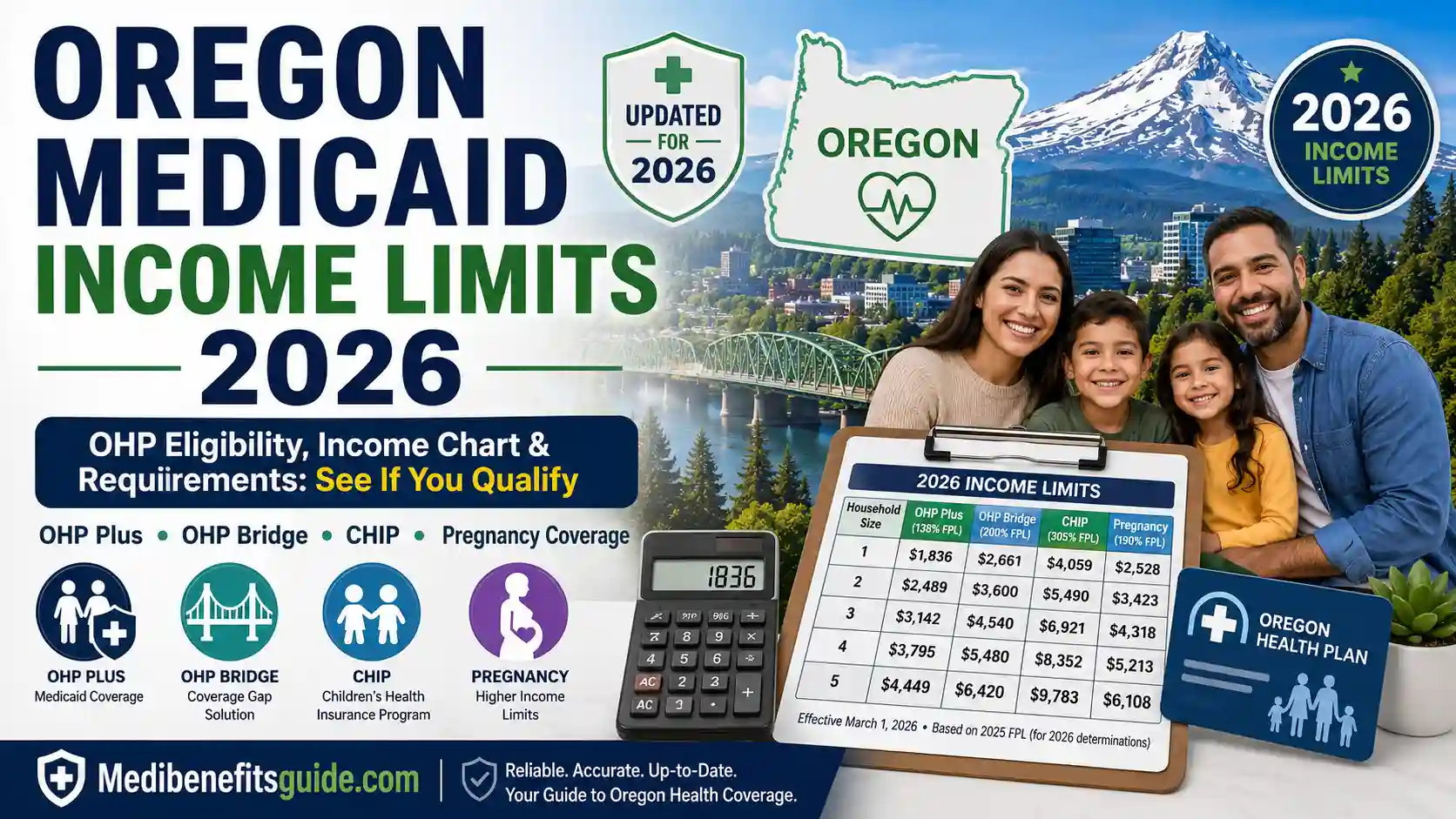
Searching for the Oregon Medicaid income limits 2026? The number you need depends on two things: your household size and which type of OHP coverage you’re applying for. Oregon Medicaid runs through the Oregon Health Plan (OHP), which folds in both Medicaid and the Children’s Health Insurance Program (CHIP).
For most adults ages 19–64, the 2026 standard is 133% of the Federal Poverty Level (FPL). Add Oregon’s 5% income disregard, and you get an effective limit of 138% FPL. For one person, that’s $1,769 a month at the base 133% rate, or $1,836 once the disregard is applied.
That 138% figure gets thrown around a lot online, but it doesn’t apply to everyone. Children, pregnant individuals, infants, OHP Bridge applicants, seniors, and people with disabilities all work off different standards.
Oregon Medicaid Income Limits 2026 at a Glance
These numbers come straight from Oregon’s official 2026 Income Thresholds, effective March 1, 2026. The adult column shows both the base 133% standard and the effective 138% amount after the disregard.
| Household size | Adult 133% | Adult effective 138% | Pregnancy/infant effective 190% | OHP Bridge Basic Medicaid effective 205% | CHIP effective 305% |
|---|---|---|---|---|---|
| 1 | $1,769 | $1,836 | $2,527 | $2,727 | $4,057 |
| 2 | $2,399 | $2,489 | $3,427 | $3,697 | $5,501 |
| 3 | $3,028 | $3,142 | $4,326 | $4,668 | $6,944 |
| 4 | $3,658 | $3,795 | $5,225 | $5,638 | $8,388 |
| 5 | $4,288 | $4,449 | $6,125 | $6,608 | $9,832 |
| 6 | $4,917 | $5,102 | $7,024 | $7,579 | $11,275 |
| 7 | $5,547 | $5,755 | $7,923 | $8,549 | $12,719 |
| 8 | $6,176 | $6,408 | $8,823 | $9,519 | $14,163 |
Each additional household member adds $654 to the effective monthly adult amount.
You can also Compare Medicaid Income Limits by State — See the Full 50-State Breakdown
What is the Oregon Medicaid income limit for one person?
$1,769 a month at 133% FPL, or $1,836 after Oregon’s 5% disregard. The effective figure — $1,836 — is usually the more useful one to reference, though the state makes final eligibility calls based on your specific program and circumstances.
What is the Oregon Medicaid income limit for a family of four?
$3,658 monthly at 133% FPL, climbing to $3,795 after the disregard. Keep in mind: other people in that same household might qualify under a completely different standard, like the child or pregnancy limits.
Why Does Oregon Use 133% vs. 138% FPL?
Here’s where most of the confusion starts. Oregon’s official table lists 133% FPL as the base 2026 standard for MAGI adults and certain children. Then it adds a 5% FPL disregard on top, which produces the effective 138% number. Put simply:
133% base standard + 5% FPL disregard = 138% effective standard. So when one site says Oregon Medicaid is a “133% FPL program” and another says adults qualify “up to 138%,” they’re not actually disagreeing. They’re just describing two different steps of the same math.
Why might one website say $1,835 instead of $1,836?
A dollar or two of drift usually comes down to:
- A different effective date
- A different FPL year
- Rounding differences
- An outdated Oregon table
- Annual figures converted to monthly ones
- A mix-up between program categories
When numbers conflict, trust the official Oregon administrative table — effective March 1, 2026 — over anything else.
Oregon OHP Income Limits by Eligibility Group
Adults Ages 19–64
Most MAGI adults fall under the 133% FPL standard, bumped to an effective 138% with the disregard. But income is only part of the picture. Oregon also weighs residency and which coverage category you fit into.
Children
Kids get more breathing room. Oregon’s 2026 CHIP standard sits at 300% FPL, or 305% effective after the disregard — $8,388 a month for a household of four.
That gap matters. A child can land OHP or CHIP coverage even when a parent in the same house doesn’t qualify for adult Medicaid at all.
Pregnant Individuals and Infants
Pregnant individuals and infants under age one qualify under a higher bar: 185% FPL, or 190% effective. For a household of four, that’s $5,225 a month.
OHP Bridge
OHP Bridge exists for adults whose income clears the traditional OHP ceiling but still falls within a higher range. The table lists OHP Bridge Basic Medicaid at 200% FPL — 205% effective — putting the household-of-four figure at $5,638 monthly.
There’s also a separate Basic Health Program (BHP) framework under OHP Bridge. For 2026, Oregon’s official annual range for the 133%–200% bracket is $21,228–$31,920 for one person and $43,896–$66,000 for a household of four. Don’t confuse these annual BHP figures with the monthly OHP Bridge Basic Medicaid numbers above — they’re two different things.
Parents and Caretaker Relatives
This is where the numbers drop sharply. Parents and caretaker relatives work under a much lower standard than the general MAGI adult category: $399 a month for one person before the disregard, $466 after it. For a four-person household, that’s $747 and $885.
Seniors and People With Disabilities
Don’t apply the 138% figure here — it doesn’t fit. Oregon treats eligibility for people 65 and older, or those qualifying through disability, as a more complex calculation involving different income and resource rules than standard MAGI-based OHP.
How Household Size Affects Oregon Medicaid Eligibility
Household size changes everything about which threshold applies to you. Eligibility calculations typically hinge on your tax household and who’s actually applying for coverage. Everyone living under one roof doesn’t automatically count as one Medicaid household — pregnancy, children, tax dependents, and who’s applying all factor in.
This means one family member can qualify while another doesn’t. A parent might sit above the adult OHP Plus limit while their child clears the bar easily under the higher CHIP standard.
Is Oregon Medicaid Based on Monthly or Annual Income?
Depends on the category. Oregon’s 2026 income-threshold document lays out monthly standards for most MAGI categories, alongside annual thresholds for specific programs. There’s another wrinkle too: 2025 FPL figures apply to certain 2026 determinations, while 2026 FPL figures won’t kick in until 2027.
For reference, HHS’s 2026 poverty guideline for the contiguous states and D.C. is $15,960 for one person and $33,000 for a family of four. That’s why simply multiplying a current federal guideline by a percentage won’t always match Oregon’s published table.
What Income Counts for Oregon Medicaid?
It varies by eligibility category. For MAGI-based coverage, Modified Adjusted Gross Income (MAGI) is the concept that matters most.
When you apply, Oregon asks about household income, expenses, and tax deductions tied to your federal return, plus other household details. Depending on your situation, that can pull in:
- Employment wages
- Self-employment income
- Other taxable income
- Social Security or similar benefits
- Unemployment income
- Household and tax filing information
Skip the assumption that gross income and net income work the same way across every category — they don’t. The right methodology depends on which program you’re being evaluated under.
Does Oregon Medicaid Have an Asset Limit?
No single rule covers every applicant here. MAGI-based Medicaid — the category most adults, children, and pregnant individuals fall into — generally looks at income, not the resource test tied to certain non-MAGI categories.
Seniors, people with disabilities, and long-term-care applicants play by different financial rules entirely. Having savings in the bank isn’t automatically a red flag or a green light. It depends entirely on which OHP category applies to you.
What If Your Income Is Above the OHP Limit?
One denied threshold doesn’t mean you’re out of options. Work through this:
- Check OHP Plus first, using your correct household and eligibility category.
- If your income is too high there, look at OHP Bridge.
- For kids specifically, check the CHIP limits — they’re much higher.
- Still no match? Check the Oregon Health Insurance Marketplace.
- Report income or household changes promptly so your record stays accurate.
That last step matters most for households with income that shifts month to month.
Can You Get OHP If You Work?
Yes. Having a job doesn’t disqualify you. What matters is whether your countable income — and everything else tied to eligibility — falls within the relevant program’s rules. Someone earning $1,700 a month should compare that figure against the standard for their household size and category, not assume employment itself is the problem.
Can Immigrants Qualify for Oregon Health Plan?
Yes, and this has changed in recent years. Since July 1, 2023, Healthier Oregon means immigration or citizenship status no longer determines whether someone qualifies for full OHP benefits, as long as they meet the applicable program requirements. Oregon Health Authority also states OHP isn’t considered a public charge.
Immigration and public-benefit rules shift over time. Lean on current Oregon guidance rather than older articles or assumptions.
How to Apply for Oregon Health Plan
Enrollment stays open year-round, and Oregon gives you three ways in.
Apply online. Oregon’s ONE Eligibility System lets you create an account, submit applications, upload documents, check status, and manage your eligibility information in one place.
Apply by phone. Call the ONE Customer Service Center at 800-699-9075, Monday through Friday, 7 a.m. to 6 p.m. Pacific Time.
Apply in person. Paper applications and in-person help are available, including through ODHS offices.
Before you start, have these ready:
- Names and dates of birth
- Social Security numbers, for anyone who has one
- Contact information
- Immigration or naturalization documentation, if applicable
- Household income information
- Expenses and tax deductions
- Details about other health insurance or Medicare
Common Oregon Medicaid Eligibility Mistakes
Watch for these when checking your 2026 eligibility:
- Applying the 138% figure across every Medicaid category
- Mixing up the 133% base standard with the 138% effective level
- Working off an outdated income chart
- Blending monthly and annual figures together
- Using the adult limit for children or pregnant applicants
- Confusing OHP Bridge Basic Medicaid with the OHP Bridge Basic Health Program
- Assuming one household member’s result applies to everyone
- Ignoring non-MAGI rules for seniors or people with disabilities
- Assuming a job automatically rules out OHP eligibility
- Trusting a third-party calculator over Oregon’s own confirmation
2026 vs. 2027 Oregon Medicaid Income Standards
Here’s a freshness issue that trips people up: the FPL year doesn’t always match the calendar year of your determination.
Oregon’s 2026 table uses 2025 FPL values for certain 2026 determinations, and separately lists 2026 FPL values for what applies in 2027. HHS’s 2026 poverty guideline is $15,960 for one person and $33,000 for four, compared to 2025’s $15,650 and $32,150.
An older article can be technically accurate for an earlier determination period and still be the wrong number to use today.
FAQs About Oregon Medicaid Income Limits
What is the Oregon Medicaid income limit for 2026?
For most MAGI adults, the base is 133% FPL, with the 5% disregard pushing it to an effective 138%. That’s $1,836 a month for one person, per the March 1, 2026 table.
What is the Oregon Medicaid income limit for one person?
$1,769 monthly at 133% FPL, $1,836 after the disregard. Other eligibility groups use different numbers entirely.
What is the Oregon Medicaid income limit for a family of four?
$3,658 at 133% FPL, $3,795 after the disregard — for MAGI adults specifically. Children, pregnancy, and CHIP categories run higher.
Is Oregon Medicaid 138% of the Federal Poverty Level?
For many MAGI adults, yes, once the 5% disregard is applied. But it’s not a blanket rule across every category.
What is OHP Bridge?
Coverage for adults whose income exceeds the traditional OHP range but still fits Oregon’s higher bracket. The 2026 effective level for OHP Bridge Basic Medicaid is 205% FPL.
Can I qualify for OHP if I work?
Yes. Employment alone doesn’t disqualify you — your income calculation, household size, and category do the deciding.
Can my child qualify for OHP if I do not?
Absolutely. Oregon’s CHIP standard sits at 300% FPL (305% effective), well above the adult threshold.
What is the Oregon Medicaid income limit for pregnant women?
185% FPL, or 190% effective after the disregard. For a household of four, that’s $5,225 monthly.
Does Oregon Medicaid have an asset limit?
Not one universal limit. MAGI-based applicants follow different financial rules than seniors, people with disabilities, or long-term-care applicants.
How do I apply for Oregon Health Plan?
Through the ONE Eligibility System online, by phone at 800-699-9075, or in person.
Conclusion
There’s no single magic number here — that’s the real takeaway. Most adults will land on that effective 138% FPL figure after the disregard, but kids, pregnant individuals, CHIP applicants, OHP Bridge participants, parents, seniors, and people with disabilities are all working from different tables entirely.
Use Oregon’s official chart, effective March 1, 2026, and you’ll avoid the confusion around $1,769 versus $1,836 or the 133% versus 138% debate. And if you land above the standard OHP limit, don’t treat that as the end of the road — OHP Bridge, CHIP, or Marketplace coverage might still be sitting there waiting for you. When you’re not sure, apply anyway. Let Oregon’s system make the actual call.
Official Resources
- Apply for OHP Online — Oregon ONE Eligibility System
- Check Your OHP Eligibility — Oregon Health Authority
- Find OHP Application Steps — Oregon Health Authority
- Verify Current Poverty Guidelines — U.S. Department of Health & Human Services
Disclaimer: This article is for general informational guidance only and is not an official Oregon Medicaid or OHP eligibility consideration. Income guidelines and program policies can change, so verify your conditions with current Oregon Health Authority or Oregon Department of Human Services guidance before making coverage decisions.

About Naseer
Naseer has 10+ years of experience creating informative content and researching medicare topics. He focuses on simplifying Medicaid and benefits details to support readers find clear, reliable, and easy-to-understand guidance.