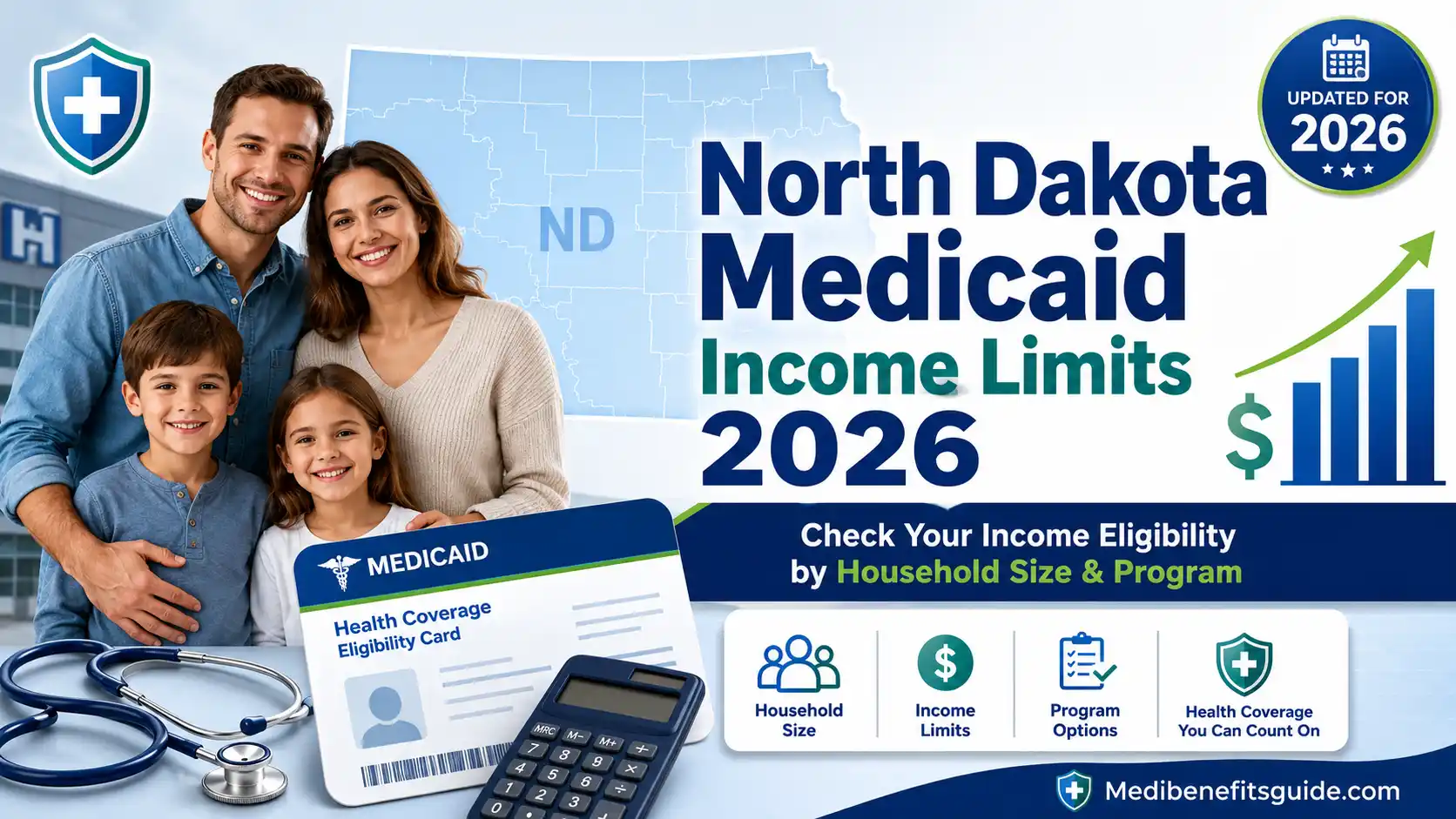
There’s no single income number that determines Medicaid eligibility in North Dakota. What applies to you depends on your age, your household size, whether you’re pregnant, whether you have a disability, and which coverage group you fall into.
Most of the 2026 income standards took effect April 1, 2026. Adults under Medicaid Expansion follow one set of rules. Children, pregnant women, parents, seniors, and people with disabilities each follow their own.
North Dakota Medicaid Income Limits at a Glance
Here’s the quick version — a snapshot of the major coverage groups before we dig into each one.
| Coverage Group | Income Standard | 1 Person | 4 People |
|---|---|---|---|
| Medicaid Expansion, ages 19–64 | 138% FPL | $1,836/month | $3,795/month |
| Children birth–age 5 | 152% FPL | $2,022/month | $4,180/month |
| Children ages 6–18 | 138% FPL | $1,836/month | $3,795/month |
| CHIP | 205% FPL | $2,727/month | $5,638/month |
| Pregnant Women | 175% FPL | $2,328/month | $4,813/month |
| Parent/Caretaker Relatives | 41% FPL | $517/month | $1,048/month |
| Aged, Blind and Disabled | 90% FPL | $1,197/month | $2,475/month |
| Workers with Disabilities | 225% FPL | $2,993/month | $6,188/month |
These figures are effective April 1, 2026.
Important: These figures are general eligibility standards. Income is only one part of a Medicaid eligibility determination.
Also See Medicaid Income Limits for Every State — Medicaid Benefits Guide
Find Your North Dakota Medicaid Category in 30 Seconds
A few quick questions will point you toward the right income limit.
Are you under age 19?
You may qualify for:
- Children’s Medicaid
- CHIP
- Children with Disabilities coverage
Are you pregnant?
You may qualify for North Dakota Medicaid pregnancy coverage. The unborn child counts as a family member for eligibility purposes.
Are you age 19 through 64?
Medicaid Expansion is likely your category, especially if nothing else fits.
Are you a parent or caretaker of a child?
There’s a separate track for that — Parent/Caretaker Relative coverage. Its income standard is much lower than Expansion’s, which trips a lot of people up.
Are you 65 or older, blind, or disabled?
Aged, Blind and Disabled (ABD) Medicaid applies here. Both income and countable assets come into play.
Do you work and have a qualifying disability?
North Dakota’s Workers with Disabilities program lets you work and buy into Medicaid through a monthly premium.
Medicaid Expansion Income Limits for Adults
Medicaid Expansion covers qualifying adults ages 19 through 64 who don’t fit into another Medicaid category. The threshold sits at 138% of the Federal Poverty Level.
2026 Medicaid Expansion Monthly Income Limits
| Household Size | Monthly Income Limit |
|---|---|
| 1 | $1,836 |
| 2 | $2,489 |
| 3 | $3,142 |
| 4 | $3,795 |
| 5 | $4,449 |
| 6 | $5,102 |
| 7 | $5,755 |
| 8 | $6,408 |
Add $654 a month for each person beyond eight. Annually, that’s $22,025 for a one-person household and $45,540 for a household of four.
Can adults without children get Medicaid in North Dakota?
Yes. Medicaid Expansion covers qualifying adults 19–64 whether or not they have dependent children.
One catch worth knowing: people already eligible for Medicare or Supplemental Security Income (SSI) generally aren’t covered through the Expansion category itself. They fall under different rules entirely.
North Dakota Medicaid Income Limits for Children
Coverage runs from birth through age 18, and the limit shifts depending on how old the child is.
| Family Size | Birth–Age 5 | Ages 6–18 |
|---|---|---|
| 1 | $2,022 | $1,836 |
| 2 | $2,742 | $2,489 |
| 3 | $3,461 | $3,142 |
| 4 | $4,180 | $3,795 |
| 5 | $4,900 | $4,449 |
| 6 | $5,619 | $5,102 |
| 7 | $6,339 | $5,755 |
| 8 | $7,058 | $6,408 |
Younger children get a slightly higher threshold — 152% FPL versus 138% FPL for ages 6 through 18.
Can my child qualify if I do not?
Yes, and this happens more often than people expect. A parent can land above the income limit for their own category while their child still qualifies for Children’s Medicaid or CHIP. Don’t assume one household member’s ineligibility rules everyone else out.
North Dakota CHIP Income Limits
CHIP exists for families who earn too much for standard Medicaid but still need help covering a child’s healthcare. The 2026 ceiling is 205% of the Federal Poverty Level.
| Family Size | Monthly Income |
|---|---|
| 1 | $2,727 |
| 2 | $3,697 |
| 3 | $4,668 |
| 4 | $5,638 |
| 5 | $6,608 |
| 6 | $7,579 |
| 7 | $8,549 |
| 8 | $9,519 |
Add $971 monthly per additional household member.
Medicaid vs. CHIP in North Dakota
| Medicaid | CHIP |
|---|---|
| Generally serves lower-income eligibility groups | Helps children in families with higher qualifying incomes |
| Different coverage group | Separate eligibility requirements |
| Children may qualify based on Medicaid limits | Designed for eligible uninsured children above Medicaid income levels |
Pregnancy Medicaid Income Limits
North Dakota covers qualifying pregnant women at 175% of the Federal Poverty Level for 2026.
| Family Size | Monthly Income Limit |
|---|---|
| 1 | $2,328 |
| 2 | $3,156 |
| 3 | $3,985 |
| 4 | $4,813 |
Add $829 for each additional family member — and here’s something people often miss: the unborn child counts as a family member when calculating household size.
Coverage extends to prenatal care and labor and delivery. Women enrolled in Medicaid during pregnancy can also receive postpartum coverage under applicable North Dakota rules.
Parent and Caretaker Medicaid Income Limits
This is its own coverage group, separate from Expansion, and the numbers are considerably lower.
| Family Size | Monthly Income Limit |
|---|---|
| 1 | $517 |
| 2 | $694 |
| 3 | $871 |
| 4 | $1,048 |
Add $178 per additional household member. This category can cover qualifying parents and certain relatives — grandparents included — who are caring for children.
Warning: Do not assume the 138% Medicaid Expansion limit applies to Parent/Caretaker Medicaid.
Medicaid Income Limits for Seniors, Blind and Disabled Adults
Anyone 65 or older, blind, or disabled may fall under Aged, Blind and Disabled (ABD) Medicaid.
| Family Size | Monthly Income Limit |
|---|---|
| 1 | $1,197 |
| 2 | $1,623 |
| 3 | $2,049 |
| 4 | $2,475 |
Add $426 per additional person.
Do assets matter?
For ABD, yes — unlike most MAGI-based categories. North Dakota’s general countable asset limit sits at $3,000 for one person and $6,000 for a couple.
Some property doesn’t count against you: a qualifying home, one vehicle, household furnishings, and a handful of other items. Checking accounts, savings, stocks, and bonds are counted differently.
MAGI vs. Asset-Tested Medicaid: What Is the Difference?
A lot of confusion comes from assuming every Medicaid program runs on the same financial rules. It doesn’t work that way.
MAGI-Based Coverage
Modified Adjusted Gross Income (MAGI) applies to groups like:
- Medicaid Expansion
- Children
- Pregnant women
- CHIP
Asset-Tested Coverage
Programs tied to age, blindness, or disability look beyond income alone. They factor in:
- Countable income
- Savings
- Checking accounts
- Other countable assets
Two people earning the exact same income can walk away with completely different eligibility outcomes because of this split.
Workers with Disabilities Medicaid
For people who are employed — or becoming employed — and have a qualifying disability, North Dakota offers a buy-in option at 225% FPL for 2026.
| Family Size | Monthly Income Limit |
|---|---|
| 1 | $2,993 |
| 2 | $4,058 |
| 3 | $5,123 |
| 4 | $6,188 |
Applicants typically pay a monthly premium, generally 5% of gross countable income, plus a one-time enrollment fee.
What Is Medicaid Client Share?
Going over the standard income limit doesn’t necessarily mean you’re out of options. North Dakota offers Client Share coverage for people whose income exceeds the normal Medicaid standard but who have significant medical needs.
Think of it like a monthly medical deductible. The math generally works like this:
Monthly gross countable income
− allowable deductions
− applicable income standard
= Client Share
Once your qualifying medical expenses meet that client share amount, Medicaid can start paying for covered services under program rules.
How Do You Check Whether You Qualify?
Six steps, start to finish:
- Identify your coverage group based on age, pregnancy, disability, or family situation.
- Determine household size using the applicable Medicaid rules.
- Calculate your income correctly, based on what counts for your program.
- Compare that number against the 2026 standard that applies to you.
- Check asset requirements if you’re applying under an age- or disability-related program.
- Apply for an official eligibility determination.
North Dakota Medicaid accepts applications online, in person, by phone, and by mail.
What Counts as Income?
The exact calculation shifts depending on which coverage group you’re applying under. Be ready to provide:
- Recent pay stubs
- Tax information for self-employment
- Pension information
- Disability payments
- Other proof of monthly income
Applicants who are blind, disabled, or 65 and older should also expect to provide proof of assets — North Dakota HHS asks for it as standard practice.
Why You May See Different North Dakota Medicaid Limits Online
Numbers vary across websites for a handful of reasons: different coverage groups, different household sizes, different years, monthly figures mixed up with annual ones, different FPL percentages, MAGI methodology versus non-MAGI.
The 138% FPL figure isn’t a universal North Dakota Medicaid limit — it matters most for Medicaid Expansion. Children, pregnant women, parents, seniors, and people with disabilities all work from different standards.
What If Your Income Is $1 Over the Limit?
Don’t assume that’s the end of the road. A few paths might still be open:
- CHIP for qualifying children
- Client Share Medicaid
- Workers with Disabilities coverage
- Medicare Savings Programs
- Marketplace coverage through the Affordable Care Act
Even a small income change can affect eligibility differently depending on the program and how income gets counted for that group.
North Dakota Medicaid Help Near You
The core income standards apply statewide. Whether you’re in Fargo, Bismarck, Grand Forks, Minot, West Fargo, Williston, Dickinson, Mandan, or Jamestown, the same financial eligibility rules apply.
Local Human Service Zone offices and Medicaid assistance locations can still help with applications, required documents, eligibility questions, enrollment assistance, and renewal or redetermination issues.
If you’re searching “Medicaid application help near me” or “North Dakota Medicaid office near me,” stick to official North Dakota HHS and Human Service Zone resources.
Common Mistakes to Avoid
- Using the Medicaid Expansion limit for every applicant
- Comparing monthly income to an annual income table
- Using outdated 2025 figures
- Forgetting that the unborn child can affect pregnancy household size
- Assuming parents and children always qualify under the same category
- Ignoring asset rules for ABD Medicaid
- Assuming being over the income limit means all coverage options are gone
FAQs About North Dakota Medicaid Income Limits
What is the income limit for Medicaid in North Dakota?
It varies by coverage group. In 2026, Medicaid Expansion for qualifying adults sits at $1,836 per month for one person. Children, pregnant women, parents, seniors, and disabled individuals each have different limits.
What is the North Dakota Medicaid income limit for one person?
Depends on the program. Medicaid Expansion: $1,836 per month. ABD Medicaid: $1,197 per month. Pregnancy and children’s programs use different standards entirely.
What is the Medicaid income limit for a family of four in North Dakota?
It changes by program. Medicaid Expansion uses $3,795 per month, CHIP uses $5,638, pregnancy Medicaid uses $4,813.
Can adults without children get Medicaid in North Dakota?
Yes. Qualifying adults ages 19 through 64 can get coverage through Medicaid Expansion even without kids.
Does North Dakota Medicaid have an asset limit?
For some programs, yes. ABD Medicaid applicants face countable asset limits. Most MAGI-based groups don’t.
Can my child qualify for Medicaid if I do not?
Yes — children can qualify for Children’s Medicaid or CHIP even when a parent doesn’t qualify under the same category.
What happens if I make too much for Medicaid?
You may still have options: CHIP, Client Share Medicaid, Workers with Disabilities coverage, Medicare Savings Programs, or Marketplace health insurance.
Does North Dakota Medicaid count pregnancy household size differently?
Yes. The unborn child counts as a family member for pregnancy Medicaid.
Can I get Medicaid if I work full time?
Possibly. Working full time doesn’t automatically disqualify you — it comes down to income, household size, coverage group, and the other requirements for your category.
Do Medicaid income limits change by city in North Dakota?
No, generally not. Living in Fargo, Bismarck, Grand Forks, Minot, or anywhere else in the state doesn’t change the statewide income standards.
Conclusion
There’s no shortcut here — North Dakota Medicaid doesn’t run on one number. Figure out which coverage group actually applies to you before you get attached to any single income figure you’ve seen floating around.
For 2026, qualifying adults 19–64 may get in through Medicaid Expansion at up to 138% FPL, while children, pregnant women, parent/caretakers, seniors, and people with disabilities each answer to their own standard. Most of these figures took effect April 1, 2026 — but policy shifts, so confirm your numbers before you make any decisions based on them.
Official Resources
- Apply for Medicaid Online — ND HHS Self-Service Portal
- Check Your Eligibility — ND Health and Human Services
- Find Your Local Zone Office — ND HHS Ways to Apply
- Verify Federal Medicaid Rules — Medicaid.gov
Disclaimer: This article is intended for general informational guidance only and does not constitute an official North Dakota Medicaid consideration. Income thresholds and program policies are subject to change, so always confirm your eligibility with current North Dakota Health and Human Services guidelines before making healthcare coverage decisions.

About Naseer
Naseer has 10+ years of experience creating informative content and researching medicare topics. He focuses on simplifying Medicaid and benefits details to support readers find clear, reliable, and easy-to-understand guidance.