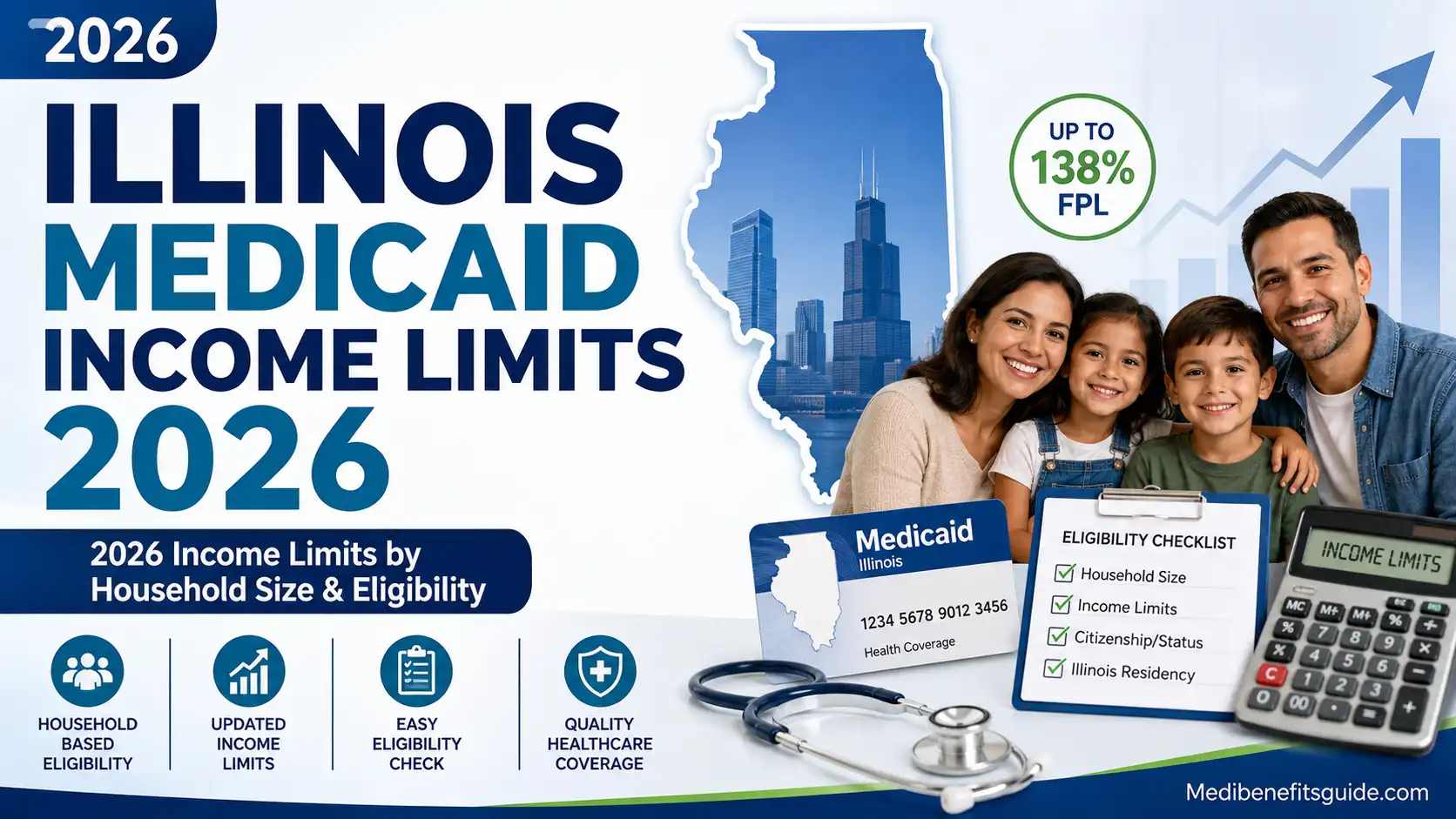
Illinois Medicaid Income Limits for 2026, Illinois ACA Adult Medicaid generally uses 138% of the Federal Poverty Level (FPL). That’s about $1,835 a month for one person, and $3,795 a month for a family of four. All Kids, FamilyCare, Moms & Babies, and AABD each run on their own rules.
Here’s the thing most people miss: Illinois doesn’t have one Medicaid income limit. It has several, and which one applies to you depends on your age, your household, whether you’re pregnant, whether you have a disability, your Medicare status, and the specific category you’re applying under.
2026 Illinois Medicaid Income Limits at a Glance
For the ACA Adult category, the 2026 screening figures break down like this:
| Household Size | 138% FPL Monthly | 138% FPL Annual |
|---|---|---|
| 1 | $1,835 | $22,024 |
| 2 | $2,488 | $29,863 |
| 3 | $3,141 | $37,701 |
| 4 | $3,795 | $45,540 |
| 5 | $4,448 | $53,378 |
| 6 | $5,101 | $61,216 |
| 7 | $5,754 | $69,048 |
| 8 | $6,407 | $76,884 |
The official 2026 Get Covered Illinois chart supplies the household-size calculations. Illinois’ Department on Aging is upfront that these are estimates — DHS decides the rounding and what counts as income in an actual determination.
Don’t assume 138% FPL applies to you just because it’s the number that shows up first in every search result.
You can also See Medicaid Income Limits for Every State — MediBenefitsGuide
Which Illinois Medicaid Income Limit Applies to You?
| Your Situation | Program to Check |
|---|---|
| Adult age 19–64 | ACA Adult |
| Parent or caretaker relative | FamilyCare |
| Child age 18 or younger | All Kids |
| Pregnant | Moms & Babies |
| Age 65+, blind, or disabled | AABD Medical |
| Medicare beneficiary with limited income | Medicare Savings Program |
| Working person with a disability | Health Benefits for Workers with Disabilities |
| Nursing-home or long-term-care applicant | Medicaid long-term-care rules |
Asking “which program fits my situation” gets you a better answer than asking “am I under 138% FPL.” Illinois HFS splits coverage into separate groups — adults, children, parents, pregnant individuals, seniors, people with disabilities — and each group plays by its own rulebook.
ACA Adult Medicaid: 138% FPL
ACA Adult Medicaid generally covers Illinois adults ages 19–64 whose countable income falls within the 138% FPL standard, assuming they meet the other eligibility requirements.
A single adult bringing in around $1,800 a month likely falls within the 2026 screening limit. A household of four sitting near $3,795 a month does too. Income alone won’t get you approved, though. Illinois still runs its own eligibility determination on top of the income screen.
Why You May See $22,024, $22,025, or Another Number
Rounding. Calculation methods. How a given site chooses to present the numbers. That’s usually the whole story behind the discrepancy.
The 2026 Get Covered Illinois chart lists $22,024 for one person at 138% FPL. Other Illinois materials round slightly differently. The Department on Aging says as much — these are estimates, and DHS controls how the poverty-level multiples get rounded and which income gets counted.
For an actual application, HFS/DHS’s determination beats any third-party calculator, full stop.
FamilyCare Income Limits
FamilyCare exists for eligible parents and caretaker relatives. For 2026, Illinois HFS publishes these monthly FamilyCare Assist guidelines:
| Family Size | Monthly Income |
|---|---|
| 1 | Up to $1,436 |
| 2 | Up to $1,945 |
| 3 | Up to $2,453 |
| 4 | Up to $2,961 |
| 5 | Up to $3,470 |
| 6 | Up to $3,978 |
| 7 | Up to $4,486 |
| 8 | Up to $4,994 |
No monthly premium under FamilyCare Assist. Some services carry small copayments, but that’s it. A parent’s household circumstances might put them under FamilyCare instead of ACA Adult — worth checking before you assume which category you fall into.
All Kids Income Limits
Kids under 19 may qualify through All Kids, Illinois’ children’s health coverage program.
There isn’t just one All Kids tier. The state runs several coverage levels — All Kids Assist, Share, Premium Level 1, Premium Level 2 — so “children qualify up to 318% FPL” is true, but incomplete.
The 2026 Get Covered Illinois chart puts 318% FPL as the broad All Kids ceiling. Which coverage level a child lands in, and what it costs, comes down to household income and family size. This matters most for families where the kids qualify even though a parent doesn’t.
Moms & Babies: Pregnancy Medicaid
Pregnant individuals get a higher income standard than ACA Adult Medicaid — that’s Moms & Babies. Illinois sets the 2026 standard at 213% FPL. The HFS chart lists $3,628 a month for a two-person household, $4,583 for three, $5,538 for four. Coverage extends through pregnancy and up to 12 months after the baby’s born, according to HFS. That postpartum window is easy to overlook.
Medicaid for Seniors, Blind and Disabled Adults
People 65 or older, or who are blind or disabled, generally fall under AABD Medical — Aid to the Aged, Blind and Disabled. The 2026 reference sets AABD Medical at 100% FPL, with resource rules layered on top. For one person, that’s $1,330 a month. This is exactly where a lot of online Medicaid guides go wrong — they apply the ACA Adult number to a program that never used it.
Do Assets Count for Illinois Medicaid?
Depends on the category. ACA Adult Medicaid generally skips the asset test that AABD relies on. AABD and certain Medicare-related programs do have resource requirements — Illinois’ 2026 materials treat these as separate tracks with separate standards.
Having savings in the bank doesn’t automatically knock you out of every Illinois Medicaid program. It might disqualify you from one and not another.
Medicare Savings Programs
Medicare and limited income? Medicaid isn’t your only option. Illinois runs Medicare Savings Programs, including:
- QMB — Qualified Medicare Beneficiary
- SLIB — Specified Low-Income Medicare Beneficiary
- QI-1 — Qualified Individual
The 2026 reference sets QMB at 100% FPL, SLIB between 100% and 120%, and QI-1 at under 135% FPL — each with its own resource requirements attached.
These programs pick up certain Medicare costs for people who qualify. Worth checking even if you assume you’re already covered elsewhere.
Illinois Medicaid Reimbursement Rates 2027
How Is Medicaid Income Calculated?
It depends on your program — there’s no single formula. Working-age applicants typically fall under MAGI (Modified Adjusted Gross Income) rules. Other categories use non-MAGI methods entirely.
The basic screening process looks like this:
- Identify your Medicaid category
- Determine your household size
- Identify countable income
- Compare it against the applicable 2026 standard
- Check asset and resource rules if your category requires them
- Apply through Illinois ABE
- Respond to any verification requests
Wages, self-employment income, Social Security, retirement income — whether a specific payment counts depends entirely on which category and rules apply to you.
What If Your Income Is Over 138% FPL?
Being above 138% FPL doesn’t mean your whole household is stuck without affordable coverage.
You might still qualify under:
- All Kids
- Moms & Babies
- FamilyCare
- AABD
- Medicare Savings Programs
No Medicaid category fits? Get Covered Illinois — the state’s official Marketplace — offers private coverage and financial assistance. The ABE system is built to route people toward Get Covered Illinois when Medicaid doesn’t pan out.
How to Apply for Illinois Medicaid
Illinois runs Medicaid applications (and other public benefits) through the Application for Benefits Eligibility system — ABE.
Application steps:
- Check which program may apply to you
- Gather household and income information
- Start an application through ABE
- Complete and electronically sign the application
- Watch for notices or verification requests
- Upload, mail, or provide requested documents
- Check your application status through Manage My Case
Beyond applying, ABE lets you check eligibility, manage an existing case, submit renewals, report changes, and file or manage an appeal.
What Documents Might You Need?
Depending on your situation, be ready to provide information on:
- Household members
- Wages and employment
- Social Security or other income
- Immigration or citizenship status, where applicable
- Current health insurance
- Medicare coverage
- Disability or age-related information
- Assets or resources, when required
- Pregnancy, when applicable
Missing a document isn’t a reason to wait. ABE allows applications with basic information up front — Illinois will request additional verification if it’s needed.
Does Your Illinois City Change the Medicaid Income Limit?
No. Medicaid financial standards are statewide. Chicago, Cook County, Springfield, Rockford, Aurora, Peoria, Joliet, Naperville, Champaign — the income limit doesn’t shift based on zip code. What does vary locally is access to application help: Family Community Resource Centers, enrollment assistance, and healthcare providers.
Northern Illinois, Central Illinois, Southern Illinois, the Chicago area — same statewide standards apply everywhere.
2026–2027 Illinois Medicaid Changes
Anyone applying for or already on ACA Adult Medicaid should pay attention here. Illinois HFS confirms that starting in 2027, new federal requirements — including work requirements — will apply to some ACA Adult Medicaid customers. ACA Adults will also shift from 12-month to six-month redetermination periods, beginning with applicable redeterminations in 2027.
New applicants who apply after 5 p.m. on December 31, 2026 fall under the new requirements unless they qualify for an exemption.
Keep your ABE information current. Check your notices. This is one of those changes that catches people off guard if they’re not paying attention.
Common Illinois Medicaid Mistakes
- Assuming 138% FPL is the only Medicaid limit
- Using a national Medicaid calculator instead of Illinois-specific rules
- Confusing annual income with monthly eligibility calculations
- Ignoring household composition
- Assuming savings automatically disqualify you
- Using All Kids limits for an adult
- Applying the ACA Adult limit to pregnancy Medicaid
- Ignoring Medicare Savings Programs when you have Medicare
- Failing to report income or household changes
- Missing a verification or renewal deadline
Quick Eligibility Decision Path
- Pregnant? → Check Moms & Babies.
- Child under 19? → Check All Kids.
- Parent or caretaker relative? → Check FamilyCare.
- Adult 19–64? → Check ACA Adult Medicaid.
- 65+, blind, or disabled? → Check AABD and applicable programs.
- Have Medicare? → Also check Medicare Savings Programs.
- Working with a disability? → Look into Health Benefits for Workers with Disabilities.
FAQs About Illinois Medicaid Income Limits
What is the Illinois Medicaid income limit for one person in 2026?
For ACA Adult Medicaid, it’s roughly $1,835 a month, or $22,024 a year, at 138% FPL. Other categories use different numbers entirely.
What is the Medicaid income limit for a family of four in Illinois?
About $3,795 a month, or $45,540 a year, under ACA Adult Medicaid. That figure doesn’t apply to every Illinois Medicaid program.
Does Illinois Medicaid count Social Security as income?
Sometimes — it depends on the category and the income methodology in play. Don’t assume every type of Social Security benefit gets treated the same way.
Can I get Illinois Medicaid if I work?
Yes. A paycheck doesn’t disqualify you on its own. It comes down to income level, household size, and which program you fall under.
Does Illinois Medicaid count savings?
Depends on the program. AABD and some Medicare-related programs apply resource rules. ACA Adult Medicaid generally doesn’t — it runs on MAGI instead.
What if my income is above 138% FPL?
Check the other programs. Kids may still qualify for All Kids, pregnant individuals for Moms & Babies, Medicare beneficiaries for Medicare Savings Programs.
What is 138% of the poverty level in Illinois in 2026?
About $1,835 a month ($22,024 a year) for one person. About $3,795 a month ($45,540 a year) for four.
How do I apply for Medicaid in Illinois?
Through the ABE system online. It also handles case management, renewals, change reporting, and notices.
What is the income limit for pregnant women in Illinois?
213% FPL under Moms & Babies. The exact dollar amount scales with household size.
What is AABD Medicaid?
Illinois Medicaid for people who are aged, blind, or disabled. Its income and resource rules run separately from ACA Adult Medicaid’s.
Conclusion
Stop hunting for one number that answers everything — Illinois Medicaid doesn’t work that way. Figure out your category first, then your household size, then compare your actual income against that specific standard. Skip the shortcuts, apply through ABE, and let HFS tell you where you stand. That’s the only answer that actually counts.
Official Resources
- Apply for Illinois Medicaid — ABE
- Check Your HFS Medicaid Coverage — Illinois HFS
- Get Covered Illinois Marketplace — Get Covered Illinois
- Verify Federal Poverty Guidelines — HHS.gov
Disclaimer: This article is for general informational guidance only and is not an official Medicaid eligibility guidelines. Illinois Medicaid policies, income standards, and program demands can change. Always verify your situation with Illinois HFS/DHS and current official guidance before making coverage decisions.

About Naseer
Naseer has 10+ years of experience creating informative content and researching medicare topics. He focuses on simplifying Medicaid and benefits details to support readers find clear, reliable, and easy-to-understand guidance.