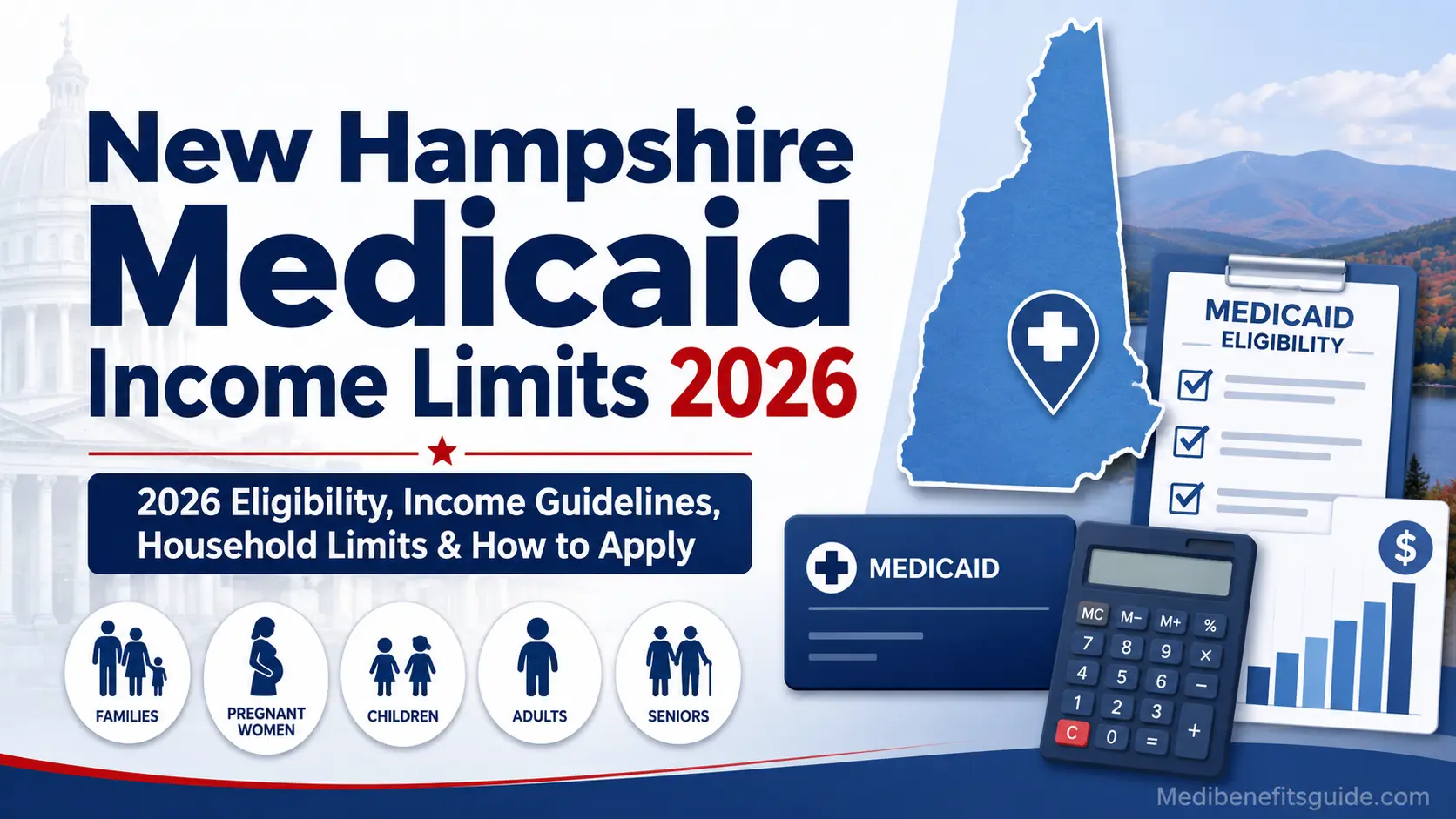
There’s no single Medicaid income number that applies to every person in New Hampshire. New Hampshire Medicaid Income limits depend on your age, household size, pregnancy status, disability status, and which Medicaid program you’re actually applying for. For most adults ages 19–64, the Granite Advantage Health Care Program uses 133% of the Federal Poverty Guideline as its standard — and a 5% income disregard can push the effective threshold to 138%.
The 2026 HHS poverty guideline for one person in the 48 contiguous states is $15,960 a year, or $1,330 a month. New Hampshire builds several of its Medicaid categories directly off that number.
2026 Medicaid Income Limits by Household Size
Here’s how the most common MAGI-based limits break down for 2026:
| Household | 133% FPG | 138% FPG* | 196% FPG | 318% FPG | 323% FPG* |
|---|---|---|---|---|---|
| 1 | $1,769/mo | $1,835/mo | $2,607/mo | $4,229/mo | $4,296/mo |
| 2 | $2,398/mo | $2,489/mo | $3,535/mo | $5,735/mo | $5,825/mo |
| 3 | $3,028/mo | $3,142/mo | $4,462/mo | $7,240/mo | $7,354/mo |
| 4 | $3,658/mo | $3,795/mo | $5,390/mo | $8,745/mo | $8,882/mo |
| 5 | $4,287/mo | $4,448/mo | $6,318/mo | $10,250/mo | $10,411/mo |
*The 138% and 323% columns show what the limit looks like after a 5-percentage-point income disregard kicks in, where that disregard applies. Don’t treat these as universal — they don’t apply to every Medicaid category. Add $5,680 to the federal guideline for each person beyond eight in the household.
Also Compare Medicaid Income Limits by State — MediBenefitsGuide
Why You May See $1,732, $1,769 or $1,835 for One Person
Medicaid tables get confusing fast, and there’s a reason for that. Some sources show the raw eligibility standard. Others show a calculated percentage of the poverty guideline. Others show the effective limit after a disregard has already been applied. Same program, three different-looking numbers.
For Granite Advantage specifically, New Hampshire sets 133% FPG as the income standard, and a 5% disregard can bring the practical threshold to roughly 138%. That gap is exactly why two websites can quote different figures and both be technically right.
The safest move? Don’t anchor to one number you found online. Match your situation to the correct Medicaid category first.
What Is Granite Advantage?
Granite Advantage Health Care Program is New Hampshire’s Medicaid expansion coverage for eligible adults. The state’s expansion population is adults ages 19 through 64, and additional eligibility conditions apply on top of age.
Income here is measured using MAGI — Modified Adjusted Gross Income — not just whatever’s sitting in a bank account.
And working doesn’t knock you out of the running. Employment alone doesn’t disqualify anyone from Medicaid. What matters is whether your income and other factors fit the program’s requirements.
New Hampshire Medicaid Income Limits for Children
Kids play by different rules than adults, and the gap is significant. According to New Hampshire’s Bureau of Family Assistance:
- Children’s Medicaid covers households up to 196% of the federal poverty guideline
- Expanded Children’s Medicaid picks up above 196% and runs up to 318% FPG
- A 5% disregard can stretch that practical ceiling to around 323%
A child can qualify even when a parent’s income is too high for adult Medicaid. That surprises a lot of families.
What About CHIP?
CHIP and children’s Medicaid sit close together but aren’t identical — the eligibility categories differ. Apply through New Hampshire’s Medicaid system directly rather than trying to guess your program from an income chart alone.
New Hampshire Pregnancy Medicaid Income Limit
Pregnancy gets its own lane entirely. New Hampshire sets the ceiling for Pregnant Women Medicaid at 196% of the federal poverty guideline. For a household of one, using the 2026 guideline, that comes out to about $2,607 a month. Your actual household size will determine the exact figure.
Pregnancy also changes how household calculations and coverage periods work. Apply even if your situation doesn’t fit the standard adult Medicaid math — it might not need to.
Does New Hampshire Medicaid Count Savings?
Depends entirely on the category. For most MAGI-based programs — including the adult expansion pathway — assets and savings aren’t counted the way you’d expect. New Hampshire explicitly excludes resources for the Granite Advantage population.
Seniors, people with disabilities, and long-term-care applicants are a different story. Their programs can carry real resource limits.
Assets that might come into play under those programs:
- Bank accounts
- Certificates of deposit
- Stocks and bonds
- Other countable resources
Certain property and personal belongings can be excluded under the applicable rules. So having savings, on its own, doesn’t rule you out of Medicaid.
Medicaid for Seniors and People With Disabilities
Don’t run a straight 138% calculation if you fall into one of these groups — it won’t give you the right answer.
People who are:
- 65 or older
- Blind
- Disabled
- Eligible for Medicare
- Receiving SSI or similar qualifying benefits
- Applying for long-term-care Medicaid
typically fall under non-MAGI Medicaid categories instead. New Hampshire runs several of these: Aid to the Permanently and Totally Disabled (APTD), Aid to the Needy Blind (ANB), MEAD, MOAD, Medicare Savings Programs, and long-term-care Medicaid. Each carries its own income and resource rules.
Medicare and Medicaid
Having Medicare doesn’t automatically shut the door on Medicaid. Low-income Medicare beneficiaries may still qualify for a Medicare Savings Program, which can help cover premiums and cost sharing.
That’s exactly why seniors shouldn’t use the Granite Advantage income limit as their only test — it’s the wrong yardstick.
What Income Counts for Medicaid?
MAGI-based Medicaid leans on federal tax concepts of household income, though the specific treatment comes down to Medicaid’s own rules.
Depending on your situation, you may need to account for:
- Wages
- Self-employment income
- Taxable income
- Social Security
- Other household income
- Certain deductions or exclusions
If you’re self-employed, focus on net self-employment income. Gross business receipts are not the same thing, and using the wrong figure will throw off your estimate.
Because the financial methodology shifts by category, get your final determination from New Hampshire DHHS — not a spreadsheet.
How to Apply for Medicaid in New Hampshire
- Identify your household. Figure out who counts as part of your Medicaid household under the applicable rules.
- Estimate your current income. Pull together pay stubs, tax records, whatever documents your income.
- Choose the right pathway. Age, pregnancy, disability, and Medicare status all shift which category fits you.
- Apply through NH EASY. This is New Hampshire’s electronic benefits system and the primary way to apply for Medical Assistance.
- Submit verification when asked. DHHS may request proof of identity, residency, income, or household details.
- Read your decision carefully. The eligibility notice matters — don’t skim it.
- Appeal if something’s off. If the decision looks wrong, follow the appeal instructions in your notice.
A New Hampshire DHHS District Office can also walk you through this in person.
What If Your Income Is Slightly Over the Limit?
Being a little over one number doesn’t mean you’re out of options. Not even close.
- Check whether an income disregard applies to your category
- See if a different Medicaid category fits better
- Look at children’s or pregnancy coverage separately — they run on different math
- Seniors and disabled applicants should check non-MAGI programs
- Medicare beneficiaries should look into Medicare Savings Programs
- If Medicaid genuinely isn’t available, compare Marketplace coverage through HealthCare.gov
New Hampshire also runs spenddown rules for some Medical Assistance categories. Under the “In and Out” pathway, medical expenses can count toward a required spenddown before coverage starts.
2026 New Hampshire Medicaid Policy Changes
Medicaid is shifting nationally, and Granite Advantage members are directly affected.
Medicaid.gov now lays out an 80-hour monthly community-engagement requirement for people it applies to. Work counts. So does volunteering, certain education programs, and job training. Several groups are exempt — some people with disabilities, people with Medicare, and other protected categories.
Implementation details and individual exemptions vary, so check your official notices. An old article — even this one, eventually — won’t have the final word.
Keep your address, phone number, and email current with Medicaid. Watch your mail and email for notices. If the requirement applies to you, keep records of your qualifying activities.
New Hampshire Medicaid by City
The income limits themselves don’t change based on zip code. Manchester, Nashua, Concord, Portsmouth, Dover, Rochester, Keene, Laconia, Derry, Merrimack, Bedford — same statewide numbers everywhere.
What does vary locally:
- DHHS District Office assistance
- Medicaid enrollment help
- Healthcare providers
- Managed-care networks
- Community organizations
New Hampshire Medicaid Care Management runs through managed-care organizations including WellSense, New Hampshire Healthy Families, and AmeriHealth Caritas New Hampshire.
Quick Eligibility Checklist
Before you sit down to apply, gather:
- Household information
- Current income records
- Social Security information
- Proof of New Hampshire residency
- Immigration or citizenship documentation, if applicable
- Pregnancy information, if applicable
- Medicare information
- Disability information, if applicable
- Asset information, for programs with a resource test
- Recent medical-expense records, if a spenddown might apply
The Bottom Line
There is no single New Hampshire Medicaid income limit for everyone. That’s the part people miss most often.
Adults, children, pregnant women, seniors, people with disabilities, and long-term-care applicants each work under different rules. The 2026 federal poverty guideline is the starting point for several categories — but which percentage applies, and which financial methodology gets used, depends entirely on the program you’re in.
FAQs New Hampshire Medicaid Income Limits
What is the Medicaid income limit for a single person in New Hampshire in 2026?
For Granite Advantage, the standard is 133% of the federal poverty guideline. For one person, that’s about $21,227 annually, or $1,769 monthly, before the 5% disregard is applied.
Can I get Medicaid if I work in New Hampshire?
Yes. Working alone doesn’t disqualify you — it comes down to income, household size, and category. Some Granite Advantage members may also face the new community-engagement requirements in 2026.
Does Social Security count as income for Medicaid?
It can, but the treatment depends on which category you’re in. MAGI and non-MAGI programs calculate this differently.
Can my child qualify if I make too much for Medicaid?
Yes. Children’s Medicaid runs up to 196% FPG, and Expanded Children’s Medicaid goes higher — up to 318%, or roughly 323% after the disregard.
Does Medicaid have an asset limit in New Hampshire?
Not for every program. MAGI-based categories generally skip the resource test. Senior, disability, and long-term-care categories often don’t.
Is Granite Advantage the same as Medicaid?
Granite Advantage is New Hampshire’s Medicaid expansion program for eligible adults, with its own eligibility rules — part of Medicaid, not separate from it.
What happens if my income changes after I qualify?
Report the change to DHHS and respond to any renewal or verification notices. Whether it affects your eligibility depends on the program and how much things shifted.
How do I apply for New Hampshire Medicaid?
Through NH EASY, the state’s online benefits system, or in person at a DHHS District Office. Have your income, household, and identity information ready.
What happens if Medicaid denies my application?
Read the notice closely first. If you think it’s wrong, you can typically appeal — check the notice for your deadline and instructions.
Conclusion
Your Medicaid eligibility in New Hampshire comes down to which category actually fits your life — not a single number you found in a search result. Adults lean on the 133% standard, kids and pregnant women get more room, and seniors and disabled applicants play by an entirely different set of rules.
If you’re not sure where you land, don’t guess. Pull your household size, run your income the right way, check whether asset rules apply to you, and apply through NH EASY or your local DHHS office. That’s the only way to get a real answer instead of an estimate.
Official Resources
- Apply for Medicaid Now — NH EASY
- Check DHHS Eligibility Rules — NH DHHS
- Verify Federal Poverty Guidelines — Medicaid.gov
- Find Marketplace Coverage Options — HealthCare.gov
Disclaimer: This article is for general guidance and is not legal, financial, or benefits guidelines. Medicaid rules and income limits can change. New Hampshire DHHS should be used to confirm your current eligibility and final benefit determination.

About Naseer
Naseer has 10+ years of experience creating informative content and researching medicare topics. He focuses on simplifying Medicaid and benefits details to support readers find clear, reliable, and easy-to-understand guidance.