There’s no single number that determines whether you qualify for Montana Medicaid Income Limits. Your eligibility hinges on household size, income, age, pregnancy status, disability, and which Medicaid category actually applies to you.
For adults ages 19–64 covered through Montana Medicaid Expansion, DPHHS’s official administrative standard is 133% of the Federal Poverty Level (FPL). You’ll also see the expansion population described publicly as roughly 138% FPL — that’s not a contradiction, it reflects the federal 5% income disregard built into MAGI-based Medicaid eligibility.
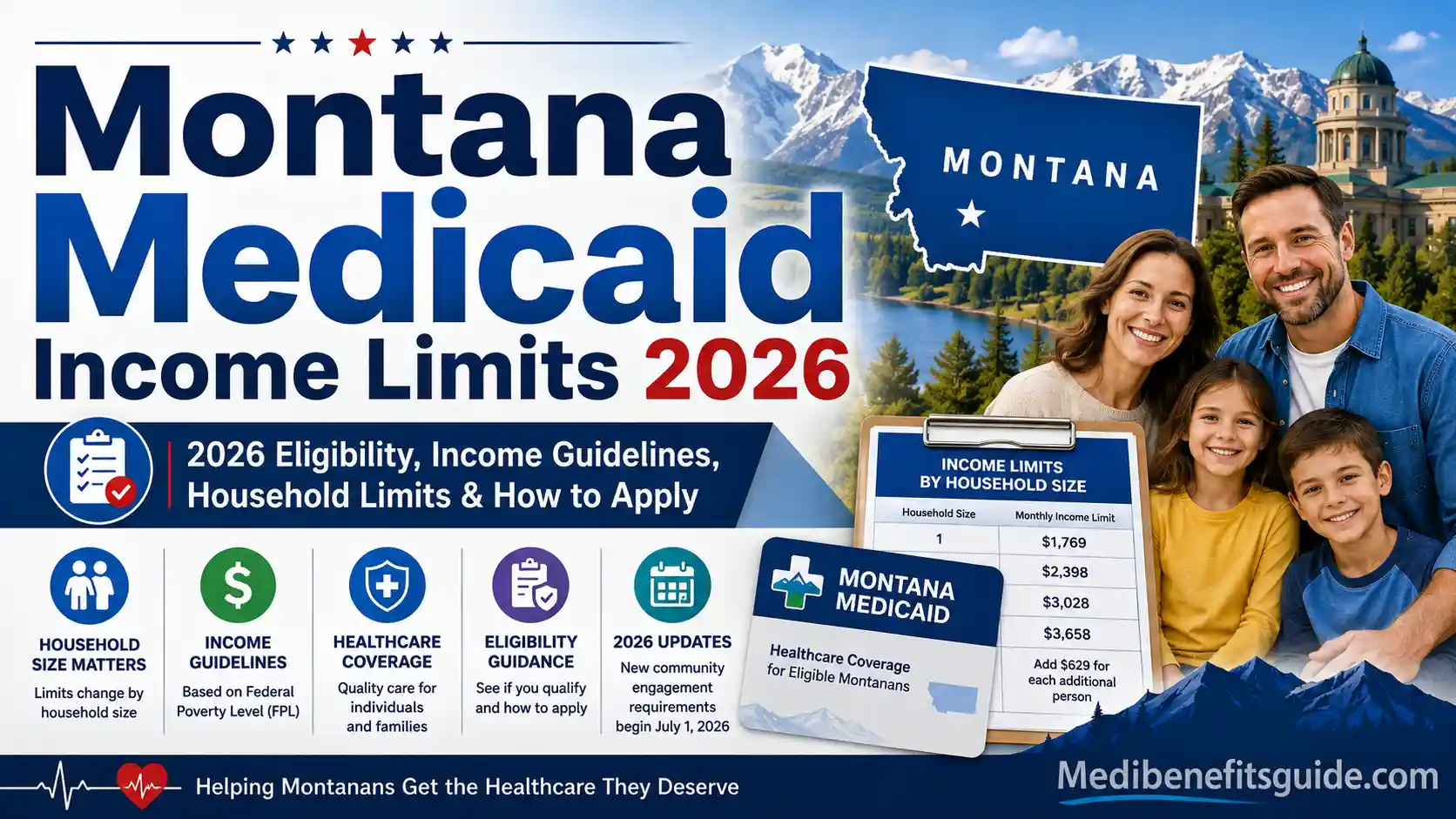
Montana Medicaid adult income limits by household size
These ACA Adult Medicaid standards took effect April 1, 2026:
| Household size | Monthly income limit |
|---|---|
| 1 | $1,769 |
| 2 | $2,398 |
| 3 | $3,028 |
| 4 | $3,658 |
| 5 | $4,287 |
| 6 | $4,917 |
| 7 | $5,546 |
| 8 | $6,176 |
| 9 | $6,805 |
| 10 | $7,435 |
| 11 | $8,064 |
Straight from Montana DPHHS’s official ACA Adult Medicaid standard of 133% FPL. Make a household of four: the monthly income standard lands at $3,658.
Why Do Some Websites Say 138% While Montana Says 133%?
This trips up more applicants than almost anything else in Montana Medicaid. DPHHS’s official ACA Adult Medicaid table lists 133% FPL as the administrative standard. But federal Medicaid guidance builds in an income disregard equivalent to 5% of FPL for MAGI-based rules.
So DPHHS also describes the Medicaid Expansion population as having income up to approximately 138% FPL. Neither number is wrong. One is the state’s administrative standard. The other reflects how the MAGI disregard gets described publicly. Same eligibility rule, two ways of talking about it.
For an actual eligibility decision, go with Montana DPHHS’s current standards — not a generic FPL calculator you found online.
Also Compare Medicaid Income Limits by State — MediBenefits Guide
Who Qualifies for Montana Medicaid?
Montana runs several Medicaid pathways, and your income limit depends entirely on which one applies to you.
- Adults ages 19–64
- Children under 19
- Pregnant women
- Parents and caretaker relatives
- People who are aged, blind, or disabled
- Medicare beneficiaries who qualify for Medicare Savings Programs
- People needing long-term-care or nursing-facility services
- Certain individuals receiving specialized Medicaid coverage
There’s no such thing as one universal Montana Medicaid income limit. That’s the whole reason this gets confusing.
Montana Medicaid for Adults: HELP Program
Montana Medicaid Expansion runs through the Montana Health and Economic Livelihood Partnership (HELP) Program.
Adults ages 19–64 qualify when they meet the nonfinancial requirements and their household income falls within the ACA Adult Medicaid standard. DPHHS uses 133% FPL for this group.
New 2026 community engagement requirement
Starting July 1, 2026, certain Medicaid Expansion adults face a new community engagement requirement. Non-excluded adults ages 19–64 generally need 80 hours a month of qualifying activities. That can include:
- Paid employment
- Community service or volunteering
- Approved workforce training
- Job-readiness programs
- Internships or apprenticeships
- School
- A combination of qualifying activities
Someone could, for example, work 60 hours and log 20 hours of community service — the mix is flexible. Not everyone falls under this requirement. Exclusions, exceptions, and short-term hardship provisions exist too.
2026 hold-harmless period
July through September 2026 is a hold-harmless period. DPHHS reviews compliance during these months, but nobody gets denied or disenrolled solely for missing the community engagement requirement — not yet.
That changes in October 2026, when failing to meet the requirement can start affecting eligibility or continued coverage.
Montana Medicaid Income Limits for Children
Kids play by different rules than adults do here. Federal Medicaid data puts Montana’s child Medicaid eligibility at 143% FPL. HMK/CHIP coverage extends further, up to 261% FPL.
HMK Plus vs. HMK
HMK Plus is Montana Medicaid coverage for eligible children. Healthy Montana Kids (HMK), on the other hand, covers kids through Montana’s CHIP-related program — for families whose income is too high for Medicaid but still within HMK limits.
So a child whose family earns too much for HMK Plus isn’t necessarily out of options. HMK may still cover them.
Pregnancy Medicaid in Montana
Pregnancy Medicaid has its own income threshold, separate from everything above. The federal Medicaid eligibility table lists 157% FPL for pregnant women in Montana.
Pregnancy also changes how household size gets calculated — an unborn child can count toward household size under applicable Medicaid rules. Montana also offers postpartum coverage, though the eligibility window and coverage period depend on the specific category and current state rules.
Do Montana Medicaid Applicants Have an Asset Limit?
Depends entirely on your category. Most MAGI-based groups — ACA Medicaid Expansion included — skip the traditional asset test. Your savings account isn’t treated the way it would be under aged, blind, disabled, or long-term-care Medicaid categories.
But asset and resource rules absolutely apply to non-MAGI programs, including some senior, disability, and long-term-care pathways.
If you’re 65 or older, disabled, applying for nursing-home Medicaid, or seeking Medicare Savings Programs — don’t assume adult Medicaid rules apply to you. They don’t.
What Income Counts for Montana Medicaid?
Many adult and family Medicaid categories run on Modified Adjusted Gross Income (MAGI). Depending on the program, countable income can include:
- Wages and salaries
- Self-employment income
- Taxable Social Security income
- Other taxable income
How income gets treated varies by category. Don’t assume every dollar you receive counts, and don’t assume every dollar is excluded either. Seniors, people with disabilities, and long-term-care applicants often fall under different Medicaid income methodologies entirely.
What If Your Income Is Slightly Over the Limit?
Going over one Medicaid threshold doesn’t mean you’re out of options.
You might still qualify for:
- HMK or HMK Plus, if the applicant is a child
- Pregnancy-related Medicaid
- A disability-related Medicaid category
- Medicare Savings Programs
- Plan First
- Marketplace coverage
- Another Medicaid eligibility pathway
The real first step isn’t comparing your income to one adult Medicaid number. It’s figuring out which eligibility category actually fits your situation.
Medicaid vs. HMK vs. HMK Plus
| Program | General purpose |
|---|---|
| Montana Medicaid/HELP | Coverage for eligible adults and other Medicaid groups |
| HMK Plus | Medicaid coverage for eligible children |
| HMK | Children’s CHIP-related coverage |
| Plan First | Family-planning services for eligible individuals |
| Medicare Savings Programs | Helps qualifying Medicare beneficiaries with certain Medicare costs |
Income standards and nonfinancial requirements shift from program to program.
How to Apply for Montana Medicaid
The application process starts through Montana’s public assistance system.
- Identify your eligibility category. Adult, child, pregnant, senior, disabled — figure out where you fit.
- Determine household size. The rules here can shift depending on the program.
- Estimate countable income. Use the rules specific to your category, not a generic guideline.
- Gather documentation. ID, income records, household information, and anything else requested.
- Submit your application.
- Respond to verification requests. DPHHS may come back asking for more.
- Read your notices carefully. They spell out eligibility decisions and deadlines.
- Complete renewal requirements. Keep your contact info current and respond when renewal time comes.
Montana Medicaid Help Across the State
DPHHS administers Montana Medicaid statewide, but help looks local. Anyone searching for Medicaid assistance in Billings, Missoula, Bozeman, Helena, Great Falls, Kalispell, Butte, Havre, Miles City, or elsewhere should start with statewide DPHHS resources or their local Office of Public Assistance.
Common local searches include:
- Montana Medicaid office near me
- Medicaid enrollment assistance Montana
- Medicaid providers near me
- Office of Public Assistance near me
- Montana Medicaid application assistance
Eligibility standards stay the same statewide. What varies is the local assistance and provider network you’ll actually deal with.
Common Montana Medicaid Mistakes to Avoid
- Don’t use an outdated 2025 income table
- Don’t assume every applicant falls under the adult 133% standard
- Don’t confuse HMK Plus with HMK — they’re not the same program
- Don’t automatically assume your savings disqualify you
- Don’t ignore pregnancy-related eligibility if it applies
- Don’t overlook disability or Medicare-related pathways
- Don’t confuse 133% FPL with the approximately 138% public description of Medicaid Expansion
- Don’t ignore DPHHS notices — deadlines are real
- If the 2026 community engagement requirement applies to you, keep proof of your qualifying activities
FAQs About Montana Medicaid Income Limits
What is the Montana Medicaid income limit for one person in 2026?
For ACA Adult Medicaid, the April 1, 2026 standard is $1,769 per month for a household of one, based on 133% FPL. Other categories have different limits.
What is the Montana Medicaid income limit for a family of four?
$3,658 per month under ACA Adult Medicaid, effective April 1, 2026. That figure changes if the household applies under a different category.
What is 138% of the federal poverty level in Montana?
DPHHS describes Medicaid Expansion as approximately 138% FPL publicly, while its official ACA Adult table uses 133% FPL administratively. The gap comes from the MAGI 5% income disregard.
Does Montana Medicaid count savings?
For most MAGI-based categories, no traditional asset test applies. Resource rules kick in for aged, blind, disabled, and long-term-care Medicaid categories though.
Can I work and still receive Montana Medicaid?
Yes. Employment alone won’t disqualify you. Your income still needs to meet the applicable limits, and some Medicaid Expansion adults ages 19–64 also need to meet the 2026 community engagement requirement.
What is the Montana pregnancy Medicaid income limit?
157% FPL, according to federal Medicaid eligibility data. Pregnancy-related eligibility runs on different rules than the standard adult pathway.
What is HMK Plus?
Montana Medicaid coverage for eligible children. Federal data lists Montana’s child Medicaid level at 143% FPL, with HMK/CHIP reaching a higher income threshold for kids who don’t qualify for HMK Plus.
How many hours are required for Montana Medicaid in 2026?
80 hours per month of qualifying activities for certain non-excluded Medicaid Expansion adults ages 19–64, starting July 1, 2026.
What happens if I do not meet the 80-hour requirement?
Nothing yet, during the July–September 2026 hold-harmless period. Starting October 2026, missing the requirement can lead to denial or disenrollment, subject to exclusions and protections that may apply to you.
Conclusion
Montana Medicaid isn’t one program with one income limit — it’s a set of pathways, and the one that matters is whichever one fits your life. For ACA Adult Medicaid, the April 1, 2026 standard runs from $1,769 a month for one person up to $7,435 for a household of ten, built on 133% FPL.
Kids, pregnant women, seniors, people with disabilities, Medicare beneficiaries, and long-term-care applicants all play by different rules. If any of that applies to you, don’t lean on the adult numbers.
And if you’re an adult on Medicaid Expansion, keep an eye on that 80-hour community engagement requirement heading into October 2026. The hold-harmless period won’t last forever — get ahead of it now.
Official Resources
- Apply for Montana Medicaid — Montana DPHHS
- Check HMK & HMK Plus Eligibility — Healthy Montana Kids
- Verify Federal Poverty Level Guidelines — Medicaid.gov
- Find Marketplace Coverage Options — Healthcare.gov
Short disclaimer: Medicaid eligibility policies and income guidelines can change. The figures above are based on current 2026 information from Montana DPHHS and federal Medicaid sources; DPHHS makes the final eligibility determination for an individual application.

About Naseer
Naseer has 10+ years of experience creating informative content and researching medicare topics. He focuses on simplifying Medicaid and benefits details to support readers find clear, reliable, and easy-to-understand guidance.