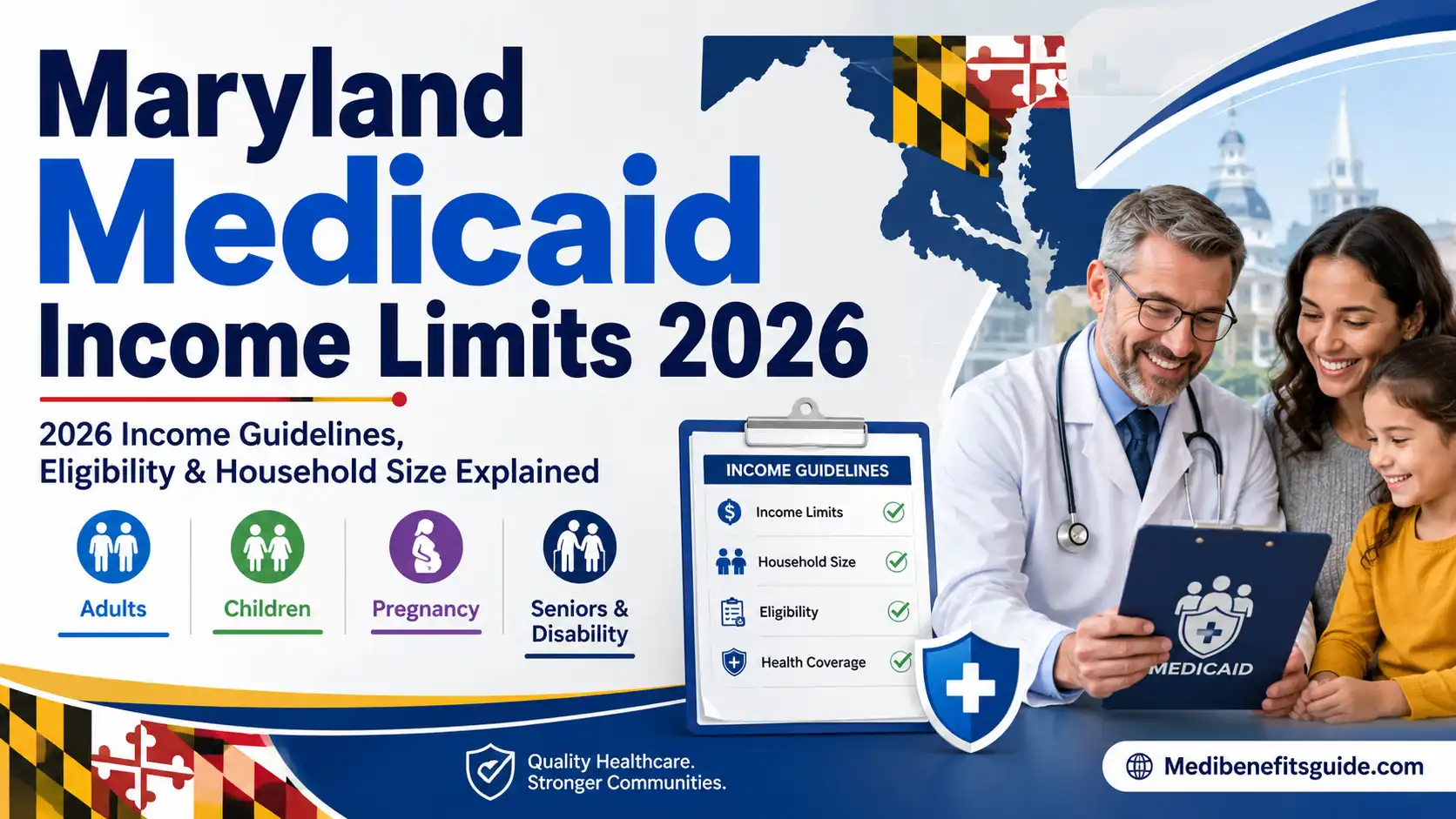
Maryland Medicaid Income Limits— officially called Medical Assistance — doesn’t use one set of rules for everyone. Your income limit depends entirely on which suitable group you fall into. For most people applying through Maryland Health Connection, the 2026 monthly limit for a single adult sits at $1,835, and it climbs from there as household size grows. Children and pregnant applicants play by different numbers entirely.
These figures took effect February 1, 2026. And here’s the thing worth remembering before you do any math on your own: income alone doesn’t decide eligibility. The Maryland Department of Health is blunt about this — applying is the only real way to find out where you stand.
Maryland Medicaid Income Limits 2026 by Household Size
Below are the current monthly limits for adults, children, and pregnant applicants through Maryland Health Connection.
Household Size Adults Children Pregnant
1 $1,835 $4,283 N/A
2 $2,490 $5,809 $4,763
3 $3,142 $7,332 $6,011
4 $3,795 $8,855 $7,260
5 $4,449 $10,381 $8,511
6 $5,102 $11,904 $9,760
7 $5,755 $13,427 $11,009
8 $6,409 $14,954 $12,260
These numbers are monthly, effective February 1, 2026. Being above one of these figures doesn’t automatically shut the door — Maryland allows exceptions to countable income, so a number that looks disqualifying on paper isn’t always the final word.
What is the Medicaid Income Limit for One Person in Maryland?
$1,835 a month. That’s the 2026 threshold for a single adult applying through the standard Medicaid category. Children, pregnant applicants, seniors, and people with disabilities each fall under separate rules — so this number won’t apply across the board.
What is the Maryland Medicaid Limit for a Family of Four?
For a household of four: $3,795 monthly for adults, $8,855 for children, and $7,260 for pregnant applicants. Three different numbers, one household size — which is exactly why category matters more than headcount alone.
You can also Compare Your State’s Medicaid Eligibility Rules
Which Maryland Medicaid Income Limit Applies to You?
Don’t assume a single number applies to your entire family. It rarely does.
Adults
Adult eligibility through Maryland Health Connection scales with household size. A one-person household tops out at $1,835 a month. Four people in the household? The ceiling rises to $3,795.
Children and MCHP
Kids qualify at noticeably higher income levels than adults do. Maryland also runs the Maryland Children’s Health Program (MCHP) alongside standard Medicaid — and a child can land coverage under one of these even when a parent doesn’t qualify for anything at all.
Pregnancy
Pregnant applicants get their own income category, and it’s more generous than the standard adult track. A two-person household can earn up to $4,763 a month; for four people, that limit jumps to $7,260.
Pregnancy can also reshape how household size gets calculated in the first place. Given how specialized these rules get, don’t lean on a simple table comparison — use the official application to get a real answer.
How Does Maryland Calculate Medicaid Household Income?
Most children, pregnant applicants, and adults going through Maryland Health Connection are evaluated using MAGI — Modified Adjusted Gross Income.
Countable income under MAGI can pull from several sources, depending on your situation:
- Wages and salary
- Self-employment income
- Tips and commissions
- Certain Social Security income
- Other taxable or countable income
Household composition matters just as much as income sources do. Tax filing status, spouses, dependents, children living in the home — all of it can shift how your MAGI household gets defined.
Here’s the mistake people make constantly: comparing a paycheck straight against the table and assuming that settles it. It doesn’t. Maryland carves out exceptions to countable income, and MAGI rules don’t match non-MAGI rules at all.
Does Maryland Medicaid Count Savings and Assets?
For MAGI-based Medicaid, no — there’s no resource test like the one applied to aged, blind, disabled, or long-term-care categories.
Those categories are a different animal. If eligibility runs through age 65+, blindness, disability, or a need for long-term services and supports, Maryland applies separate income and asset limits entirely.
For 2026, here’s what one specific aged, blind, or disabled category looks like:
Household Size Monthly Income Asset Limit
1 $350 $2,500
2 $392 $3,000
Don’t mistake this for a universal “senior Medicaid limit.” It isn’t. Other programs run on different rules, and exceptions exist throughout.
Medicaid for Seniors and People With Disabilities
Income is only part of the picture for seniors and people with disabilities. Maryland may also require:
- Age requirements
- Disability or medical requirements
- Income requirements
- Asset requirements
- Technical eligibility rules
- Level-of-care requirements for certain programs
One shortcut worth knowing: if you already receive Supplemental Security Income (SSI), you’re already Medicaid-eligible under Maryland’s rules. No separate application needed.
Employed Individuals with Disabilities Program
The Employed Individuals with Disabilities (EID) Program exists for a specific problem — workers with disabilities who’d otherwise lose Medicaid the moment their earnings climbed too high.
There’s no maximum income limit under EID. That’s not a typo. An asset limit still applies, along with other requirements: applicants generally need to be at least 16 but under 65, working for pay, meeting disability criteria, living in Maryland, and satisfying whatever else the program requires.
Can You Get Maryland Medicaid If You Work?
Yes. Full stop. Working doesn’t knock you out of Medicaid automatically — eligibility still comes down to coverage group, household size, countable income, and the other applicable requirements.
Someone earning above the standard threshold might still qualify through another pathway, EID among them. And if your income shifts, report it. Don’t assume a change means instant cancellation.
How to Apply for Maryland Medicaid
Applications go through Maryland Health Connection. The process breaks down like this:
- Identify your household — include everyone required under the applicable rules.
- Gather income information, including recent pay records.
- Apply through Maryland Health Connection.
- Answer questions covering age, pregnancy, disability, and citizenship or qualified immigration status.
- Submit verification documents if Maryland requests them.
- Review any notices that come back from Maryland Health Connection.
- Complete enrollment, and if it applies, select a HealthChoice managed care organization.
You can apply anytime. Maryland is clear that the application itself — not a table, not a guess — is what determines eligibility.
What If Your Income Is Too High?
One published number doesn’t mean you’re out of options. Depending on your circumstances, you might still qualify for:
- Medicaid under another coverage group
- MCHP for an eligible child
- EID
- Medicare Savings Programs
- Long-term-care Medicaid
- Home and Community-Based Services
- Marketplace coverage if Medicaid isn’t available
Which one fits depends on age, household, disability status, pregnancy, Medicare coverage, income, assets, and health needs — a lot of variables, and no shortcut around checking each one.
Maryland Medicaid Income Limits and HealthChoice Are Not the Same Thing
Medicaid is the coverage program itself. HealthChoice is how most Medicaid members in Maryland actually receive care — it’s the state’s managed-care system.
Once Medicaid eligibility is confirmed, members often need to pick a HealthChoice managed care organization (MCO).
This choice isn’t just paperwork — provider networks differ from plan to plan, sometimes significantly.
Before booking anything, confirm the provider actually accepts your specific Medicaid coverage and HealthChoice plan.
How to Find a Maryland Medicaid Provider Near You
Access matters as much as eligibility. You might be searching for:
- Medicaid doctors in Baltimore
- Medicaid dentists in Maryland
- Medicaid providers in Montgomery County
- Medicaid doctors in Annapolis
- Medicaid providers in Prince George’s County
- Medicaid specialists near you
A general “accepts Medicaid” label isn’t enough. Verify the provider against your specific plan and location before you count on them.
Healthcare professionals and organizations looking to enroll or verify their own status can find those resources through the Medicaid program as well.
Important Maryland Medicaid Changes in 2026 and 2027
Federal policy is reshaping Maryland Medicaid right now, and the timeline matters.
Changes affecting certain non-citizens begin October 2026. Then in January 2027, some adults ages 19–64 face new requirements — approved activities totaling at least 80 hours a month, plus more frequent renewals, unless an exemption applies.
Not everyone gets swept into this.
Exemptions can cover children, adults 65 and older, pregnant individuals, people with disabilities, and certain caregivers or people with serious health conditions. Members affected by the new rules should expect to hear from Maryland directly about what’s required.
Given how fast this is moving, don’t rely on 2025 or early-2026 information. Check current guidance.
Quick Eligibility Checklist
Before you apply, run through this:
- Am I a Maryland resident?
- What is my household size?
- What coverage group applies to me?
- What is my countable monthly income?
- Am I pregnant?
- Is the application for a child?
- Am I 65 or older?
- Do I have a qualifying disability?
- Do I receive Medicare or SSI?
- Could an asset test apply?
- Has my income recently changed?
- Have I received a Maryland Medicaid renewal notice?
Residency, appropriate citizenship or qualified immigration status, and the relevant financial and technical requirements — Maryland expects all of it.
Common Maryland Medicaid Mistakes to Avoid
Using outdated income limits. The current table is effective February 1, 2026 — anything older is stale.
Applying the adult limit to everyone. Children, pregnant applicants, seniors, and people with disabilities all play by different numbers.
Assuming savings always disqualify you. MAGI-based Medicaid skips the asset test that non-MAGI categories use.
Assuming income over the table means automatic denial. It doesn’t. Exceptions to countable income exist for a reason.
Assuming every Medicaid doctor accepts your plan. Provider participation hinges on your HealthChoice MCO and its network — always confirm first.
FAQs About Maryland Medicaid Income Limits
What are the Maryland Medicaid income limits for 2026?
$1,835 a month for a single adult household. Larger households and different coverage groups have their own limits.
How much can a family of four make for Maryland Medicaid?
$3,795 a month under the adult category. Children and pregnancy categories run higher.
Can I get Medicaid if I make $2,000 a month in Maryland?
Possibly. That’s above the standard one-person adult limit, but your coverage group, household situation, and any applicable exceptions could still open the door.
Does Maryland Medicaid count bank savings?
Depends on the category. MAGI applicants generally skip the asset test that certain aged, blind, disabled, or long-term-care programs require.
Can my child qualify if I do not qualify for Medicaid?
Yes — Maryland states this directly. A child can qualify for Medicaid or MCHP regardless of a parent’s eligibility.
Does pregnancy change Medicaid household size?
It can. Pregnancy comes with its own income category and its own household-size rules, which is exactly why the official application matters more than a table lookup.
Can seniors qualify for Maryland Medicaid?
Yes, but through specific categories involving income, assets, medical or technical requirements, and sometimes long-term-care criteria.
How do I apply for Maryland Medicaid?
Through Maryland Health Connection, any time. Provide what’s requested, complete verification if asked, and wait for a determination.
What happens if my Medicaid income changes?
Report it through the proper channel and follow whatever notice you receive. A change in income — up or down — doesn’t automatically end your coverage.
What is HealthChoice?
Maryland’s Medicaid managed-care program. Once eligible, you’ll likely select or be assigned an MCO, and it’s on you to confirm your preferred providers are actually in that network.
Conclusion
Numbers on a table only tell part of the story. Maryland’s Medicaid system is built around categories, exceptions, and circumstances that a chart simply can’t capture — which is exactly why so many people who assume they don’t qualify actually do.
If you’re anywhere close to these limits, don’t talk yourself out of applying. Fill out the application, let Maryland Health Connection sort out the category, and get the real answer instead of guessing at one.
Official Resources
- Apply Now — Maryland Health Connection
- Check Eligibility Rules — Maryland Department of Health
- Find a HealthChoice Plan — Maryland Medicaid
- Verify Federal Guidelines — Medicaid.gov
Disclaimer: This article is for general educational guidance only and does not guarantee Medicaid acceptability. Maryland income limits and program policies can change. For an official determination, apply through Maryland Health Connection and review current Maryland Department of Health guidance.

About Naseer
Naseer has 10+ years of experience creating informative content and researching medicare topics. He focuses on simplifying Medicaid and benefits details to support readers find clear, reliable, and easy-to-understand guidance.