Connecticut Medicaid income limits run through HUSKY Health, and here’s the thing people get wrong right away: there’s no single income number that decides who qualifies. It depends on which HUSKY program you’re looking at, how many people are in your household, your age, whether you’re pregnant, disabled, already on Medicare, and a few other variables that shift the math.
For 2026, Connecticut DSS published its HUSKY income guidelines effective March 1. The programs that matter most for income-based eligibility are HUSKY A, HUSKY B, and HUSKY D.
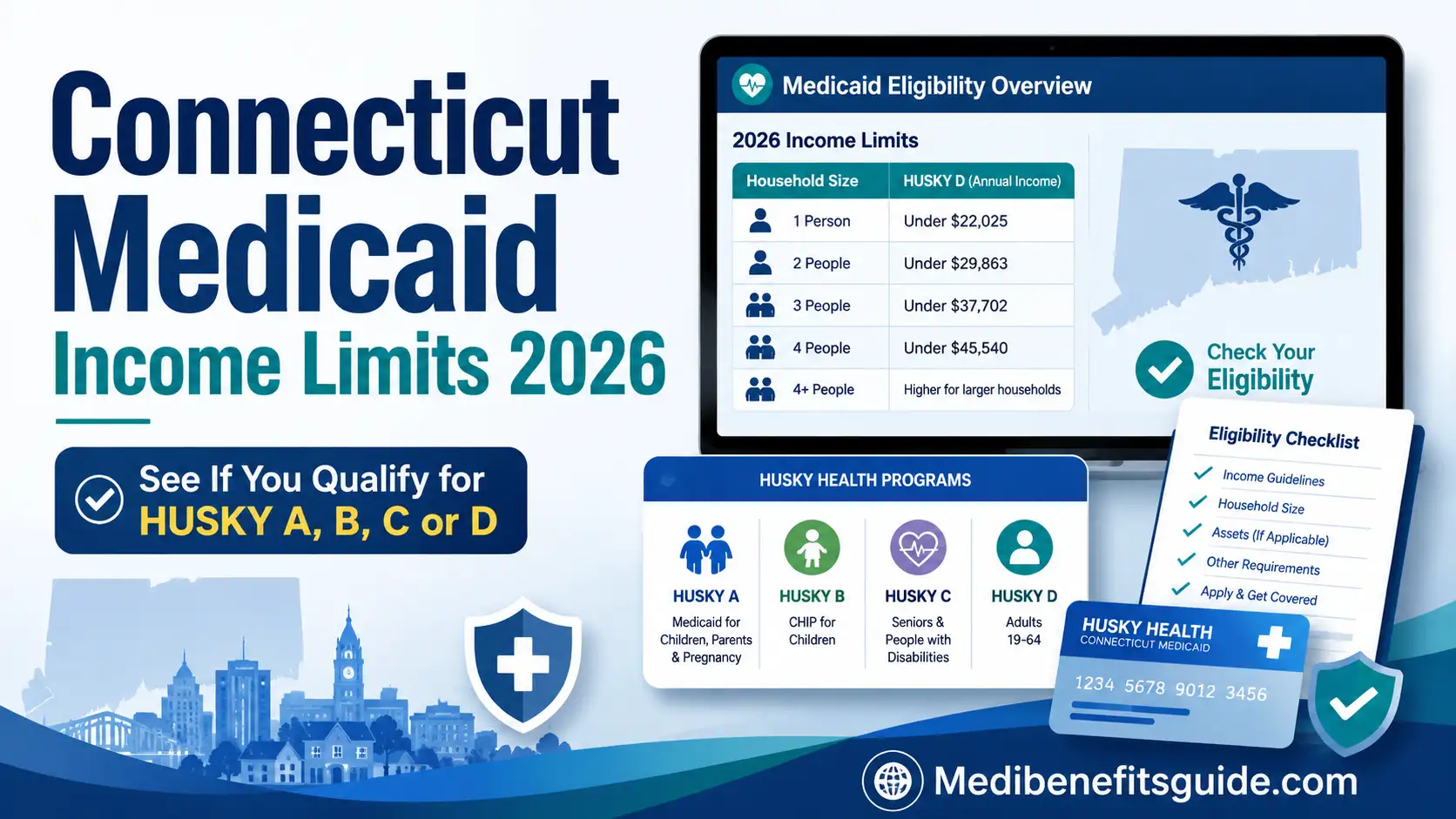
Quick answer: Connecticut Medicaid income limits vary by HUSKY program and household size. HUSKY D allows annual income under $22,025 for one person in 2026. Children, pregnant individuals, and parents or caretakers can qualify at much higher income levels through HUSKY A or B.
Connecticut HUSKY Income Limits for 2026
These figures come straight from the Connecticut Department of Social Services’ HUSKY Health annual income chart, effective March 1, 2026.
| HUSKY program | Household size 1 | 2 | 3 | 4 | 5 | 6 |
|---|---|---|---|---|---|---|
| HUSKY D | Under $22,025 | Under $29,863 | Under $37,702 | Under $45,540 | Under $53,378 | Under $61,217 |
| HUSKY A – children | Under $32,080 | Under $43,496 | Under $54,913 | Under $66,330 | Under $77,747 | Under $89,164 |
| HUSKY A – pregnant | — | Under $56,913 | Under $71,852 | Under $86,790 | Under $101,728 | Under $116,667 |
| HUSKY A – parents/caretakers | — | Under $29,863 | Under $37,702 | Under $45,540 | Under $53,378 | Under $61,217 |
| Household definitions and income methodology aren’t identical across these programs. Treat this table as a screening tool. It tells you where you likely stand — not whether you’re actually approved. |
Which HUSKY Program Might Apply to You?
Start with who actually needs the coverage. That one question narrows things fast.
HUSKY A
HUSKY A covers qualifying children, parents and caretaker relatives, and pregnant individuals.
Pregnancy gets its own, higher income standard — and here’s a detail people miss: the unborn child counts as a household member when determining eligibility for that pregnancy category.
HUSKY B
HUSKY B isn’t traditional Medicaid. It’s Connecticut’s CHIP program, built for kids whose household income lands above the HUSKY A cutoff.
For 2026, there are two HUSKY B income bands. Band 1 has no monthly premium, though copayments may apply. Band 2 runs $30 a month for one child, $50 for more than one, plus some copayments on top.
This matters more than people realize. Being above the HUSKY A limit doesn’t mean your child goes without coverage.
HUSKY C
HUSKY C serves Connecticut residents who are generally 65 or older, or who have a qualifying disability. It doesn’t follow the MAGI-based rules that govern HUSKY A, B, and D — it runs on its own track entirely.
Don’t borrow the HUSKY D number for a HUSKY C situation. Asset and resource rules come into play here, especially for long-term services and supports, nursing-home Medicaid, and home- and community-based services.
HUSKY D
HUSKY D covers adults ages 19 to 64 who typically don’t have dependent children in the household, aren’t pregnant, and don’t have Medicare.
For 2026, that’s under $22,025 a year for one person. For a household of four, under $45,540.
You can also See Medicaid Income Limits by State — MediBenefits Guide
How Household Size Affects Connecticut Medicaid Eligibility
Household size moves the threshold a lot. Look at HUSKY D alone: the annual limit climbs from under $22,025 for one person to under $45,540 for a household of four.
But don’t assume everyone living at your address automatically counts as your Medicaid household. Tax relationships, spouses, children, and other factors shape household composition differently depending on the program.
A Practical Eligibility Check
- Identify the person applying.
- Determine whether they’re a child, parent/caretaker, pregnant, age 65+, disabled, or an adult 19–64.
- Determine the applicable HUSKY category.
- Establish the appropriate household size.
- Review the current Connecticut DSS income chart.
- Determine what income is countable under that program.
- Check asset/resource rules when applicable.
- Submit an application for an official determination.
What Income Counts for Connecticut Medicaid?
A lot of people assume Medicaid eligibility just means holding your gross paycheck up against one number. It’s not that simple.
Connecticut DSS notes that some income doesn’t count, and certain expenses can be deducted — the exact methodology depends on which program you’re applying under.
For most MAGI-based programs, Modified Adjusted Gross Income and household composition drive the calculation. HUSKY C and other specialized pathways play by different rules.
Income questions commonly touch on:
- Wages and employment earnings
- Self-employment income
- Social Security benefits
- Unemployment compensation
- Pensions
- Other countable income
- Certain deductions or exclusions
If your income swings month to month, keep your documentation. Don’t let one unusually high or low paycheck skew the picture.
Also Check Connecticut Medicaid Rates
Does Connecticut Medicaid Have an Asset Limit?
No single asset rule covers every HUSKY program — that’s the short version.
This matters especially when you’re comparing MAGI Medicaid against HUSKY C, disability-related Medicaid, or long-term-care programs. The rules simply aren’t uniform.
Savings and other resources can matter a great deal, or barely at all, depending on the pathway. Don’t assume a bank balance disqualifies you automatically. Don’t assume it’s irrelevant either.
What If Your Income Is Too High for Medicaid?
Missing one threshold doesn’t end the search for affordable coverage. A few paths forward, depending on who you are:
If the Applicant Is a Child
Check HUSKY B. CHIP can cover kids whose household income sits above the HUSKY A range.
If You’re an Adult Ages 19–64
Look at Covered Connecticut through Access Health CT. For 2026, it generally serves residents with household income up to 175% of the Federal Poverty Level, subject to additional requirements.
If You Have a Qualifying Disability and Work
MED-Connect exists for exactly this. It’s Connecticut’s Medicaid program for employees with medically certified disabilities or blindness who work for pay.
If You Have Medicare
Connecticut’s Medicare Savings Programs, including QMB, SLMB, and ALMB, can help with certain Medicare-related costs.
Can You Get Connecticut Medicaid If You Work?
Yes. Working doesn’t automatically knock you out of HUSKY Health.
What actually matters is how your earnings get treated under your specific program. A working parent, a working teenager, a pregnant employee, a disabled worker, and a childless adult all face different rules for the same paycheck.
MED-Connect deserves a special mention here — it’s built specifically as a Medicaid pathway for disabled workers who want to stay employed without losing coverage.
How to Apply for HUSKY Health
Once you’ve figured out the likely program, the process generally looks like this:
- Identify the correct coverage pathway.
- Prepare household and income information.
- Gather supporting documents — identification, income records, anything else requested.
- Submit an application through the appropriate Connecticut enrollment channel.
- Respond to verification requests.
- Review the eligibility decision.
- Report relevant changes and complete renewals when required.
One thing worth remembering: the final call comes from the state eligibility system. Not a calculator, not a blog post, not an income-limit table.
2026 vs. 2027: Important HUSKY D Changes
If you’re on HUSKY D now, or planning to apply, 2027 brings changes worth flagging early.
Starting January 1, 2027, HUSKY D adults ages 19–64 who don’t live with a child under 14 and are able to work will face new work requirements. Qualifying activities include working, earning at least the specified monthly amount, education, training, community service, or other approved options.
HUSKY D renewals will also shift from annual to every six months, effective the same date.
Connecticut has also outlined changes to retroactive coverage for applications submitted starting January 1, 2027, while certain immigration-related eligibility changes take effect October 1, 2026.
Policy shifts like these move fast. Check current DSS guidance before you apply or renew.
Why You May See Different Medicaid Income Numbers Online
This trips up more people than almost anything else in this article.
Different sites show different numbers because they’re pulling from different effective dates, different federal poverty-level calculations, rounded estimates, outdated Connecticut standards, the wrong HUSKY program, or monthly figures mixed up with annual ones.
For 2026 eligibility, start with Connecticut DSS’s published HUSKY chart for the HUSKY A, B, or D threshold that applies to you. DSS updates these figures annually.
Don’t reverse-engineer a Connecticut number from a generic FPL percentage — DSS has already published the exact figure. Use it.
Where Connecticut Residents Can Get Help
Connecticut Medicaid rules apply statewide — Hartford, New Haven, Bridgeport, Stamford, Waterbury, Norwalk, Danbury, Greenwich, and everywhere in between.
The income standards don’t change because you live in Hartford County versus Fairfield County versus New Haven County. What does change locally is access to enrollment help, DSS offices, healthcare providers, and community resources.
For official eligibility information, go to Connecticut DSS and Access Health CT directly. Skip the third-party calculators when it counts.
FAQs About Connecticut Medicaid Income Limits
What is the Connecticut Medicaid income limit for 2026?
There’s no single statewide limit. HUSKY D’s 2026 limit is under $22,025 annually for one person, while HUSKY A and B use different standards based on household and applicant category.
How much can a single person make to qualify for Medicaid in Connecticut?
For HUSKY D, a one-person household needs annual income under $22,025 under the March 1, 2026 DSS chart. Other pathways use different rules.
What is the Medicaid income limit for a family of four?
Depends on the program. For 2026, HUSKY D’s limit for four people is under $45,540. HUSKY A’s children and pregnancy categories run substantially higher.
Can I get HUSKY if I work?
Yes. Employment doesn’t automatically disqualify you. Your income gets evaluated under the rules for your specific program.
Is HUSKY B Medicaid?
No — it’s Connecticut’s CHIP program, separate from traditional Medicaid, covering kids whose household income generally sits above the HUSKY A range.
Does pregnancy increase the Connecticut Medicaid income limit?
Yes. Connecticut publishes a separate HUSKY A pregnancy standard, and the unborn child counts as a household member for that eligibility category.
What happens if my income is too high for HUSKY D?
You may still qualify elsewhere. Look at Covered Connecticut, Access Health CT marketplace coverage, MED-Connect, or a Medicare Savings Program depending on your situation.
Does Connecticut Medicaid count savings?
It depends on the program. MAGI-based HUSKY programs and HUSKY C don’t share identical financial rules, so check asset eligibility under your specific program.
What is MED-Connect?
Connecticut Medicaid for employees with disabilities — designed for people with a medically certified disability or blindness who work for pay, with its own income and asset rules.
When do HUSKY D work requirements begin?
January 1, 2027, for affected adults. Qualifying activities include work, education, training, and community service.
Conclusion
Connecticut Medicaid isn’t a single number you memorize — it’s a set of doors, and HUSKY Health tells you which one fits. Figure out whether you’re a child, parent, pregnant individual, adult 19–64, senior, disabled person, or Medicare beneficiary, and the right path gets a lot clearer.
From there, it’s household size, countable income, and whatever asset rules apply to your category. Use the DSS chart effective March 1, 2026, as your starting point, and if HUSKY D is part of your plan, keep an eye on the 2027 changes headed your way.
Official Resources
- Check Your HUSKY Eligibility — CT Department of Social Services
- Apply for Coverage Now — Access Health CT
- Verify Current Income Limits — CT DSS
- Find Medicare Savings Programs — Medicaid.gov
Disclaimer: This article is for general informational causes and is not an eligibility determination or legal advice. Medicaid principle and income standards can change. Always verify your conditions with the Connecticut Department of Social Services or Access Health CT before making coverage decisions.

About Naseer
Naseer has 10+ years of experience creating informative content and researching medicare topics. He focuses on simplifying Medicaid and benefits details to support readers find clear, reliable, and easy-to-understand guidance.