
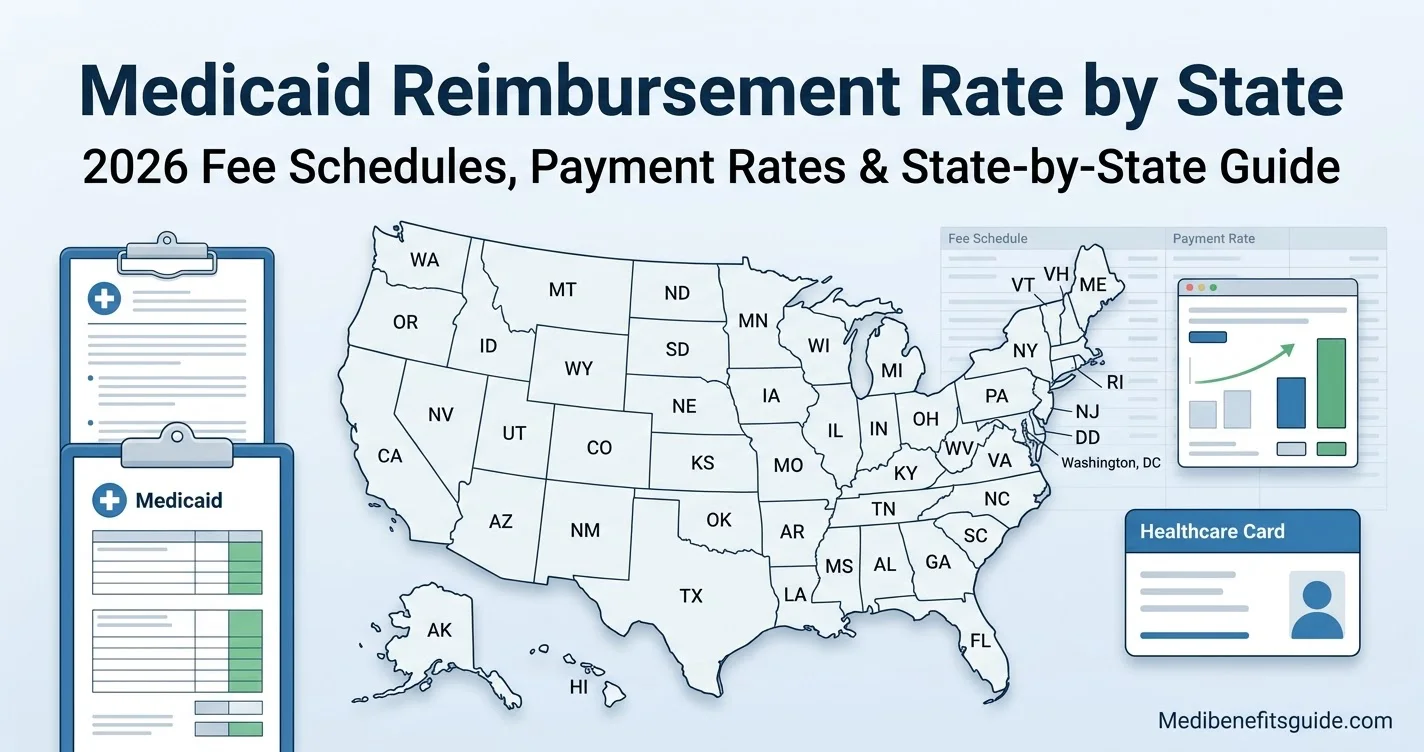
Ask ten people what Medicaid pays for a doctor visit and you’ll get ten different answers. None of them wrong, exactly — just incomplete. There is no single Medicaid reimbursement rate for any given service, because rates shift by state, service, procedure code, provider type, place of service, payment method, and effective date. All at once, sometimes.
If you’re trying to figure out what Medicaid actually pays for a checkup, therapy session, dental cleaning, or home health visit, skip the guesswork. Go straight to the state’s official Medicaid fee schedule or payment resource. That’s the only place the number means anything.
CMS lays out the basic framework here: states set their own Medicaid provider payment rates within federal requirements, generally through fee-for-service (FFS) arrangements or managed care. Everything else is detail on top of that foundation.
What Is a Medicaid Reimbursement Rate?
A Medicaid reimbursement rate is simply the payment tied to a covered healthcare service under a state’s Medicaid program. Simple in concept. Messy in practice.
You’ll find that rate listed in a fee schedule, buried inside a managed-care contract, or shaped by a state-directed payment or supplemental payment arrangement. Three different places, three different structures, often three different numbers for something that sounds like the same service.
Here’s what actually moves the number:
| Factor | Why It Matters |
|---|---|
| State | Each state has its own Medicaid payment methodologies |
| Service | Different healthcare services have different rates |
| CPT/HCPCS code | Payment can be procedure-specific |
| Provider type | Physician, hospital, therapist and other providers may have different rates |
| Effective date | Rates can change over time |
| FFS or MCO | Different payment arrangements can apply |
| Modifier | Some services have modifier-specific pricing |
| Place of service | Facility and non-facility settings can have different payment rules |
| Units | Payment may depend on the number of units billed |
Search for one nationwide dollar figure and you’ll land on something misleading nine times out of ten. Worth remembering before you trust the first result you see.
Medicaid Reimbursement Rates by State
Medicaid runs as a joint operation — federal government on one side setting the floor, states on the other building their own programs on top of it. CMS handles the federal requirements. States handle everything about how the money actually gets paid out.
For 2026, if you want a rate specific to your state, the official Medicaid agency or its provider fee-schedule system is where you look. Not a search engine snippet. Not a forum post from three years ago.
| State | Medicaid Program / Agency |
|---|---|
| Alabama Medicaid Reimbursement Rates | Alabama Medicaid |
| Alaska Medicaid Reimbursement Rates | Alaska Medicaid |
| Arizona Medicaid Reimbursement Rates | AHCCCS |
| Arkansas Medicaid Reimbursement Rates | Arkansas Medicaid |
| California Medicaid Reimbursement Rates | Medi-Cal |
| Colorado Medicaid Reimbursement Rates | Health First Colorado |
| Connecticut Medicaid Reimbursement Rates | Connecticut Medicaid |
| Delaware Medicaid Reimbursement Rates | Delaware Medicaid |
| Florida Medicaid Reimbursement Rates | Florida Medicaid / AHCA |
| Georgia Medicaid Reimbursement Rates | Georgia Medicaid |
| Hawaii Medicaid Reimbursement Rates | Hawaii Medicaid |
| Idaho Medicaid Reimbursement Rates | Idaho Medicaid |
| Illinois Medicaid Reimbursement Rates | Illinois Medicaid |
| Indiana | Indiana Medicaid |
| Iowa | Iowa Medicaid |
| Kansas | Kansas Medicaid |
| Kentucky | Kentucky Medicaid |
| Louisiana | Louisiana Medicaid |
| Maine | MaineCare |
| Maryland | Maryland Medicaid |
| Massachusetts | MassHealth |
| Michigan | Michigan Medicaid |
| Minnesota | Minnesota Medical Assistance |
| Mississippi | Mississippi Medicaid |
| Missouri | Missouri Medicaid |
| Montana | Montana Medicaid |
| Nebraska | Nebraska Medicaid |
| Nevada | Nevada Medicaid |
| New Hampshire | New Hampshire Medicaid |
| New Jersey | New Jersey Medicaid |
| New Mexico | New Mexico Medicaid |
| New York | New York Medicaid |
| North Carolina | NC Medicaid |
| North Dakota | North Dakota Medicaid |
| Ohio | Ohio Medicaid |
| Oklahoma | Oklahoma Medicaid |
| Oregon | Oregon Health Plan |
| Pennsylvania | Pennsylvania Medicaid |
| Rhode Island | Rhode Island Medicaid |
| South Carolina | South Carolina Medicaid |
| South Dakota | South Dakota Medicaid |
| Tennessee | TennCare |
| Texas | Texas Medicaid |
| Utah | Utah Medicaid |
| Vermont | Vermont Medicaid |
| Virginia | Virginia Medicaid |
| Washington | Washington Apple Health |
| West Virginia | West Virginia Medicaid |
| Wisconsin | Wisconsin Medicaid |
| Wyoming | Wyoming Medicaid |
| District of Columbia | DC Medicaid |
For an actual dollar amount, check the current state-specific fee schedule or rate file. Don’t assume every service in a state has one flat statewide rate — most don’t. And while you’re checking payment rates, it’s worth confirming your income eligibility for the program itself, since qualification rules shift by state just like reimbursement does.
How to Find Your State’s Medicaid Reimbursement Rate
Nine steps, and none of them can be skipped if you want a real answer:
- Select your state.
- Identify the applicable Medicaid program.
- Find the state’s official Medicaid fee schedule or provider rate resource.
- Identify the service or procedure code.
- Search the applicable CPT, HCPCS, or other code.
- Check the rate’s effective date.
- Review provider type, modifier, units, and place-of-service requirements.
- Determine whether the claim is FFS or managed care.
- Confirm with your state Medicaid agency or health plan if anything’s unclear.
The code matters more than people expect. Search “Medicaid reimbursement rate for CPT 99213” and the answer changes depending on the state and the payment methodology behind it.
States also aren’t required to use one identical coding system across every Medicaid program. Coding requirements vary by state and by service — another reason a single national answer doesn’t exist.
Why There Is No Single Medicaid Reimbursement Rate
“Medicaid reimbursement rate” sounds like one thing. It’s actually shorthand for several different payment arrangements stacked on top of each other.
Fee-for-Service Medicaid
Under FFS Medicaid, payment generally follows a state-established methodology or fee schedule. The state Medicaid agency is almost always the primary source for the rate itself.
Managed Care Medicaid
Most Medicaid beneficiaries actually receive care through a Managed Care Organization, not straight FFS.
In managed care, what a provider gets paid can trace back to the MCO’s contract and applicable state requirements — not simply the state’s published FFS fee schedule. Two beneficiaries, same procedure, potentially different payment paths entirely.
CMS’s managed-care framework includes risk-based MCO arrangements along with other entities like PIHPs and PAHPs.
State-Directed Payments
States can also direct specific payments inside Medicaid managed-care contracts. These State Directed Payments, or SDPs, can involve provider fee schedules, uniform rate increases, value-based arrangements, and other CMS-approved approaches.
Supplemental Payments
Some Medicaid payment systems layer supplemental or additional payment methodologies on top of the base rate. A published base fee, in other words, isn’t automatically the whole story.
Medicaid Fee Schedule vs Actual Payment
Don’t confuse a fee schedule with the final amount that lands on a claim. They’re related. They’re not the same thing.
CMS draws a clear line between the allowed amount and the paid amount. The allowed amount is the maximum allowable under the applicable arrangement. The paid amount is what Medicaid or the managed-care plan actually ends up owing after everything else gets factored in.
Think of the fee schedule as a reference point, not a guarantee. That distinction alone saves a lot of confusion.
Are Medicaid Rates the Same in Every State?
No.
Each state builds its own Medicaid payment methodology inside federal requirements. States set different rates for the same service, and even within one state, rates shift depending on the procedure, the provider, the setting, and the payment arrangement.
Which is exactly why there’s no reliable answer to “which state pays the most for Medicaid.” A state might lead on one service and lag badly on another. There’s no consistent winner.
How Much Does Medicaid Pay for a Doctor Visit?
There’s no single nationwide amount — full stop.
Payment for a doctor visit depends on the state, the procedure code, the provider type, whether it’s FFS or managed care, the place of service, and the effective date. Change any one variable and the number moves.
Searching for the Medicaid reimbursement rate on CPT 99213 or CPT 99214? Pull up the applicable state fee schedule first, then confirm whether coverage runs FFS or managed care. Skip that step and the number you find might not apply to your situation at all.
Medicaid Reimbursement Rates vs Medicare
Medicaid and Medicare run on separate tracks entirely.
Medicare uses federal payment methodologies across the board. Medicaid payment methodologies, on the other hand, get built by individual states within federal requirements — a fundamentally different structure.
CMS’s Medicaid access rules also require states to run certain comparisons between Medicaid FFS payment rates and Medicare rates for specified services.
A Medicare rate is not a stand-in for a Medicaid rate. Don’t substitute one for the other and assume it’s close enough.
2026 Medicaid Rate Transparency
2026 matters more than most years for anyone researching Medicaid rates.
CMS’s Ensuring Access to Medicaid Services final rule brought updated requirements around access monitoring and payment-rate information. According to CMS, the rule replaced older access-monitoring requirements with a more streamlined, standardized process.
The takeaway for consumers is straightforward: pull the state’s current publicly available payment information, and pay close attention to the effective date stamped on it.
What to Expect for Medicaid Reimbursement Rates in 2027
Rates will move in 2027. States update fee schedules, file State Plan Amendments, revise managed-care arrangements, and adjust other payment methodologies on their own timelines.
CMS already released its 2026–2027 Medicaid Managed Care Rate Development Guide, covering rating periods that begin between July 1, 2026, and June 30, 2027.
Still — don’t build decisions around predicted 2027 numbers. Wait for the state to publish an official rate. When comparing 2024, 2025, 2026, and 2027 figures side by side, keep these categories separate:
- Current rates
- Historical rates
- Proposed rates
- Future effective rates
- Managed-care contract rates
- FFS fee-schedule rates
Medicaid CPT and HCPCS Reimbursement Rates
Procedure codes carry a lot of weight in this research. Depending on the service and the state, you’ll run into:
- CPT codes for many professional services
- HCPCS codes for healthcare services, supplies and products
- CDT codes for dental services
- ICD-10 codes for diagnoses
A code by itself won’t get you to the final Medicaid payment. State, provider type, modifier, units, place of service, effective date — all of it has to line up before the number means anything.
How Often Do Medicaid Reimbursement Rates Change?
No fixed nationwide schedule governs this. States update rates through fee schedule revisions, State Plan Amendments, managed-care contract changes, and state-directed payment arrangements — each on its own timeline.
That old 2024 or 2025 fee schedule sitting in your bookmarks? Don’t present it as current 2026 data without checking it against the latest version first.
Frequently Asked Questions
What is a Medicaid reimbursement rate?
It’s the payment tied to a covered Medicaid service. The amount shifts based on state, service, procedure code, provider type, payment system, and effective date.
Does Medicaid pay the same amount in every state?
No. States set their own rates within federal requirements, so the same service can pay very differently depending on where you are.
How can I find my state’s Medicaid fee schedule?
Go to your state’s official Medicaid agency website and look for a provider fee schedule, reimbursement rate list, or rate lookup tool. Then confirm the code and effective date match what you’re researching.
How much does Medicaid pay for a doctor visit?
No single national number exists. It depends on the state, procedure code, provider type, place of service, and whether the claim runs FFS or managed care.
Are Medicaid reimbursement rates public?
Many FFS fee-schedule rates are publicly available through state Medicaid resources, and CMS’s access requirements have pushed for more transparency around payment-rate information generally.
Is a Medicaid fee schedule the same as the actual amount paid?
Not necessarily. The fee schedule is a rate reference. The final paid amount depends on the specific claim and payment arrangement behind it.
Do Medicaid managed-care plans use the same rates as FFS Medicaid?
Not always. Managed-care payment arrangements can differ from a state’s FFS fee schedule, depending on the contract and applicable state rules.
Are Medicaid reimbursement rates higher or lower than Medicare?
Depends entirely on the service and the state. There’s no consistent pattern across the board.
Will Medicaid reimbursement rates increase in 2027?
Some will. Some won’t move at all. Others could drop. Confirm through official state announcements and effective fee schedules — not predictions.
Can I look up a Medicaid reimbursement rate by CPT code?
Yes, wherever the state’s Medicaid system provides code-level detail. Search the applicable CPT or HCPCS code, then verify state, provider type, effective date, and any other requirements attached to it.
Who sets Medicaid reimbursement rates?
States do, within federal requirements. Changes to certain payment methodologies may need a State Plan Amendment and CMS review before they take effect.
Conclusion
At the end of the day, “Medicaid reimbursement rate” was never going to be one number you could pin down and walk away with. It’s a moving target shaped by your state, your service, your provider, and the date you happen to be checking. Go to the source — your state’s official Medicaid agency, current fee schedule in hand, effective date checked twice — and you’ll have something you can actually trust. Whether you’re researching California, Texas, Florida, or New York rates, and whatever your eligibility picture looks like once you’ve checked your state’s income thresholds, that habit of verifying against the source is the one thing that never changes.
Official Resources
- Check State Payment Rates — Medicaid.gov
- Verify Payment Rules — eCFR Title 42 Part 447
- Get Managed Care Rate Guides — Medicaid.gov
- Find Your State’s Medicaid Agency — Medicaid.gov
Disclaimer: This article is for general informational purposes only and is not medical, legal, billing, or financial advice. Medicaid rates and payment rules can change. Always verify current rates with your state Medicaid agency, CMS, or applicable Medicaid health plan before relying on payment information.