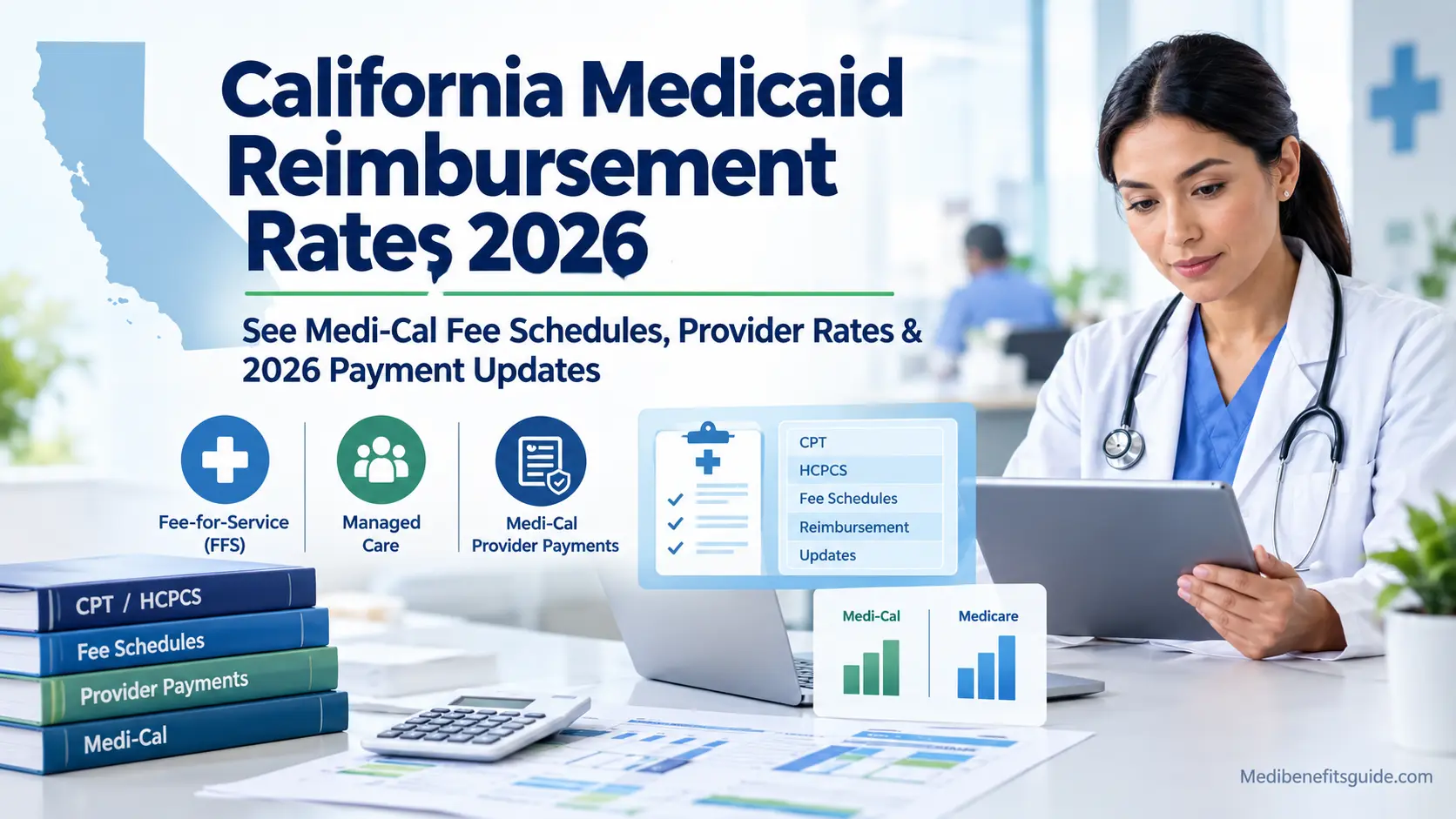
California Medicaid goes by a different name here: Medi-Cal. And there’s no single number attached to it. Payment shifts depending on the procedure code, the provider type, the service category, the delivery system, the effective date, the modifier, the place of service, and the payment methodology behind it. Seven variables, one claim.
California’s Department of Health Care Services (DHCS) keeps separate resources for provider rates, managed care, long-term care, laboratory services, behavioral health, and pharmacy pricing. Each one runs on its own logic.
For providers, the split that matters most is Fee-for-Service versus Managed Care. Beyond that, specialized programs — Medi-Cal Rx, dental, behavioral health, nursing facilities, Ground Emergency Medical Transportation (GEMT) — often use their own reimbursement methodology entirely.
So if you’re searching for “the” California Medicaid reimbursement rate, stop. Identify the service and the payment system first. Everything else follows from that.
How Much Does Medi-Cal Reimburse Providers?
There’s no flat statewide percentage. Reimbursement comes from whatever payment methodology applies to that specific claim.
For an individual claim, these factors typically come into play:
- CPT or HCPCS procedure code
- NDC for certain pharmacy claims
- Provider type
- Service category
- Modifier
- Place of service
- Effective date
- Fee-for-Service or managed care
- Applicable supplemental or directed payments
- Contract terms for certain managed-care services
Here’s something providers get tripped up on constantly: a published fee-schedule amount isn’t always the final paid amount. Payment adjustments, supplemental payments, billing requirements, and claim-specific rules all sit on top of that base number.
Medi-Cal Fee-for-Service Rates by Procedure Code
Fee-for-Service Medi-Cal pays according to published rules and fee schedules for covered services. If you’re hunting for a specific procedure rate, go to the official DHCS resources first. Third-party databases lag behind, and lag is expensive when you’re billing.
How to Look Up a California Medi-Cal Rate
- Identify the billing code. CPT, HCPCS, NDC, whatever applies.
- Identify the service category. Physician, laboratory, behavioral health, and pharmacy services each have their own resource.
- Open the correct DHCS rate resource for that category.
- Check the effective date. A rate from two years ago won’t cover a 2026 claim.
- Review modifiers and billing rules that apply to your case.
- Confirm whether the claim is FFS or managed care — this changes everything downstream.
Six steps beats one assumption. Assuming a CPT code carries a single permanent Medi-Cal rate is how underpayments and denied appeals happen.
What Is the Medi-Cal Rate for CPT 99213 or 99214?
There isn’t a number you can quote off the top of your head and trust. Not without checking the current fee schedule, the effective date, and the specific billing circumstances first.
CPT 99213 and 99214 are two of the most common office-visit codes in the system. But the correct reimbursement amount still has to be verified against current DHCS data tied to your claim.
This matters even more when you’re comparing Medi-Cal against Medicare. The two programs run on different payment systems and different policies — a side-by-side comparison only works once you’re looking at the current numbers for both.
Medi-Cal FFS vs. Managed Care Reimbursement
| Payment system | How payment works | Where to verify |
|---|---|---|
| Medi-Cal FFS | Covered services are reimbursed under applicable Medi-Cal fee schedules and payment rules | DHCS Medi-Cal provider rates |
| Managed Care | DHCS pays managed-care plans through capitation and related arrangements; plans contract with providers | DHCS managed-care resources and applicable plan contract |
| Medi-Cal Rx | Pharmacy claims use drug-specific reimbursement methodology and applicable dispensing fees | Medi-Cal Rx |
| Behavioral Health | Separate fee schedules and county/plan arrangements may apply | DHCS behavioral health |
| Long-Term Care | Facility-specific rate methodologies apply | DHCS LTC |
| GEMT | Ground ambulance services can involve FFS and supplemental payment methodologies | DHCS GEMT resources |
California’s official managed-care data covers 2021 through 2026 capitation rates across County Organized Health Systems (COHS), Geographic Managed Care, Regional, SCAN, Single Plan, Two-Plan, and PACE models.
Don’t treat managed-care reimbursement as a mirror of the standard FFS fee schedule. It isn’t one. If you’re comparing rates across states, our breakdown of Medicaid reimbursement rates by state shows just how much these structures diverge outside California too.
2026 Medi-Cal Provider Rate Changes
A few things converged this year to make 2026 a genuinely important year for California Medicaid reimbursement.
Targeted Provider Rate Increases
DHCS rolled out targeted rate increases starting January 1, 2024, covering eligible primary care, obstetric, and non-specialty mental health services.
For those targeted services, DHCS pushed rates to no less than 87.5% of the Medicare rate, factoring in specified payment adjustments. Eligible providers see this in FFS. Eligible network providers see it in Medi-Cal managed care, through a minimum fee schedule directed payment.
That 87.5% figure gets quoted a lot — usually out of context. It’s not a universal Medi-Cal rate. It applies only to the specified services and providers under this particular policy.
Proposition 35
Proposition 35 touches Medi-Cal financing and provider-payment policy directly. According to DHCS, the proposition made the managed-care organization tax permanent, pending federal approval, and it funds specified Medi-Cal purposes.
What it didn’t do: eliminate the targeted provider rate increases from January 1, 2024. Those stayed in place.
DHCS also published a 2026 Proposition 35 primary and specialty code list, along with supplemental payment information tied to it.
Comparative Payment Rate Analysis
DHCS’s Comparative Payment Rate Analysis (CPRA) is another lens worth using here. It covers primary care, obstetrical and gynecological services, and outpatient mental health and substance use disorder services. The analysis shows Medi-Cal FFS base rates as a percentage of Medicare rates, plus data on Medicaid-paid claims and the beneficiaries receiving those services.
Medi-Cal Reimbursement by Service Type
Physician Services
Physician reimbursement depends on the CPT/HCPCS code, provider type, modifiers, and whatever rate policies apply. Primary care, obstetric, and certain non-specialty mental health services can also get a boost from the targeted provider rate increases described above.
Hospital Services
Inpatient and outpatient hospital services run on different methodologies entirely. Check the specific DHCS methodology for the service type — don’t extend a general physician fee schedule to hospital claims. It won’t hold up.
Behavioral Health
Behavioral health runs on its own fee schedules, separate from everything else. For fiscal year 2026–27, DHCS lists schedules for Specialty Mental Health Services, Drug Medi-Cal Organized Delivery System services, and Drug Medi-Cal services — several rates take effect July 1, 2026.
Here’s the catch a lot of providers miss: some published behavioral-health rates are payments to Mental Health Plans or counties, not to individual providers. Those entities negotiate their own rates downstream. The DHCS-published number and your actual contracted payment can be two different things.
Laboratory Services
Clinical laboratory and laboratory services have dedicated Medi-Cal rate resources. Check the code, the effective date, and the laboratory-specific policy every time — don’t assume carryover from a related service line.
Pharmacy
Medi-Cal Rx operates as its own reimbursement system. Pharmacy payment includes ingredient cost, a professional dispensing fee, and — depending on the benefit — additional components layered on top.
For 2026, the professional dispensing fee breaks down like this:
- $13.20 for pharmacies with fewer than 90,000 annual net claims
- $10.05 for pharmacies with 90,000 or more annual net claims
Volume decides which tier applies, along with whatever program requirements are in effect. Medi-Cal Rx also runs a Drug Lookup Tool for searching medications and National Drug Codes (NDCs) directly.
Dental
Medi-Cal dental has its own program rules and fee schedules, full stop. Verify through the Medi-Cal Dental resources — the general physician fee schedule won’t apply here at all.
Long-Term Care
Skilled nursing and subacute facilities each have separate reimbursement methodologies under Medi-Cal.
For 2026, DHCS published rate studies and Rates on File for freestanding skilled nursing and adult freestanding subacute facilities. The published CY 2026 rates on file are dated September 15, 2026.
Ambulance and GEMT
Ground Emergency Medical Transportation involves specialized reimbursement, often layered with supplemental payment methodologies. Use the DHCS GEMT resources directly. A standard physician or hospital rate simply doesn’t translate here.
FQHCs and RHCs
Federally Qualified Health Centers and Rural Health Clinics get reimbursed under specialized payment methodologies built specifically for them. Evaluate their reimbursement against the applicable Medi-Cal rules — not against a standard FFS physician claim template.
Why Can the Final Medi-Cal Payment Differ From the Published Rate?
A fee schedule tells you the starting point. It doesn’t guarantee the final deposit.
Differences show up because of:
- Claim-specific billing information
- Modifiers
- Provider eligibility
- Covered versus noncovered services
- Coordination of benefits
- Managed-care contracts
- Supplemental or directed payments
- Payment adjustments
- Effective-date differences
- Program-specific reimbursement rules
Before you conclude a claim was underpaid, run through the procedure code, the date of service, the payer, the provider type, and the payment methodology. Usually the answer’s sitting in one of those five.
Do Medi-Cal Reimbursement Rates Vary by County?
Yes — particularly inside managed care. California runs multiple managed-care models: COHS, Geographic Managed Care, Regional, Single Plan, and Two-Plan arrangements, among others. DHCS publishes capitation data by model and year, 2026 included.
This shows up concretely in counties like Los Angeles, San Diego, Orange County, Sacramento, and San Francisco, where the managed-care structure and the available health plans differ from one county to the next.
For statewide FFS questions, though, the DHCS fee schedule and service-specific methodology are still your starting point — county variation matters less once you’re outside managed care.
How Often Does California Update Medicaid Rates?
There’s no single update date that governs every category. That’s just not how the system works.
Updates come through:
- Annual or periodic fee-schedule revisions
- State Plan Amendments
- Legislative changes
- Federal approvals
- Managed-care rate-setting
- Program-specific policy letters
- Supplemental or directed payment changes
Right now, DHCS lists 2026 behavioral-health schedules, 2026 long-term-care rates, and current pharmacy pricing resources — all updated on their own separate timelines. Check the effective date before you use any rate for a current claim. Every time.
If eligibility questions come up alongside rate questions — which they often do — our guide to California Medicaid income limits covers the qualification side of the equation.
FAQs About California Medicaid Reimbursement Rates
What is the Medi-Cal reimbursement rate?
There isn’t one. Payment varies by service, procedure code, provider, delivery system, effective date, and payment methodology.
How do I find California Medicaid reimbursement rates?
Start with the DHCS Medi-Cal Rates resources, identify your service category, and pull the applicable fee schedule from there.
Does California Medicaid have a fee schedule?
Yes. DHCS publishes provider fee schedules plus separate rate resources for several specialized programs.
Does Medi-Cal pay 87.5% of Medicare?
Not across the board. That 87.5% benchmark applies only to specified eligible services under the targeted provider rate-increase policy.
Are Medi-Cal managed-care rates different from FFS rates?
Yes. Managed-care plans receive capitation payments and contract independently with providers, while FFS follows the standard Medi-Cal fee-schedule rules.
Are pharmacy reimbursement rates different?
Yes. Medi-Cal Rx uses its own methodology, combining drug pricing with applicable dispensing fees.
How are nursing-home Medi-Cal rates calculated?
Long-term-care facilities use specialized reimbursement methodologies. DHCS publishes rate studies and Rates on File for each applicable facility category.
Why did my Medi-Cal claim pay less than the published rate?
The published rate isn’t always the final claim payment. Billing details, modifiers, eligibility, managed-care contracts, supplemental payments, and other adjustments can all shift the final number.
Where can providers check current Medi-Cal rates?
The DHCS Rates page. It links out to provider, managed-care, laboratory, behavioral-health, pharmacy, and long-term-care resources from one place.
Conclusion
Think of California Medicaid reimbursement less as a rate and more as a set of rules you have to walk through every time. Identify the service, confirm FFS or managed care, check the effective date, and don’t skip the modifiers.
The DHCS resources are the last word here — not this article, not a spreadsheet you saved last year. When money’s on the line, verify before you bill.
Official Resources
- Check Current Medi-Cal Rates — DHCS
- Apply for Medi-Cal Benefits — Covered California
- Verify Pharmacy Rates — Medi-Cal Rx
- Find State Medicaid Data — Medicaid.gov
Disclaimer: This article provides general information about California Medi-Cal reimbursement and is not an official payment determination. Rates, policies, and effective dates can change. Providers should verify current reimbursement information with DHCS and the applicable Medi-Cal program or managed-care plan before billing or making financial decisions.

About Naseer
Naseer has 10+ years of experience creating informative content and researching medicare topics. He focuses on simplifying Medicaid and benefits details to support readers find clear, reliable, and easy-to-understand guidance.