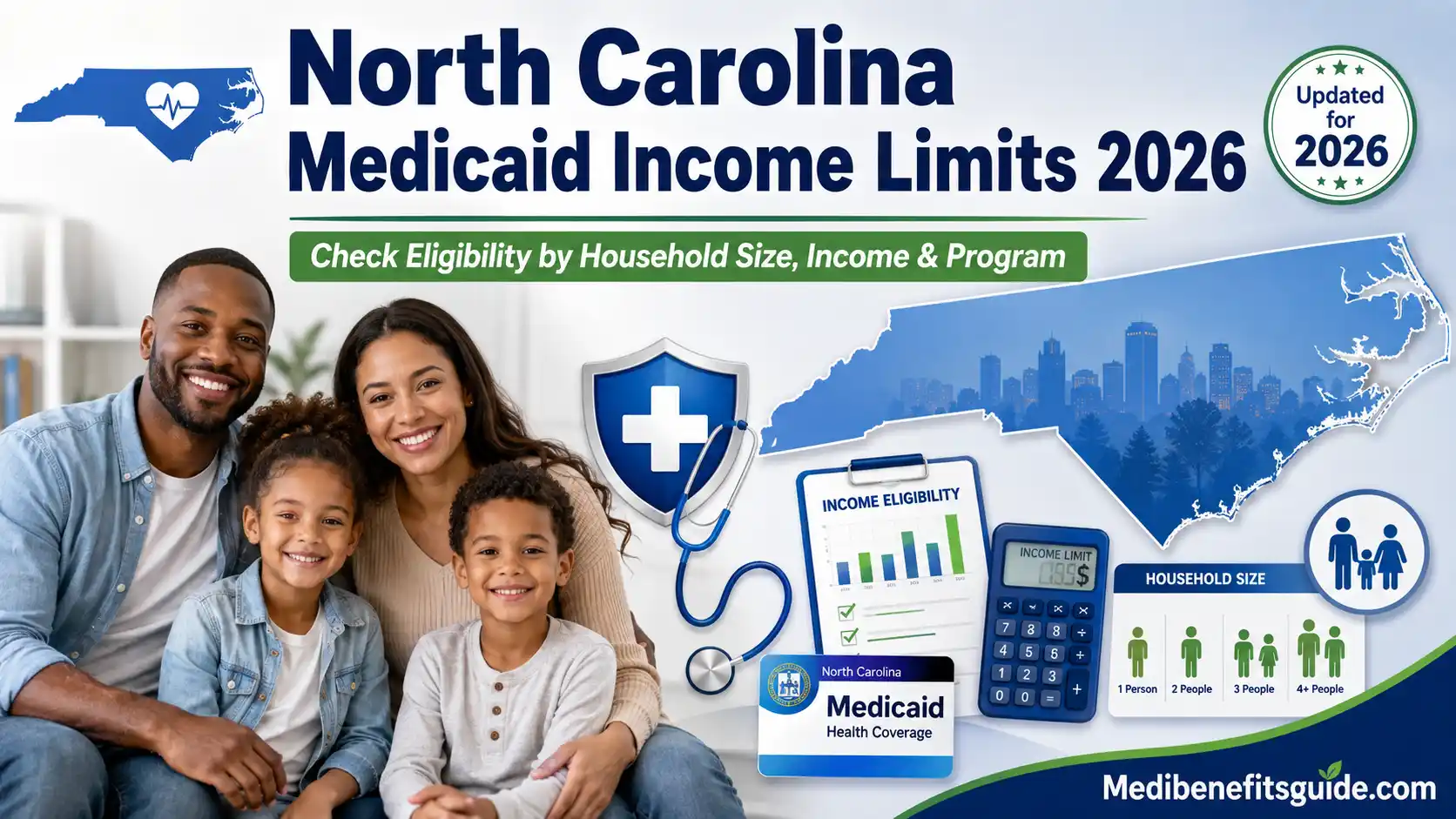
There’s no single number that tells you whether you qualify for NC Medicaid. That’s the first thing to understand. Adults, kids, pregnant people, seniors — they all fall under different income rules, and mixing them up is the most common reason people assume they’re ineligible when they’re not.
For 2026, NC Medicaid measures eligibility using monthly income before taxes, with the limit shifting based on household size and which program applies to you. The numbers below reflect current official NC Medicaid guidance.
North Carolina Medicaid Income Limits at a Glance
Here’s a quick snapshot for households of one through five.
| Family Size | Adults Ages 19–64 | Children Ages 0–18 | Pregnant Person* |
|---|---|---|---|
| 1 | $1,835/month | $2,807/month | $3,535/month |
| 2 | $2,399/month | $3,806/month | $4,463/month |
| 3 | $3,141/month | $4,804/month | $5,390/month |
| 4 | $3,795/month | $5,803/month | $6,318/month |
| 5 | About $4,449/month | $6,802/month | $7,246/month |
*NC Medicaid’s household rules for the public income chart include specific treatment for pregnancy, including an unborn child in the pregnancy eligibility amount. All amounts are generally stated as income before taxes.
Don’t assume the adult limit applies to your whole household. A child or a pregnant family member can qualify even when everyone else doesn’t.
You can also Compare Medicaid Income Limits by State — MediBenefits Guide
How Much Can You Make and Still Qualify for Medicaid in NC?
For most adults ages 19 through 64, the 2026 threshold sits at $1,835 a month for one person, climbing to $3,795 for a family of four.
North Carolina expanded Medicaid in December 2023. That opened the door for a much larger group of low-income adults who previously earned too much for traditional Medicaid but too little to afford real coverage elsewhere. The state now describes this expansion pathway as covering eligible adults ages 19–64 who meet the income and other requirements.
Eligibility isn’t just about income, though. A few other factors come into play:
- North Carolina residency
- Age
- Household composition
- Citizenship or qualifying immigration status
- Income methodology
- Pregnancy or disability status
- Whether a non-MAGI program applies
Which NC Medicaid Income Limit Applies to You?
Walk through this in order.
Adults ages 19–64 — Start with the adult expansion limits.
Children under 19 — Their limits run higher than the adult ones, generally by a wide margin.
Pregnant people — Check the pregnancy-specific limits. Don’t default to the standard adult number.
Adults 65+, blind, or disabled — Different rules apply here, and they’re more complex. Non-MAGI Medicaid often factors in resources, not just income.
Long-term care applicants — Nursing facility Medicaid and similar programs carry their own separate income and asset tests.
One household. Multiple outcomes. That’s just how it works.
NC Medicaid for Adults Ages 19–64
Medicaid expansion matters most for adults who used to fall into the coverage gap — too much income for old Medicaid rules, not enough to buy affordable insurance on their own.
2026 Adult Income Limits
| Household Size | Monthly Income Before Taxes |
|---|---|
| 1 | $1,835 |
| 2 | $2,399 |
| 3 | $3,141 |
| 4 | $3,795 |
| 5 | About $4,449 |
These figures are based on household income before taxes, calculated under the applicable eligibility methodology.
Can Adults Without Children Get NC Medicaid?
Yes. Eligible adults 19 through 64 can qualify under expansion whether or not they have kids at home. That’s a real shift from the old system, where childless adults were largely locked out regardless of income.
NC Medicaid Income Limits for Children
Kids get more room. Their income limits sit noticeably above the adult thresholds across every household size.
The 2026 guidance puts the children’s limit at $2,807 a month for a household of one, $3,806 for two, and $5,803 for four — ages 0 through 18.
So a parent who gets denied can still have a child who qualifies. It happens constantly.
Example: A family of four earning above the adult Medicaid cutoff might still land under the children’s threshold with room to spare.
Check every person in the household separately. One denial doesn’t mean the whole family is out of luck.
Medicaid Income Limits During Pregnancy
Pregnancy opens up a different eligibility category, and the income ceiling is significantly higher than the standard adult pathway.
2026 figures:
- Family size 1: $3,535/month
- Family size 2: $4,463/month
- Family size 3: $5,390/month
- Family size 4: $6,318/month
Household calculations for pregnancy can differ from the standard method, so it’s worth following NC Medicaid’s current instructions closely rather than assuming the general rules apply.
Postpartum coverage and other pregnancy-related eligibility rules may layer additional requirements on top of this.
Seniors, Blind and Disabled Applicants
If you’re 65 or older, blind, or living with a disability, the standard expansion chart above isn’t really built for you. Lean on it too heavily and you’ll miss the real picture.
These applicants typically move through non-MAGI Medicaid pathways instead, where the state may weigh:
- Countable income
- Resources or assets
- Disability status
- Medicare status
- Long-term-care needs
- Specific deductions or exclusions
NC Medicaid’s worker-with-disabilities program is a good example — it factors in both income and resources. That alone shows why the standard adult table can’t answer these questions on its own.
MAGI vs. Non-MAGI Medicaid: What’s the Difference?
MAGI Medicaid
Modified Adjusted Gross Income rules generally cover:
- Adults ages 19–64
- Children
- Pregnant people
- Families
The focus here is household income and tax-related household structure.
Non-MAGI Medicaid
This track applies more often to:
- Seniors
- Blind individuals
- People with disabilities
- Certain long-term-care applicants
Income and resource testing both come into play.
Quick Comparison
| MAGI | Non-MAGI |
|---|---|
| Often used for adults, children and pregnancy | Often used for aged, blind and disabled applicants |
| Household and income focused | May include assets/resources |
| Tax-related household methodology may apply | Different financial eligibility rules may apply |
Does NC Medicaid Use Gross Income or Take-Home Pay?
NC Medicaid’s public chart states its figures in pre-tax terms. Straightforward enough.
But don’t just glance at your paycheck’s gross line and call it done — the program’s actual income-counting rules go deeper than that.
| Term | Meaning |
|---|---|
| Gross income | Income before taxes |
| Take-home pay | Income after taxes and deductions |
| MAGI | A Medicaid eligibility methodology based on modified adjusted gross income |
| Countable income | Income considered under the rules of a specific program |
Self-employed applicants, people with irregular income, and anyone eligible for certain deductions usually need a more detailed calculation than the chart alone provides.
Unsure where you land? Apply anyway. A caseworker can review your actual situation and figure out whether deductions or another pathway change the outcome.
How Is Household Size Calculated?
Getting household size right matters just as much as getting income right.
NC Medicaid generally counts:
- You
- Your spouse
- Your children under age 21, including stepchildren
- Other people included on the same federal income tax return
Exceptions exist, and you don’t have to file taxes to get health coverage. Common mistake: Don’t automatically count everyone living under your roof. Medicaid’s household definition isn’t the same as a guest list.
Why Do North Carolina Medicaid Income Limits Differ Online?
Older sites, outdated calculators, and stale articles all still float around. That doesn’t necessarily mean someone’s lying to you — usually it’s just drift.
Common causes:
- Different effective years
- Annual Federal Poverty Level updates
- Program-specific eligibility categories
- Different household sizes
- The gap between 133%, 135%, and 138% references
- Income disregards
- Older expansion figures
- Generic calculators versus official state guidance
Best practice, in order:
- Check the year.
- Check the effective date.
- Confirm the Medicaid program.
- Confirm the household size.
- Prefer current official NC Medicaid information.
How to Apply for NC Medicaid
Step 1: Identify Your Household
Figure out who counts under the applicable household rules before you do anything else.
Step 2: Gather Financial Information
You’ll want:
- Wages
- Self-employment income
- Other income sources
- Household members
- Health coverage, if applicable
Step 3: Apply
Common routes in:
- ePASS
- Your local Department of Social Services (DSS)
- Other approved NC Medicaid application pathways
NC FAST and local DSS offices form the backbone of the state’s Medicaid eligibility system.
Step 4: Respond to Requests
Caseworkers sometimes need more documents or clarification. Respond promptly — delays here slow everything down.
Step 5: Check Every Family Member
Don’t stop once you’ve figured out one person’s status. A child, a pregnant household member, or an older adult might qualify through an entirely different door.
NC Medicaid Help Near You
Income limits are statewide. Charlotte, Raleigh, Durham, Greensboro, Asheville, Wilmington — none of them run separate local thresholds.
Application help, though, is local.
Worth searching for:
- Mecklenburg County DSS Medicaid help
- Wake County Medicaid application assistance
- Durham Medicaid assistance
- Greensboro Medicaid application help
- Asheville Medicaid help
- A DSS office near me
County DSS offices are the ones who’ll actually walk you through your specific application.
What If Your Income Is Too High for NC Medicaid?
Missing one threshold doesn’t mean you’re out of options entirely.
Depending on your circumstances, look into:
- Checking another Medicaid eligibility category
- Checking children’s eligibility separately
- Checking pregnancy-related coverage
- Exploring Family Planning Medicaid
- Reviewing Marketplace coverage through HealthCare.gov
- Checking whether income deductions or special rules apply
Family Planning Medicaid runs on its own separate income limits for qualifying reproductive-health services — worth a look if the standard categories don’t fit.
Common Mistakes to Avoid
1. Using the adult limit for everyone. Children and pregnant people qualify at higher income levels. Applying the adult number across the board underestimates who’s eligible.
2. Using take-home pay. Official charts run on income before taxes, though actual calculations can still vary by program.
3. Counting household members incorrectly. Medicaid’s household definition isn’t the same as who happens to live in your house.
4. Using an old income chart. 2025 numbers still show up in search results. Confirm you’re looking at 2026 figures.
5. Assuming assets never matter. They matter far more in certain non-MAGI programs than people expect.
6. Assuming one family member’s result applies to everyone. A parent can be denied while their child sails through.
FAQs About North Carolina Medicaid Income Limits
What is the income limit for Medicaid in North Carolina in 2026?
For adults ages 19–64, it’s $1,835 a month for one person and $3,795 for a family of four. Children and pregnant people qualify at higher levels.
How much can a single person make and get Medicaid in NC?
Up to $1,835 a month under the 2026 adult guidance, assuming other eligibility requirements are met.
What is the NC Medicaid income limit for a family of four?
$3,795 for adults, $5,803 for children, $6,318 for a pregnant person — depending on which program applies.
Does North Carolina have expanded Medicaid?
Yes, since December 1, 2023. It extended coverage to more adults ages 19 through 64 who meet the requirements.
Can my child get Medicaid if I do not qualify?
Yes. Children’s limits run higher than adult limits, so evaluate each family member on their own.
Does NC Medicaid look at gross income?
The public chart lists pre-tax amounts, but exact calculations depend on the program.
Do assets count for NC Medicaid?
For certain non-MAGI programs — especially those involving older adults, disability, or long-term care — yes. Standard MAGI pathways generally don’t weigh assets the same way.
Can I get NC Medicaid if I work?
Yes. Employment alone doesn’t disqualify you. Household income and eligibility category are what matter.
Can I apply for NC Medicaid online?
Yes, through ePASS or with help from your local DSS office.
Conclusion
There isn’t one magic number that decides Medicaid eligibility in North Carolina — and that’s actually good news for a lot of families. An adult might get turned down while their kid or pregnant partner qualifies without issue. The only way to know for sure is to check each person against the right category, with current figures, not whatever number turns up first in a search.
If you’re on the fence, apply anyway. A caseworker looking at your actual numbers will catch pathways a chart never could.
Good, I have solid official links now.
Official Resources
- Check Your Eligibility — NC Medicaid
- Apply Online Now — ePASS North Carolina
- Find Your Local DSS Office — NCDHHS
- Verify Marketplace Options — HealthCare.gov
Disclaimer: This article is for general informational guidance only and is not an legal NC Medicaid eligibility consideration. Income limits and program policies can change, so always verify your eligibility using current North Carolina Department of Health and Human Services and NC Medicaid guidance before making coverage decisions.

About Naseer
Naseer has 10+ years of experience creating informative content and researching medicare topics. He focuses on simplifying Medicaid and benefits details to support readers find clear, reliable, and easy-to-understand guidance.