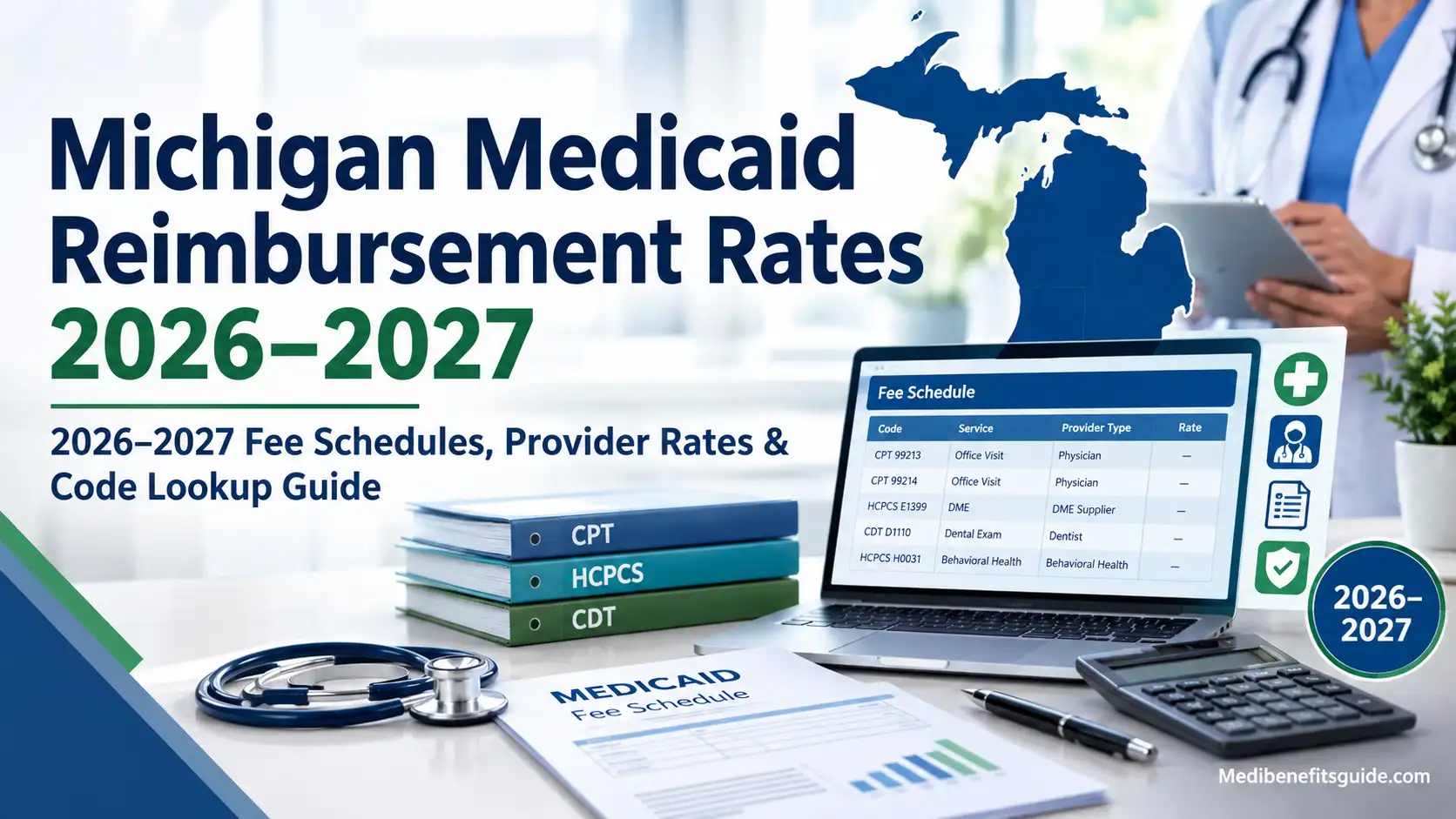
Michigan Medicaid reimbursement rates determine what the state pays for covered Medicaid services. But no single rate applies to every service, provider, or procedure.
What you actually get paid comes down to a handful of moving parts: the CPT, HCPCS, or CDT code you’re billing, the type of provider you are, when the claim’s effective date falls, which modifier applies, where the service happened, coverage rules, whether prior authorization was needed — and whether the claim runs through fee-for-service Medicaid or a managed-care arrangement.
For 2026, the Michigan Department of Health and Human Services (MDHHS) publishes several provider-specific fee databases. CHAMPS adds the Medicaid Code and Rate Reference for code-level detail. Comparing Michigan against other states? The guide to Medicaid reimbursement rates by state puts the numbers side by side.
Michigan Medicaid Reimbursement Rates at a Glance
| What you need | Where to look |
|---|---|
| Physician/practitioner rate | MDHHS provider fee database and CHAMPS |
| Dental rate | Dental fee database and CHAMPS |
| DMEPOS rate | DMEPOS database and CHAMPS |
| Laboratory rate | Clinical Laboratory fee database |
| Ambulance rate | Ambulance fee database |
| Hospital outpatient payment | OPPS payment lists and applicable policy |
| Nursing facility rate | Nursing facility rate resources |
| FQHC/RHC payment | Applicable facility-specific methodology and CHAMPS |
| Behavioral health | Applicable Medicaid/behavioral health policies and payment arrangements |
| Code details | Medicaid Code and Rate Reference |
MDHHS treats its provider-specific databases as reference resources. For coverage and reimbursement policy, go to the Medicaid Provider Manual and the applicable bulletins.
What Are Michigan Medicaid Reimbursement Rates?
They’re the payment amounts tied to covered Medicaid services and procedure codes. Simple enough.
The catch: a fee schedule shows a fee screen for a service, and that number is not a guaranteed claim payment. Billing conditions, coverage requirements, modifiers, authorization, provider qualifications, and payment arrangements all change the final result.
That’s why the Medicaid Provider Manual matters so much. MDHHS says it holds the Medicaid coverage, billing, and reimbursement policies, and it’s updated quarterly.
How Michigan Medicaid Rates Are Determined
A long list of factors shapes the amount that applies to a claim:
- CPT, HCPCS, or CDT code
- Provider type
- Effective date
- Modifier
- Place of service
- Age restrictions
- Frequency limits
- Documentation requirements
- Prior authorization
- Coverage rules
- Facility or non-facility setting
- Fee-for-service versus managed care
- Special payment methodologies
Searching only for “Michigan Medicaid rates” rarely gets you an answer. The better question: what’s the applicable rate for this specific code, provider type, date, and billing situation?
How to Look Up a Michigan Medicaid Rate
1. Find the CPT, HCPCS, or CDT Code
Begin with the code for the service being billed. Medical and professional services typically use CPT or HCPCS codes. Dental services use CDT codes.
2. Identify the Provider Category
Pin down who is billing: a physician, dentist, DME supplier, laboratory, hospital, therapist, ambulance provider, FQHC, RHC, nursing facility, or another category.
3. Select the Correct Effective-Date Schedule
The newest spreadsheet doesn’t automatically apply to every claim. MDHHS publishes databases with different effective periods, and some provider databases update in January, April, and July while others run on their own schedules.
4. Check the Fee Screen
Read the procedure code, description, fee amount, and any other fields in the relevant database.
5. Check Modifiers and Coverage Rules
The fee screen won’t hold every coverage requirement. The CHAMPS Medicaid Code and Rate Reference fills the gaps with rates, limits, age restrictions, modifier requirements, documentation requirements, and prior authorization information. Eligibility questions sit upstream of all this, and the Michigan Medicaid income limits page covers who qualifies in the first place.
6. Determine FFS or Managed Care
Last step. Establish whether Michigan Medicaid fee-for-service or a managed-care organization pays the claim.
Michigan Medicaid Fee Schedules by Provider Type
Physicians and Practitioners
MDHHS maintains physician, practitioner, medical clinic, and related fee resources. For professional services, check the right fee database, then CHAMPS, then the Provider Manual.
Dental
Dental reimbursement runs on dental-specific fee resources and CDT procedure codes. Check coverage separately, since a listed fee doesn’t guarantee the service is covered.
Behavioral Health
Payment here often flows through specialized Medicaid programs and managed arrangements. For some services, a simple professional fee schedule doesn’t capture the payment methodology at all.
DMEPOS
Michigan publishes a DMEPOS database for medical suppliers, orthotists, prosthetists, and DME dealers. The 2026 resources include January, April, and July schedules.
Hospitals
Hospitals get paid under methodologies that differ from ordinary professional fee schedules. Michigan’s outpatient hospital resources include OPPS payment-rate lists and wraparound code lists.
FQHCs and RHCs
Federally Qualified Health Centers and Rural Health Clinics have specialized payment methodologies. Evaluate their reimbursement under the applicable facility rules, not a standard physician fee.
Nursing Facilities
Nursing facilities have their own rate and policy resources. Don’t mix them up with the professional fee schedule used for individual physician services.
Laboratory, Ambulance, Therapy, Vision and Other Services
Michigan also publishes separate resources for clinical laboratory, ambulance, vision, therapy, urgent care, local health departments, and other provider categories. MDHHS currently provides July 2026 clinical laboratory and ambulance databases, for example.
Michigan Medicaid FFS vs Managed Care Rates
This is the distinction that trips up the most people.
A published Michigan Medicaid FFS fee schedule works as a baseline. Medicaid Health Plans, though, can hold contracted payment arrangements with their network providers, and Michigan’s official materials publish Medicaid Health Plan rate-certification and managed-care information separately.
So don’t assume an FFS fee-screen amount is the exact amount paid under every managed-care contract. Rates in other states follow their own structures, which the Medicaid reimbursement rates by state breakdown makes easy to compare.
Why Michigan Medicaid Rates Differ
Two providers can bill what looks like the same service and land in different payment situations. The causes:
- A different procedure code
- A modifier
- Provider classification
- Place of service
- Effective date
- Coverage limitations
- Prior authorization
- Frequency restrictions
- Facility versus professional billing
- Managed-care contracting
- A specialized reimbursement methodology
One more point from MDHHS: its fee databases are reference information. When a rate or coverage discrepancy turns up, the Medicaid Provider Manual controls.
How to Read a Michigan Medicaid Fee Schedule
Skip past the dollar amount first. Then work through the columns that decide whether that amount applies:
- Procedure code
- Service description
- Effective date
- Fee screen
- Modifier requirements
- Age or frequency limitations
- Place-of-service requirements
- Prior authorization
- Documentation requirements
- Applicable Medicaid policy
Doing this avoids the classic mistake of finding a number in a fee schedule and treating it as the final amount a provider receives.
Common Michigan Medicaid Reimbursement Mistakes
Using an outdated spreadsheet
Michigan updates databases by provider category. Confirm the effective date every time.
Treating a fee as a coverage guarantee
A listed rate doesn’t mean every Medicaid member qualifies for the service.
Ignoring modifiers
Modifiers change how a code is processed and whether a particular fee screen applies.
Confusing FFS with managed care
A state FFS rate and a managed-care contractual payment aren’t automatically identical.
Ignoring the Provider Manual
The fee database is one piece of the reimbursement picture. MDHHS sends providers to the Medicaid Provider Manual and applicable policy for coverage and reimbursement requirements.
Official Michigan Medicaid Rate Resources
Bookmark these:
- Michigan Department of Health and Human Services (MDHHS)
- Michigan Medicaid Provider Manual
- CHAMPS
- Medicaid Code and Rate Reference
- Provider-specific fee databases
- Medicaid policy bulletins
- Michigan Medicaid Health Plan resources
CHAMPS is the MDHHS web-based Medicaid management system. Through its external links you get claims, eligibility, prior authorization, provider enrollment, payment status, and the Medicaid Code and Rate Reference.
MDHHS keeps publishing provider-specific fee databases and updates across multiple service categories for 2026.
Michigan Medicaid Reimbursement Rates FAQs
What are Michigan Medicaid reimbursement rates?
Payment amounts tied to covered Medicaid services and procedure codes. The amount that applies depends on the provider, code, effective date, modifier, coverage rules, and payment arrangement.
Does Michigan Medicaid have one reimbursement rate?
No. Michigan runs multiple provider- and service-specific fee databases and payment methodologies, with no universal rate across Medicaid services.
How do I look up a Michigan Medicaid CPT code?
Use the applicable MDHHS provider fee database together with the CHAMPS Medicaid Code and Rate Reference. CHAMPS returns rate, limit, modifier, age, and prior-authorization information.
How do I check an HCPCS code in Michigan Medicaid?
Identify the provider or service category, find the current fee schedule, verify the HCPCS code in CHAMPS, and review the applicable Medicaid policy.
Do modifiers change Michigan Medicaid reimbursement?
Yes. The Medicaid Code and Rate Reference lists modifier requirements and other code-specific information.
Does prior authorization affect Michigan Medicaid payment?
Yes, for applicable services it’s a condition of coverage or payment. The Code and Rate Reference shows PA-related information, and current Medicaid policy fills in the rest.
Are Michigan Medicaid FFS and managed-care rates the same?
Not necessarily. FFS fee schedules publish Medicaid payment information, while Medicaid Health Plans hold their own network payment arrangements.
Does a Medicaid reimbursement rate tell a patient what they owe?
No. A reimbursement rate describes the Medicaid payment side of a covered service, not the amount a member personally owes.
Does a listed fee guarantee that a service is covered?
No. MDHHS states that its fee databases are reference information and points providers to the Provider Manual and applicable policy for coverage and reimbursement requirements.
Conclusion
Michigan Medicaid reimbursement rates work as a code-, provider-, service-, and date-specific payment system, not one statewide list of prices.
Start with the code. Find the provider category. Pull the fee schedule for the right effective date, then work through modifiers, coverage, prior authorization, and whether FFS or managed care is footing the bill.
Every lookup should begin in the same four places: MDHHS, the Provider Manual, CHAMPS, and the Medicaid Code and Rate Reference. Third-party tools have their uses for research, sure — but when it comes to what actually gets paid, official MDHHS resources and current Medicaid policy have the final word.
Official Resources
- Check Your Code’s Current Fee Screen — MDHHS
- Verify Coverage Rules Before You Bill — Michigan Medicaid Provider Manual
- Get CHAMPS Access for Live Code Lookups — MDHHS CHAMPS
- See How Michigan Sets Reimbursement Policy — Michigan Medicaid State Plan
Disclaimer: Providers, not patients, should treat this as a starting point, not a final answer. Rates shift. Coverage rules shift. Payment policies shift, sometimes without much warning. Before submitting a claim or relying on one, check current information with MDHHS, CHAMPS, the Provider Manual, and any relevant Medicaid policy in effect at the time.

About Naseer
Naseer has 10+ years of experience creating informative content and researching medicare topics. He focuses on simplifying Medicaid and benefits details to support readers find clear, reliable, and easy-to-understand guidance.