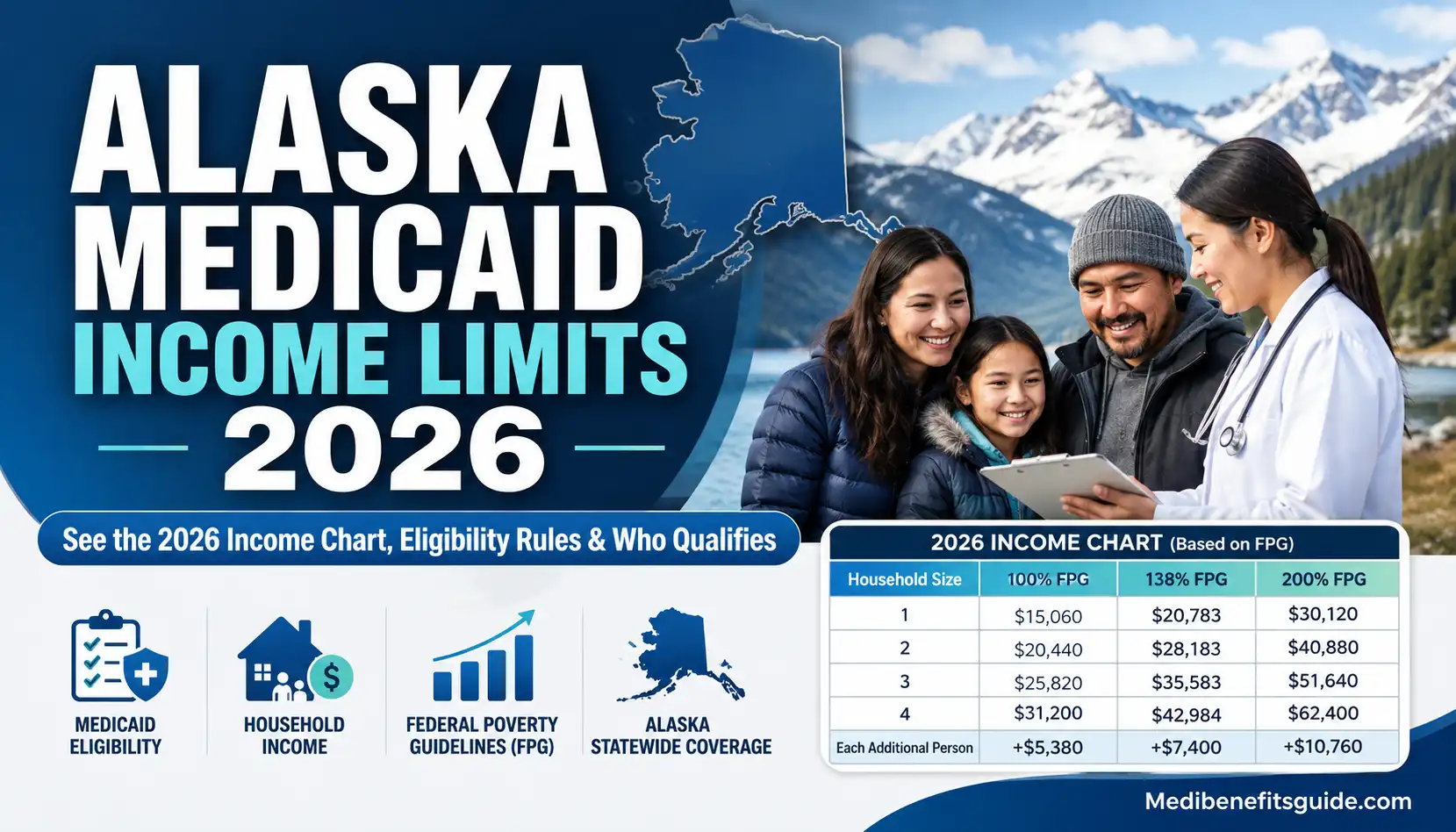
Start with this number: 138% of Alaska’s federal poverty guideline (FPG). That’s the figure driving Medicaid expansion eligibility in 2026. For one person, Alaska’s poverty guideline sits at $19,950 — so 138% comes out to $27,531 a year, or roughly $2,294 a month. But don’t stop reading there. This limit only applies to one slice of Alaska Medicaid, and assuming it covers everyone is where a lot of people go wrong.
Eligibility here isn’t just about a paycheck. Household size, age, pregnancy, disability status, Medicare enrollment, and the specific Medicaid category you’re applying under all shape the outcome.
2026 Alaska Medicaid Income Limits by Household Size
This table reflects the official 2026 Alaska poverty guidelines from the U.S. Department of Health and Human Services (HHS). Alaska gets its own guidelines — separate from the 48 contiguous states and Washington, D.C. For the adult expansion pathway, 138% of the guideline is your reference point.
| Household Size | 100% Alaska FPG | 138% FPG | Approx. Monthly at 138% |
|---|---|---|---|
| 1 | $19,950 | $27,531 | $2,294 |
| 2 | $27,050 | $37,329 | $3,111 |
| 3 | $34,150 | $47,127 | $3,927 |
| 4 | $41,250 | $56,925 | $4,744 |
| 5 | $48,350 | $66,723 | $5,560 |
| 6 | $55,450 | $76,521 | $6,377 |
| 7 | $62,550 | $86,319 | $7,193 |
| 8 | $69,650 | $96,117 | $8,010 |
Past eight people, HHS tacks on $7,100 per additional household member to Alaska’s poverty guideline. One caveat worth repeating: these numbers apply to a specific income-based pathway. They are not a blanket Medicaid income limit. What you actually qualify for comes down to the rules for your category.
Who Can Qualify for Alaska Medicaid?
Alaska Medicaid isn’t one program — it’s several, bundled under one name. And the income test changes depending on which door you’re walking through. Here’s who typically applies:
- Adults ages 19–64
- Parents and caretaker relatives
- Children
- Pregnant women
- Seniors
- People with disabilities
- People receiving or qualifying for SSI-related benefits
- Medicare beneficiaries who may qualify for Medicare Savings Programs
- People seeking Medicaid-funded long-term care
That’s the whole point of this section, really: 138% FPG is not the universal answer. It’s the answer for one group.
See How Your State Stacks Up on Medicaid Eligibility
Alaska Medicaid for Adults Ages 19–64
If you’re between 19 and 64, expansion Medicaid is your likely path — assuming your income falls within the limit and you meet the other requirements. 138% of the poverty guideline is the number that matters here. A single-person household lines up against roughly $27,531 a year, or about $2,294 a month, using 2026 figures.
Having a job doesn’t knock you out of the running. What matters is your countable income under the applicable rules — not your gross pay, not your bank balance on a random Tuesday.
Why Alaska’s Income Limits Are Different
Here’s a mistake that trips people up constantly: pulling the federal poverty number for the lower 48 and applying it to Alaska. HHS publishes three separate sets of guidelines — one for Alaska, one for Hawaii, one for everyone else. Alaska’s 2026 single-person guideline is $19,950. Compare that to $15,960 in the contiguous states. That’s not a small gap.
And because Medicaid limits are calculated as a percentage of the guideline, that gap carries through every number in this article.
Also See Alaska Medicaid Reimbursement Rates 2027
133% vs. 138% FPG: Why Do You See Both?
You’ll run into both numbers in different places, and no, one of them isn’t wrong. The gap comes from Medicaid’s income-disregard rules. A 5-percentage-point disregard effectively pushes eligibility up to 138% for certain MAGI-based groups — even though the base rule reads 133%.
So a technical document citing 133% and a plain-English explainer citing 138% can both be accurate at the same time.
Does Alaska Medicaid Count Household Income?
For most income-based categories, Alaska uses Modified Adjusted Gross Income (MAGI) rules to figure out what counts. Depending on your situation, that can include:
- Wages and salary
- Self-employment income
- Certain taxable income
- Some Social Security income
- Other income under applicable MAGI rules
Your Medicaid category and personal circumstances determine exactly how this gets applied. One thing to avoid: eyeballing your bank deposits and assuming that’s your MAGI figure. It usually isn’t.
Does Alaska Medicaid Have an Asset Limit?
Income rules and asset rules are two different animals. Mixing them up leads to bad assumptions. For most MAGI-based groups, there’s generally no traditional asset test. Money sitting in a savings account won’t disqualify you the way it might under other programs.
That said, different rules kick in for:
- Seniors
- People with disabilities
- SSI-related Medicaid
- Medicare Savings Programs
- Nursing-home Medicaid
- Other long-term-care programs
So if you’re applying for standard adult Medicaid, leave the long-term-care asset rules out of it. And if you’re applying for nursing-home coverage, the 138% expansion chart alone won’t tell you what you need to know.
Also Compare with Alabama Medicaid Income Limits 2026: What You Need to Know
Alaska Medicaid for Children and Denali KidCare
Kids play by a different rulebook than adults do. Denali KidCare is Alaska’s combined Medicaid and CHIP program for eligible children and certain pregnant women. The income level depends entirely on the category in question.
For 2026, KFF puts Alaska’s Medicaid income eligibility limit for pregnant women at 230% of the federal poverty level. Here’s what that means in real terms: a parent who earns too much for adult Medicaid shouldn’t assume their kid is automatically shut out too. A family can miss the cutoff for adult Medicaid entirely while their child still qualifies through Denali KidCare or another child-specific pathway.
Alaska Medicaid and Pregnancy
Pregnancy opens up its own eligibility track, separate from the standard adult rules. For 2026, Alaska’s reported income limit for pregnant women is 230% of the federal poverty level.
Pregnancy can also change how household size gets counted. If you’re expecting, use the pregnancy-specific rules — not the adult expansion figure you’d otherwise apply to yourself.
What About Seniors and People With Disabilities?
If you’re 65 or older, or you have a qualifying disability, the 138% expansion number isn’t your test. Set it aside. Many senior and disability programs run on non-MAGI methodology — different income math, and in some cases, resource or asset requirements layered on top.
Medicare beneficiaries have another option worth checking: a Medicare Savings Program. It can help cover certain Medicare-related costs even in cases where full Medicaid eligibility doesn’t apply.
A quick way to sort yourself into the right bucket:
Under 65 and applying mainly because of low income? MAGI rules likely apply.
65+, disabled, or Medicare-related? Look into the non-MAGI program.
Need nursing-home or HCBS coverage? That’s long-term-care Medicaid territory.
Long-Term-Care Medicaid Is Different
Need help paying for nursing-home care or home- and community-based services (HCBS)? The regular adult 138% chart won’t get you a final answer here. Long-term-care Medicaid brings its own set of rules around:
- Income
- Countable resources
- Transfers of assets
- Spousal protections
- Medical eligibility
- Income caps
- Trusts, including situations involving a Miller Trust
- The Medicaid five-year look-back period
These rules run deep enough that a general online chart won’t cut it. Get an actual eligibility determination or talk to someone who handles this specifically.
How to Apply for Alaska Medicaid
The process, broken into steps:
- Identify your eligibility category.
- Determine your household size.
- Estimate your applicable income.
- Gather required personal and financial information.
- Submit an Alaska Medicaid application through the appropriate official channel.
- Respond to requests for verification.
- Review your eligibility decision.
- Complete renewals when required.
If your income sits close to the limit, apply anyway. An online estimate is a starting point — not a verdict.
What Happens If Your Income Changes?
Life changes, and so does Medicaid eligibility. Report the changes Alaska requires you to report, especially ones involving:
- Income
- Household members
- Address
- Pregnancy
- Employment
- Other eligibility circumstances
One thing not to do: cancel your own coverage because you assume you’re over the limit now. Let the agency review it. They’ll tell you whether your coverage continues or whether something else fits better.
Alaska Medicaid vs. Marketplace Coverage
Income too high for Medicaid? You’re not out of options. Depending on your situation, a Marketplace health plan through HealthCare.gov could work — often with financial assistance attached.
The decision tree looks something like this:
- Under the applicable Medicaid limit → apply for Medicaid.
- Over the Medicaid limit → check Marketplace eligibility and financial assistance.
- Child doesn’t qualify under the adult pathway → check Denali KidCare.
- 65+ or disabled → check Medicare, Medicaid, and Medicare Savings Program pathways.
Alaska Medicaid Help Across the State
Alaska Medicaid runs statewide, so people search for help from Anchorage, Fairbanks, Juneau, Wasilla, Kenai, Palmer, Sitka, and Ketchikan alike. Stick to official Alaska resources for application help. Skip the unverified private services floating around online.
The Alaska Department of Health and the Division of Public Assistance are your go-to sources for eligibility and application details.
2027 Changes to Watch
Federal Medicaid changes are coming for certain expansion adults starting in 2027. Alaska’s Department of Health has said new community-engagement requirements will apply to the expansion population, with exemptions and other federal rules factored in.
Don’t confuse these upcoming requirements with the 2026 numbers covered above — they’re separate matters, on separate timelines.
FAQs About Alaska Medicaid income limits
What is the Alaska Medicaid income limit for one person in 2026?
For the adult expansion pathway, 138% of Alaska’s 2026 poverty guideline is $27,531 a year — about $2,294 a month for a household of one. Other categories use different rules.
What is the Alaska Medicaid income limit for a family of four?
At 138% of the guideline, that’s $56,925 a year, or roughly $4,744 a month. Your specific category still determines the final answer.
Can I get Alaska Medicaid if I work?
Yes. A job doesn’t disqualify you. Eligibility depends on your category and how income gets counted under that program’s rules.
Does Alaska Medicaid count savings?
For most MAGI-based groups, no traditional asset test applies. Seniors, disability-related Medicaid, Medicare Savings Programs, and long-term-care Medicaid follow different rules.
What is 138% of the federal poverty level in Alaska?
$27,531 for one person. $37,329 for two. $47,127 for three. $56,925 for four. Alaska’s guidelines run separate from the lower 48.
Can my child qualify for Medicaid if I do not?
Yes. Children have their own eligibility pathways, including Denali KidCare. Your eligibility and your child’s aren’t tied together.
What is the Alaska Medicaid pregnancy income limit?
230% of the federal poverty level, according to KFF’s 2026 figures. Pregnancy-specific household and income rules apply on top of that.
Does the 138% limit apply to seniors?
Not necessarily. Seniors and people with disabilities often fall under non-MAGI pathways with different income and resource rules entirely.
What if I need nursing-home Medicaid?
Different rules altogether. The standard 138% adult chart won’t give you a real answer — long-term-care Medicaid has its own eligibility framework.
Conclusion
Your Medicaid category decides everything here — not one chart, not one percentage. For the adult expansion pathway, 138% of Alaska’s 2026 poverty guideline runs from $27,531 for a single person up to $56,925 for a household of four.
Figure out your category first. Then your household size. Then the income rules that actually apply to you. Pregnant, raising kids, over 65, living with a disability, on Medicare, or looking at long-term care — each of those changes the math, so don’t force your situation into the standard adult number just because it’s the one everyone talks about.
Official Resources
- Apply for Medicaid — Alaska Division of Public Assistance
- Check Denali KidCare Eligibility — Alaska Dept. of Health
- See Current Federal Poverty Guidelines — HHS ASPE
- Find Marketplace Plans — HealthCare.gov
This article is for general guidance only and does not guarantee Medicaid approval. Alaska Medicaid makes the final eligibility determination, and program policies can change. Always see current requirements with official Alaska and federal department.

About Naseer
Naseer has 10+ years of experience creating informative content and researching medicare topics. He focuses on simplifying Medicaid and benefits details to support readers find clear, reliable, and easy-to-understand guidance.