There’s no single Pennsylvania Medicaid income limit. Ask ten people what the cutoff is and you’ll get ten different answers — because the real number depends on your age, your household size, whether you’re pregnant, whether you have a disability, and which Medical Assistance program you’re actually applying for.
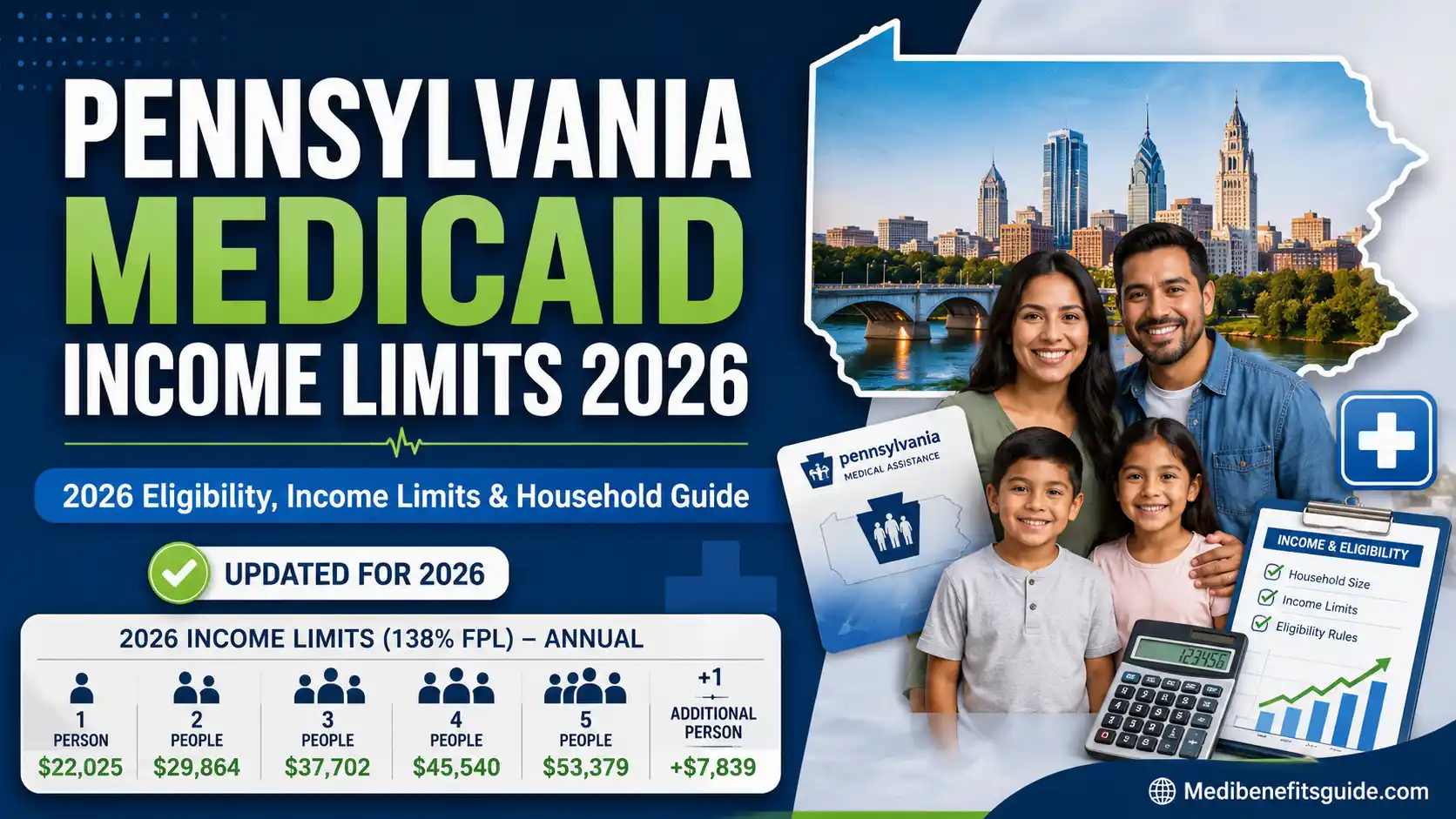
For the most common HealthChoices income standard, Pennsylvania sets the limit at 138% of the Federal Poverty Income Guidelines (FPIG), effective January 13, 2026. That works out to $22,025 a year for one person and $45,540 for a household of four.
2026 Pennsylvania Medicaid Income Limits by Household Size
Here’s how the standard HealthChoices numbers break down for 2026:
| Household Size | Annual Income Limit |
|---|---|
| 1 | $22,025 |
| 2 | $29,864 |
| 3 | $37,702 |
| 4 | $45,540 |
| 5 | $53,379 |
| 6 | $61,217 |
| 7 | $69,056 |
| 8 | $76,894 |
| Each additional person | +$7,839 |
| These figures come straight from the Pennsylvania Department of Human Services (DHS) and took effect January 13, 2026. | |
| Take a single adult earning close to $22,025 a year. That falls within the published standard, so they may qualify under the relevant HealthChoices pathway. Income alone won’t seal the deal, though. |
Also See Medicaid Income Limits by State — Full Guide
Who Qualifies for Pennsylvania Medicaid?
Pennsylvania splits Medical Assistance eligibility into two broad buckets: MAGI and non-MAGI.
MAGI (Modified Adjusted Gross Income) generally covers:
- Children age 18 and under
- Pregnant women
- Parents and caretakers of children under 21
- Certain adults ages 19–64
- Family planning services
Non-MAGI pathways cover different ground: - Adults age 65 and older
- People who are blind or disabled
- Medical Assistance for Workers with Disabilities (MAWD)
- People receiving long-term care or Home and Community-Based Services (HCBS)
Why does the split matter? Because income methodology and resource rules shift depending on which bucket you land in.
Pennsylvania Medicaid Income Limits for Adults Ages 19–64
The standard adult HealthChoices figure is 138% FPIG. But Pennsylvania DHS’s general eligibility page describes the underlying MAGI adult category at 133% FPIG — which is exactly why you’ll see both numbers floating around when you research this.
Neither number is wrong. The current DHS HealthChoices table is the one that publishes the applicable 2026 income limits, and it uses 138% FPIG.
Why Do You See 133% and 138%?
This isn’t a typo or a mistake somewhere in the system.
Medicaid rules sometimes reference a statutory or underlying percentage, while the actual eligibility table folds in the federal income disregard used to determine coverage.
Chase the percentage alone and you can end up with the wrong picture.
For a real application, work from the current DHS income table and match yourself to the eligibility category that fits — don’t assume 133% or 138% applies across the board.
Pennsylvania Medicaid Income Limits for Children
Kids get their own income standards, and those standards change by age.
For 2026, Pennsylvania DHS lists:
| Child/Pregnancy Category | Monthly Limit — Household of 1 |
|---|---|
| Pregnant women & infants under 1 | $2,860 |
| Children ages 1–5 | $2,089 |
| Children ages 6–18 | $1,769 |
| Scale that up to a household of four and the monthly figures become $5,913, $4,318, and $3,658. | |
| The underlying percentages: 215% FPIG for pregnant women and infants under one, 157% for kids one through five, and 133% for kids six through 18. | |
| Which means a child can qualify for Medical Assistance even when a parent doesn’t qualify under the same category. That surprises a lot of families. |
Pennsylvania Pregnancy Medicaid Income Limit 2026
Pregnancy comes with a higher income standard than the standard adult category — by design. In 2026, the published limit for pregnant women and infants under age one sits at 215% FPIG. That’s $2,860 a month for one person, $5,913 for a household of four. Household size matters more here than people expect.
Pennsylvania counts unborn children when calculating household size for the pregnancy income limit. Pregnant with twins? That’s a three-person household for this calculation, not one.
And coverage doesn’t end at delivery. Pregnant women who qualify for Medical Assistance keep coverage for a full year after giving birth.
Does Pennsylvania Medicaid Have an Asset Limit?
Not for everyone. Pennsylvania draws a line between MAGI and non-MAGI eligibility. Resources generally aren’t counted for MAGI groups — pregnant women, children under 21, and people caring for children age 20 or younger.
Non-MAGI programs are a different story. Countable resources there can include cash, checking and savings accounts, stocks and bonds, certain trust funds, life insurance, vehicles, and non-resident property.
So having savings in the bank doesn’t automatically knock you out of every Pennsylvania Medicaid program. It depends entirely on which one you’re applying for.
Pennsylvania Medicaid Income Limits for Seniors and People With Disabilities
People 65 and older, along with those who are blind or disabled, generally fall under non-MAGI rules — not the standard adult HealthChoices calculation.
These programs weigh both income and resources, and the limits look nothing like the standard 138% HealthChoices figure.
Medicare beneficiaries may also have access to separate Medicare Savings Programs, depending on their situation.
Older, disabled, on Medicare, or looking into long-term care? Using the ordinary adult income limit here will give you the wrong answer.
Pennsylvania MAWD Income Limit 2026
Medical Assistance for Workers with Disabilities (MAWD) exists for one reason: to let Pennsylvanians with disabilities work without losing coverage. MAWD lets an eligible person keep Medical Assistance while earning employment income above the limits that apply to other Medicaid categories.
To qualify, you generally need to be at least 16 and under 65, employed and compensated, have a qualifying disability, keep countable income below 250% of the Federal Poverty Income Guidelines, and hold no more than $10,000 in countable resources. Certain property and one automobile don’t count toward that resource limit.
If you’ve been wondering “can I get Medicaid if I work?” — this is your answer. Employment doesn’t automatically cut off Medicaid eligibility in Pennsylvania, because this pathway exists specifically for working people with disabilities.
What Income Counts for Pennsylvania Medicaid?
DHS counts several types of income, including:
- Wages
- Interest
- Dividends
- Social Security
- Pensions
- Certain veterans’ benefits
- A spouse’s income when living together
Some things stay off the books. SSI, SNAP, TANF, LIHEAP, foster-care payments, certain housing or utility subsidies, and a handful of other payments are generally excluded. Child support doesn’t count for MAGI Medical Assistance either.
Treatment depends on the eligibility category you fall into — don’t assume every dollar gets counted the same way.
How to Apply for Medicaid in Pennsylvania
You’ve got four ways in:
- Online through COMPASS
- By telephone
- In person through a County Assistance Office (CAO)
- By mail
DHS points most people toward COMPASS for online applications. Have your household income, Social Security numbers and dates of birth, tax information, health insurance details, and any other eligibility documentation ready before you start.
Need help figuring out where you stand? Your County Assistance Office can walk you through questions and the application itself.
What If Your Income Is Slightly Above the Limit?
Missing one threshold doesn’t mean your whole household is out of luck.
Eligibility runs by category, not by household. A child may still qualify under a children’s category.
A pregnant applicant may qualify under the higher pregnancy standard. A disabled worker may get in through MAWD. Someone who doesn’t qualify for Medicaid at all might still land CHIP or marketplace coverage.
If Medical Assistance isn’t in the cards, DHS points to Pennie — the state’s official health insurance marketplace — as a route to low-cost or no-cost coverage.
Medicaid vs. CHIP in Pennsylvania
Medicaid, or Medical Assistance, covers eligible low-income adults, children, pregnant women, seniors, people with disabilities, and other qualifying groups.
CHIP (Children’s Health Insurance Program) picks up kids who don’t qualify for Medical Assistance but meet CHIP’s own requirements. Pennsylvania’s CHIP income guidelines run separately from Medicaid’s.
So if a child’s household income is too high for Medicaid, don’t assume that’s the end of the road. Check CHIP before writing it off.
Pennsylvania Medicaid Eligibility: A Simple Decision Guide
Start here:
- Age 19–64, applying mainly based on income? Look at the MAGI/HealthChoices rules.
- Pregnant, or applying for a child? Check the age-specific children’s or pregnancy standard.
- 65+, blind, disabled, or need long-term care/HCBS? That’s non-MAGI territory.
- Working with a disability? MAWD is built for you.
- Not eligible for Medicaid? CHIP covers kids, Pennie covers the marketplace.
This gets you further than comparing your income against one statewide number ever will.
FAQs About Pennsylvania Medicaid Income Limits
What is the Pennsylvania Medicaid income limit for one person in 2026?
$22,025 a year under the standard HealthChoices requirement, effective January 13, 2026. Other categories use different standards entirely.
What is the Medicaid income limit for a family of four in Pennsylvania?
$45,540 a year under HealthChoices for 2026. Pregnancy and children’s coverage run on different, often higher, limits.
Is Pennsylvania Medicaid based on 138% of FPL?
The current DHS HealthChoices table uses 138% of the Federal Poverty Income Guidelines. The general eligibility page also references 133% for the adult MAGI category — use the current DHS table, not the percentage alone.
Does Pennsylvania Medicaid count Social Security as income?
Yes, DHS lists it as countable income. Exact treatment can shift depending on the specific Medical Assistance category.
Does Pennsylvania Medicaid count savings?
Sometimes. MAGI groups generally skip the resource test; certain non-MAGI programs apply one.
Can my child qualify for Medicaid if I do not?
Yes. Children have their own income standards by age, so a child can qualify even when a parent falls outside the limit.
What is the Pennsylvania pregnancy Medicaid income limit?
215% FPIG for 2026 — $2,860 a month for one person, $5,913 for a household of four.
Can I get Medicaid if I work?
Potentially, yes. MAWD exists specifically for eligible working people with disabilities, with its own income and resource rules.
What happens if my income is above the Medicaid limit?
You might still qualify under a different category, or your child might qualify for CHIP. DHS also points to Pennie for low-cost or no-cost marketplace coverage if Medicaid isn’t an option.
Does pregnancy increase household size?
Yes. Pennsylvania counts unborn children toward household size for the pregnancy income standard. Twins add two to the count, not one.
Conclusion
The number that matters isn’t a single figure — it’s the category that actually fits your life. For the standard HealthChoices requirement, that’s $22,025 for one person and $45,540 for four, effective January 13, 2026. But if you’re pregnant, raising kids, aging into Medicare, living with a disability, or working while disabled, a different set of numbers applies to you.
Don’t rule yourself out because one number didn’t work. Find your category, check the real limit, and apply. That’s the only way to know for sure.
Official Resources
- Apply Online — PA COMPASS
- Check Medical Assistance Eligibility — PA Department of Human Services
- Find Low-Cost Coverage — Pennie (PA Health Marketplace)
- Verify Federal Medicaid Rules — Medicaid.gov
Disclaimer: This article is for general informational guidance only and is not an official Pennsylvania Medicaid eligibility consideration. Income limits and program guidelines can change, so verify your conditions with current Pennsylvania DHS guidance before making coverage decisions.

About Naseer
Naseer has 10+ years of experience creating informative content and researching medicare topics. He focuses on simplifying Medicaid and benefits details to support readers find clear, reliable, and easy-to-understand guidance.