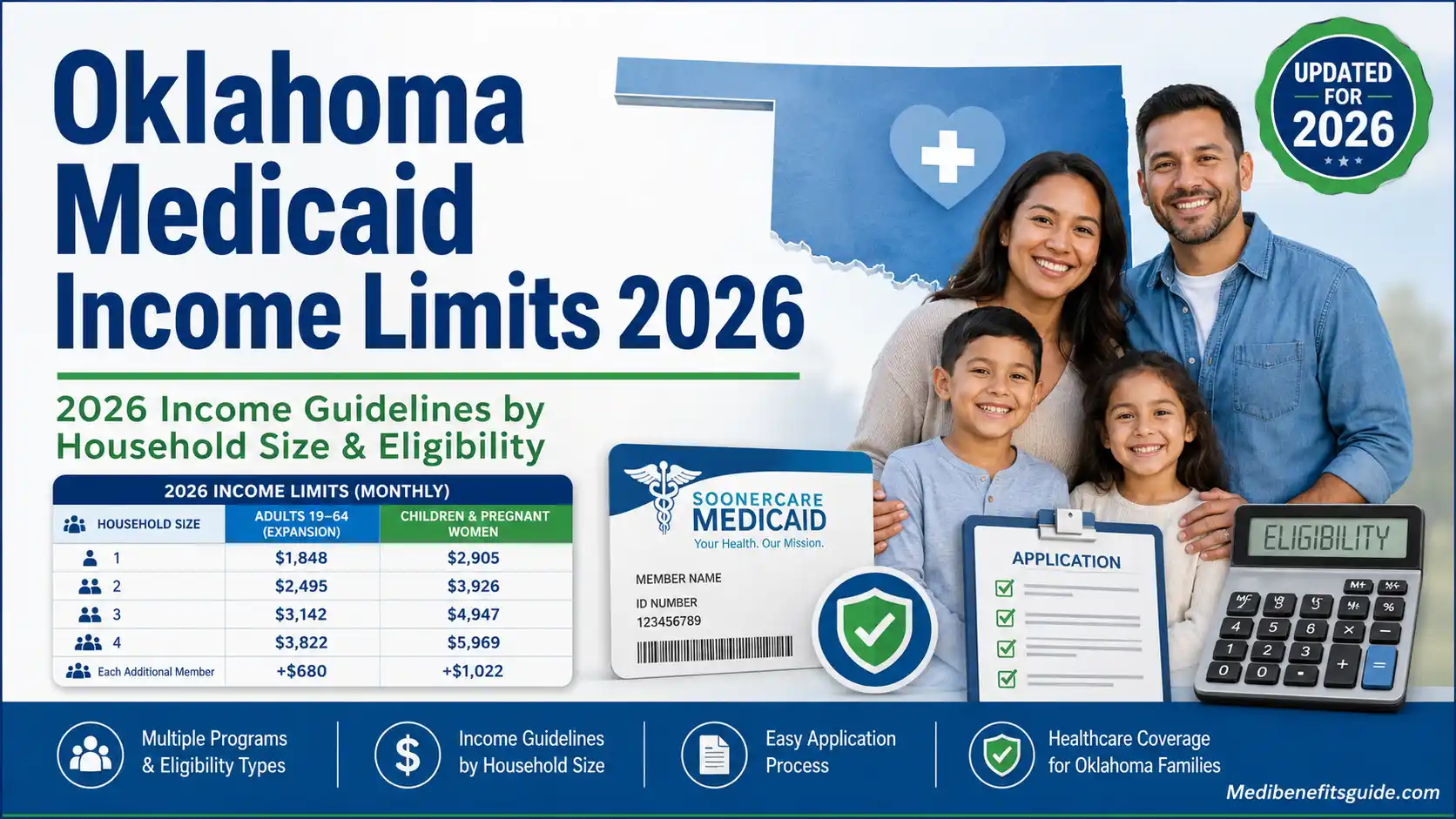
What are the Oklahoma Medicaid income limits in 2026? The official Oklahoma Health Care Authority (OHCA) income guidelines effective April 1, 2026, vary by eligibility category. For Expansion Adults ages 19–64, the published limit is $1,848 per month for one person and $3,822 per month for a household of four.
Oklahoma Medicaid runs through SoonerCare, and income is just one piece of the puzzle. Your age, household size, pregnancy status, Medicare status, disability, and the specific SoonerCare category you apply under can all shift which limit actually applies to you.
Oklahoma Medicaid Income Limits 2026 by Household Size
Here’s the official 2026 Expansion Adult guideline table for adults ages 19–64 who qualify under the Medicaid expansion category. These figures took effect April 1, 2026.
Household Size| Monthly Income Limit| Annual Income Limit
1| $1,848| $22,176
2| $2,507| $30,084
3| $3,165| $37,980
4| $3,822| $45,864
5| $4,481| $53,772
6| $5,138| $61,656
7| $5,796| $69,552
8| $6,455| $77,460
Household bigger than eight? Confirm the applicable guideline directly with OHCA. Don’t try to extrapolate it from a table on some website.
Also See Medicaid Income Limits for All 50 States
What is the Oklahoma Medicaid income limit for one person?
For an Expansion Adult household of one, the 2026 guideline is $1,848 per month, or $22,176 a year. That’s not a blanket number for every Oklahoma resident, though — children, pregnant women, and caretaker relatives all fall under different guidelines.
What is the Oklahoma Medicaid income limit for a family of four?
Expansion Adults land at $3,822 per month, or $45,864 annually, for 2026. Children and pregnant applicants qualify under a much higher threshold, so don’t assume $3,822 is the ceiling for everyone under your roof.
Which SoonerCare Income Limit Applies to You?
Oklahoma runs several Medicaid and related coverage categories. Picking the right one often matters more than comparing your income to a single percentage of the Federal Poverty Level.
OHCA lists potentially eligible groups including adults with children, children under 19, pregnant women, adults ages 19–64 who aren’t eligible for Medicare, people 65 and older, people who are blind or disabled, and a handful of other specialized groups.
Adults ages 19–64
Expansion Adults — sometimes tied to the HAP category — work off this 2026 table:
- 1 person: $1,848/month
- 2 people: $2,507/month
- 3 people: $3,165/month
- 4 people: $3,822/month
- 5 people: $4,481/month
- 6 people: $5,138/month
- 7 people: $5,796/month
- 8 people: $6,455/month
You don’t need kids to qualify here. This category generally applies to eligible adults ages 19–64 who aren’t entitled to or enrolled in Medicare and who meet the other requirements.
Income Limits for Children
Children ages 0–18 get a noticeably higher 2026 SoonerCare guideline than Expansion Adults do.
Household Size| Monthly Limit| Annual Limit
1| $2,806| $33,672
2| $3,806| $45,672
3| $4,804| $57,648
4| $5,802| $69,624
5| $6,802| $81,624
6| $7,800| $93,600
7| $8,798| $105,576
8| $9,798| $117,576
These figures are effective April 1, 2026. Here’s where it gets interesting: a parent can earn too much for their own Medicaid category while their child still qualifies for SoonerCare. Each person’s eligibility gets determined separately, under its own rules.
Oklahoma Medicaid Pregnancy Income Limit
Pregnant women receiving full-scope benefits use the same 2026 income table as children, but household size gets calculated using pregnancy-specific rules.
OHCA instructs applicants to count the number of expected babies as part of household size. This guideline covers pregnancy coverage and Soon-To-Be-Sooners (STBS).
A pregnant applicant expecting one baby, for example, may end up with a larger household size — for income calculation purposes — than a nonpregnant applicant in an otherwise similar situation. The 2026 pregnancy guideline for a four-person household sits at $5,802 per month, or $69,624 annually.
SoonerPlan Income Guidelines
SoonerPlan, a family-planning program for eligible adults, uses that same 2026 household income schedule. A household of one lands at $2,806 per month. A household of four: $5,802 per month.
Parents and Caretaker Relatives Have Different Limits
Here’s one of the easiest Oklahoma Medicaid rules to get wrong: confusing an Expansion Adult with an adult caretaker or relative caring for a child. Adults ages 19–64 in the Caretaker/Relative with Child category face considerably lower 2026 limits:
Household Size| Monthly Limit| Annual Limit
1| $407| $4,884
2| $521| $6,252
3| $668| $8,016
4| $820| $9,840
5| $958| $11,496
6| $1,098| $13,176
7| $1,236| $14,832
8| $1,364| $16,368
These numbers are entirely separate from the Expansion Adult guidelines. Which is exactly why searching for one single “Oklahoma Medicaid maximum income” gets you a misleading answer.
Why Do You See 133% vs. 138% FPL?
This is probably the single biggest source of confusion around Oklahoma Medicaid income limits. Medicaid expansion gets commonly described using 133% of the Federal Poverty Level. But a 5% income disregard pushes the effective threshold to roughly 138% FPL for applicable applicants.
Don’t just multiply the 2026 Federal Poverty Level by 138% and call that the official Oklahoma cutoff. It isn’t, necessarily. For 2026, the federal poverty guideline for the contiguous United States is $15,960 for one person and $33,000 for four people.
OHCA publishes its own dollar figures.
For Expansion Adults, that table lists $1,848 monthly for one person and $3,822 for four people, effective April 1, 2026. That’s why some websites show numbers like $1,835 or $3,795, while the official OHCA table shows $1,848 and $3,822. When you’re determining eligibility, go with the current OHCA guideline — not an independently calculated percentage.
How Does Oklahoma Medicaid Calculate Income?
For applicable MAGI-based programs, SoonerCare uses Modified Adjusted Gross Income (MAGI) and your tax household.
Income sources can include:
- Wages and salary
- Tips
- Self-employment income
- Unemployment compensation
- Certain Social Security income
- Interest and dividends
- Retirement income
- Rental or business income
- Other taxable income
Not everything that lands in your household counts as income, though. Certain assistance payments and other excluded sources get different treatment.
Does Oklahoma Medicaid use gross or net income?
There’s no simple gross-versus-take-home rule that covers every applicant. For MAGI programs, OHCA evaluates countable income under Medicaid’s MAGI methodology, applicable deductions and exclusions included.
Self-employed? Business expenses and income calculation rules can make your final countable amount look pretty different from what actually hits your bank account. If your income bounces around month to month, hang onto documentation — pay stubs, income statements, self-employment records. Don’t let one unusually high or low paycheck convince you that’s your whole eligibility picture.
Does SoonerCare Have an Asset Limit?
Depends entirely on the category. For many MAGI-based groups, including Medicaid expansion adults, eligibility mostly comes down to income rather than a traditional resource test.
Seniors, people who are blind or disabled, and applicants seeking long-term-care Medicaid, though — different story. Different income and resource rules apply.
Don’t apply an asset rule from a nursing-home Medicaid guide to a working-age Expansion Adult. The rules for one category simply don’t transfer to another.
Can You Qualify If Your Income Is Slightly Too High?
Possibly — and honestly, this trips people up more than it should. OHCA specifically tells people whose income might be slightly too high to apply anyway. Some applicants qualify despite income that looks somewhat above the published guideline.
If your income is above the applicable SoonerCare limit, other options might include:
- Another Medicaid eligibility category
- SoonerPlan
- Insure Oklahoma
- Employer-sponsored insurance
- HealthCare.gov Marketplace coverage
A denial under one category doesn’t mean everyone in your household is shut out of all public or private coverage.
What Is Insure Oklahoma?
Insure Oklahoma ESI helps eligible adults ages 19–64 afford employer-sponsored insurance. Its 2026 income range differs from the standard Expansion Adult Medicaid limit. A household of one tops out at $3,032 per month, or $36,384 annually.
A household of four maxes out at $6,269 per month, or $75,228 annually.
That gap matters for working Oklahomans whose income runs too high for Expansion Adult Medicaid but still falls within Insure Oklahoma’s guidelines.
What Happens When You Turn 65?
Turning 65 can flip which Medicaid rules apply to you, especially once you become eligible for Medicare. Oklahoma runs separate eligibility pathways for people 65 and older and for people who are blind or have disabilities. Don’t assume your age-19-to-64 Expansion Adult limit just carries over.
Long-term-care Medicaid comes with its own specialized financial rules too — nursing-home eligibility gets evaluated on its own terms, separate from ordinary MAGI Medicaid.
How to Apply for SoonerCare
You apply through the official MySoonerCare system. Before you start, gather what you’ll need to verify household and income.
Basic Application Process
- Determine your household size.
- Identify your likely eligibility category.
- Gather income information, including wages, self-employment records, Social Security and other applicable sources.
- Submit the SoonerCare application.
- Provide requested verification documents.
- Review the eligibility decision carefully.
- Complete future renewals and report required changes.
OHCA offers online application assistance, plus a SoonerCare helpline at 1-800-987-7767. MySoonerCare also has income verification forms, no-income attestations, self-employment/cash-income statements, and a 12-month profit-and-loss worksheet.
Oklahoma Medicaid Changes Coming in 2027
A big one is coming for some Expansion Adult members starting January 1, 2027.
OHCA says work requirements will apply to certain Expansion Adults ages 19–64 who aren’t otherwise exempt. You can generally meet it through at least 80 hours per month of work, community service, a qualifying work program or education — or through qualifying monthly income of at least $580.
Plenty of exemptions exist too: certain people receiving Medicare, pregnant and postpartum women, parents or caretakers of young children, people with disabilities, qualifying veterans, American Indian/Alaska Native individuals, and others.
Meeting the work requirement doesn’t replace the income test, though. OHCA checks financial eligibility separately. Pay attention to notices from OHCA. The agency says it’ll check work requirements or exemptions during applications and renewals, with documentation procedures kicking in when information can’t be verified automatically.
Common Oklahoma Medicaid Eligibility Mistakes
Watch for these:
- Using an outdated 2025 income table.
- Treating 138% FPL as the universal Oklahoma Medicaid limit.
- Using the adult limit for children.
- Forgetting to include an expected baby in pregnancy household size.
- Assuming gross wages are always the final countable income.
- Applying an SSI or long-term-care asset rule to a MAGI applicant.
- Assuming the entire family must qualify together.
- Giving up because income is slightly above a published number.
- Ignoring renewal or income-verification requests.
- Overlooking Insure Oklahoma when Medicaid income runs too high.
Compare your circumstances against the current OHCA category-specific guideline. Not a generic Medicaid percentage pulled from somewhere else.
FAQs About Oklahoma Medicaid Income Limits
What is the Oklahoma Medicaid income limit for one person in 2026?
For an Expansion Adult, it’s $1,848 per month, or $22,176 annually. Children and pregnancy coverage run higher.
What is the Oklahoma Medicaid income limit for a family of four?
Expansion Adults: $3,822 per month, or $45,864 annually. Children and pregnant women can go as high as $5,802 per month for a household of four.
Can adults without children get SoonerCare?
Yes. Eligible adults ages 19–64 who aren’t eligible for Medicare may qualify through the Medicaid expansion category, assuming they meet the income and other requirements.
Does Oklahoma Medicaid count Social Security?
Certain Social Security payments count as income, depending on the program and benefit type. Report applicable income rather than assuming it’s automatically excluded.
Does Medicaid count savings?
No single rule covers every applicant here. MAGI-based categories generally differ from programs serving seniors, people with disabilities, or long-term-care applicants, where resource rules kick in.
Can my child qualify if I do not?
Yes. Children have their own eligibility category with a higher 2026 guideline than Expansion Adults get. A parent and child can land on entirely different eligibility outcomes.
What if my income is slightly above the Oklahoma Medicaid limit?
Apply anyway. OHCA notes some applicants still qualify with slightly higher incomes, and another category might fit better.
How does pregnancy affect household size?
OHCA has you include the number of expected babies when calculating household size for pregnancy coverage.
What happens if my income changes every month?
Keep pay stubs, self-employment records, and other documentation on hand, and report changes as required. Variable income often needs extra documentation and careful calculation.
What happens when I turn 65?
Your eligibility category can shift, since adults 65 and older may fall under different Medicaid and Medicare-related rules. Don’t keep using the Expansion Adult limit automatically.
Where can I apply for Oklahoma Medicaid?
Through MySoonerCare. OHCA’s SoonerCare helpline — 1-800-987-7767 — offers application assistance too.
Conclusion
Oklahoma Medicaid income limits for 2026 come down to which SoonerCare category fits your situation. Expansion Adults sit at $1,848 per month for one person and $3,822 for four, effective April 1, 2026 — while children and pregnant women qualify at substantially higher thresholds.
Don’t lean on a single 133% or 138% FPL calculation. Oklahoma publishes category-specific dollar guidelines, and where you land also depends on household circumstances, MAGI, age, pregnancy, Medicare status, disability, and a few other moving pieces.
Close to the limit? Income all over the place? Think someone else in your household might qualify even if you don’t? Apply through the official SoonerCare process rather than banking on an online estimate. And if you’re an Expansion Adult, keep an eye on those 2027 work-requirement changes — they’re worth knowing about well before they take effect.
Official Resources
- Apply for SoonerCare Now — MySoonerCare
- Check Insure Oklahoma Eligibility — Oklahoma Health Care Authority
- Verify 2026 Federal Poverty Guidelines — HHS ASPE
- Find Marketplace Coverage Options — HealthCare.gov
Disclaimer: This article is for general informational causes only and is not an official Medicaid eligibility selection. Income limits and program guidelines can change, so verify your circumstances with the Oklahoma Health Care Authority before making coverage decisions.

About Naseer
Naseer has 10+ years of experience creating informative content and researching medicare topics. He focuses on simplifying Medicaid and benefits details to support readers find clear, reliable, and easy-to-understand guidance.