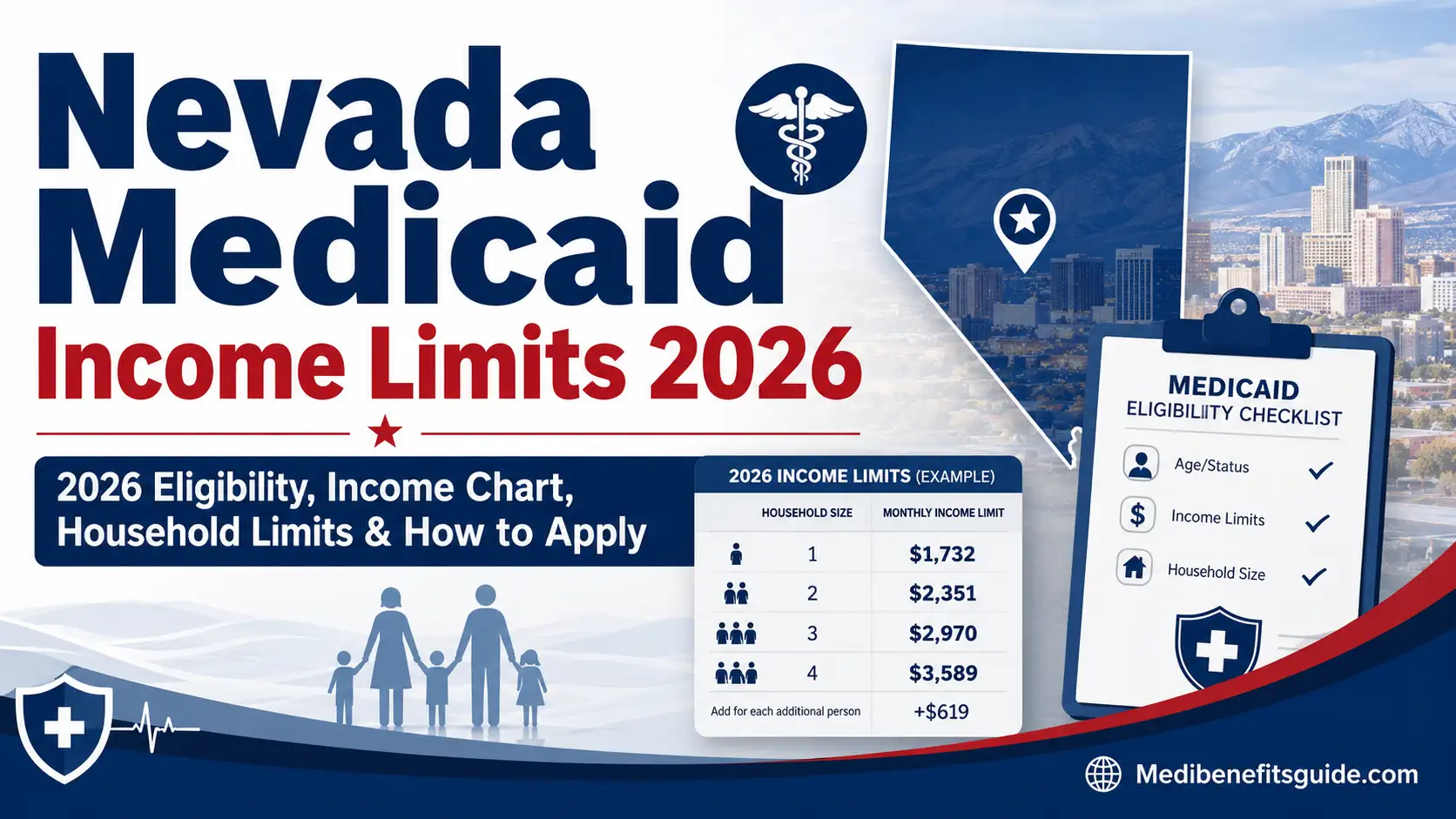
Your Nevada Medicaid income limits for 2026 comes down to two things: household size and which Medicaid category you’re applying under. Most adults ages 19–64 qualify through Medicaid expansion, where the standard is 138% of the federal poverty level (FPL).
Nevada’s current 2026 medical income chart puts that at $1,836 a month for one person, $3,795 for a household of four.
That 138% figure isn’t universal, though. Children, pregnant women, seniors, people with disabilities, Medicare beneficiaries, and long-term-care applicants all play by different rules.
2026 Nevada Medicaid Income Chart
These numbers come straight from Nevada’s current 2026 medical income chart.
| Household Size | 100% FPL | 122% | 138% | 165% | 190% | 205% |
|---|---|---|---|---|---|---|
| 1 | $1,330 | $1,623 | $1,836 | $2,195 | $2,527 | $2,727 |
| 2 | $1,804 | $2,201 | $2,489 | $2,976 | $3,427 | $3,697 |
| 3 | $2,277 | $2,778 | $3,142 | $3,757 | $4,326 | $4,668 |
| 4 | $2,750 | $3,355 | $3,795 | $4,538 | $5,225 | $5,638 |
| 5 | $3,224 | $3,933 | $4,449 | $5,319 | $6,125 | $6,608 |
| 6 | $3,697 | $4,510 | $5,102 | $6,100 | $7,024 | $7,579 |
| 7 | $4,170 | $5,088 | $5,755 | $6,881 | $7,923 | $8,549 |
| 8 | $4,644 | $5,665 | $6,408 | $7,662 | $8,823 | $9,519 |
Add a household member beyond eight, and the chart grows by $474 at 100% FPL, $577 at 122%, $653 at 138%, $781 at 165%, $900 at 190%, and $970 at 205%.
For reference: the federal 2026 poverty guideline for one person in the 48 contiguous states is $15,960 a year. For a household of four, it’s $33,000.
Also See Medicaid Income Limits for Every State — Medi Benefits Guide
What Is the Medicaid Income Limit for One Person in Nevada?
$1,836 a month, if you’re an adult qualifying under Medicaid expansion at 138% FPL. Multiply that by 12 and you get roughly $22,032 a year — but don’t rely on that math to determine your own eligibility. Medicaid doesn’t work that simply.
Your actual limit depends on your household, how income gets calculated in your case, your age, pregnancy status, Medicare status, and a handful of other factors.
What Is the Medicaid Income Limit for a Family of Four?
$3,795 a month, at 138% FPL, for the standard Medicaid expansion pathway. But other Medicaid programs — especially those for children — use higher thresholds. A household earning above $3,795 shouldn’t assume everyone in it is locked out of coverage.
Who Can Qualify for Nevada Medicaid?
Nevada Medicaid runs through several eligibility groups, and which one applies to you changes the financial rules you’re working with.
Common categories:
- Adults ages 19–64
- Parents and caretaker relatives
- Children
- Pregnant women
- Seniors
- People with disabilities
- Medicare beneficiaries
- People needing long-term-care services
- Certain individuals receiving or qualifying for SSI-related assistance
Nevada handles family medical coverage for low-income adults and children separately from Nevada Check Up, which covers eligible children under 19 at income levels up to 205% FPL.
Nevada Medicaid for Adults
Adults qualifying under Medicaid expansion generally fall under the 138% FPL standard. Take a one-person household earning $1,700 a month — that’s below the 2026 figure of $1,836. Approval still isn’t guaranteed, though.
Nevada checks other eligibility requirements beyond income alone. Having a job doesn’t disqualify you. Employment income counts, sure, but exactly how it counts depends on your eligibility category.
Nevada Medicaid for Children and Nevada Check Up
Kids play by different rules than adults do. Nevada Check Up is the state’s CHIP program for children under 19. Nevada allows income up to 205% FPL for this coverage — well above the adult standard.
Here’s the practical takeaway: a parent can be over the adult Medicaid income limit while their child still qualifies for Medicaid or Nevada Check Up. Don’t use the 138% adult figure to judge a child’s eligibility. It’s the wrong number entirely.
Pregnancy Medicaid Income Limit in Nevada
Pregnancy has its own standard, and it’s a generous one. A 2025 Nevada State Plan Amendment, approved by the Centers for Medicare & Medicaid Services, raised the state’s pregnancy Medicaid income standard to 200% FPL, effective July 1, 2025.
So if you’re pregnant and checking eligibility, skip the 138% adult number. It doesn’t apply to you. Pregnancy eligibility also involves household and pregnancy-specific rules, so it’s worth verifying your exact situation directly with Nevada.
Seniors and People With Disabilities
65 or older? Disabled? On Medicare or applying for long-term-care Medicaid? Don’t assume the 138% MAGI limit has anything to do with your case. Nevada runs separate MAABD and Medicare-beneficiary rules, with different income calculations and — in some cases — resource or asset limits.
The state’s Medical Assistance Manual keeps MAABD and MAGI materials separate for exactly this reason. This matters most for people with:
- Social Security
- SSI
- Medicare
- Retirement income
- Savings
- Investments
- A home or other property
- Nursing-home or long-term-care needs
Does Nevada Medicaid Have an Asset Limit?
Depends on the category. Many MAGI-based Medicaid groups skip the traditional asset test entirely. Non-MAGI programs — the ones covering seniors, disability, and certain Medicare-related cases — often don’t skip it. Having savings, in other words, doesn’t automatically knock you out of the running.
One caution: if you’re thinking about transferring money, selling property, or giving away assets to qualify for long-term-care Medicaid, talk to a professional first. This is not a place to guess.
What Income Counts for Nevada Medicaid?
Depends, again, on the eligibility group. Income that can factor in:
- Wages and salaries
- Self-employment income
- Social Security
- Retirement income
- Certain benefits
- Other earned or unearned income
MAGI-based Medicaid uses Modified Adjusted Gross Income methodology. Non-MAGI programs budget differently. Your take-home paycheck and your Medicaid countable income are not the same number — don’t treat them as if they are.
How to Apply for Nevada Medicaid
Applications go through Access Nevada, the state’s online benefits system. The process generally looks like this:
- Figure out which Medicaid category fits your situation.
- Gather household and income information.
- Submit your application through Access Nevada or another available route.
- Provide verification documents when asked.
- Respond promptly to any follow-up questions.
- Review the eligibility decision once it arrives.
- Complete renewal requirements when they come due.
Hold onto copies of everything you submit. If Nevada asks for verification, hitting the deadline matters — missing it is one of the most common reasons applications stall.
What If Your Income Is Too High for Medicaid?
Being over one limit doesn’t mean you’re out of options. It means you need to check a different door.
Worth looking into:
- Nevada Check Up for eligible children
- Pregnancy Medicaid
- Medicare Savings Programs
- Disability-related Medicaid
- Long-term-care Medicaid
- Nevada Health Link marketplace coverage
- Employer-sponsored insurance
- Other Medicaid eligibility categories
Which one makes sense depends on why you’re over the limit and who in your household actually needs coverage.
Nevada Medicaid: Las Vegas, Reno and Other Areas
Income standards are statewide — they don’t shift because you live in Las Vegas, Henderson, North Las Vegas, Reno, Sparks, Carson City, or Elko. Local application help does vary, though.
Searches like “Nevada Medicaid office near me” or “Medicaid application help Las Vegas” are usually about finding assistance, not a different income number. The program itself runs through Nevada’s statewide public-benefits system; the help available on the ground just depends on where you live.
2026 Changes and Important Future Rules
This year’s figures reflect updated federal poverty guidelines paired with Nevada’s current medical income chart. HHS sets the 2026 poverty guideline at $15,960 for one person, adding $5,680 per additional household member in the 48 contiguous states.
Medicaid rules shift during the year sometimes. Before you lean on an old chart, confirm you’re looking at 2026 numbers — not 2025 ones.
Keep an eye out for federal and state eligibility changes announced throughout 2026, including anything affecting specific eligibility or immigration categories.
Common Nevada Medicaid Mistakes
- Using a 2025 income chart for a 2026 application
- Assuming 138% FPL applies to everyone
- Using the adult limit for pregnancy
- Treating children exactly like adults
- Assuming savings automatically disqualify you
- Confusing gross and countable income
- Ignoring household composition
- Applying MAGI rules to a senior or disability case
- Failing to submit verification documents
- Assuming being slightly over one limit ends every coverage option
FAQs About Nevada Medicaid Income Limits
What is the Nevada Medicaid income limit for 2026?
For most adults under Medicaid expansion, it’s 138% FPL — $1,836 a month for one person, $3,795 for four. Other groups have different limits.
How much can I make and still qualify for Medicaid in Nevada?
$1,836 monthly for a one-person adult household, $3,795 for four. Your actual eligibility depends on category and how Nevada calculates your household income.
Can I get Nevada Medicaid if I work?
Yes. A job doesn’t disqualify you. What matters is whether your countable income falls within your category’s standard.
Does Social Security count as income for Nevada Medicaid?
Sometimes, and how it counts depends on the program. MAGI and non-MAGI groups calculate it differently, so seniors and Medicare beneficiaries shouldn’t apply the adult expansion math to their own case.
Does Nevada Medicaid check bank accounts?
Depends on the category. Many MAGI-based groups skip asset checks entirely; certain senior, disability, Medicare-related, and long-term-care programs don’t.
What is the Nevada pregnancy Medicaid income limit?
200% FPL, effective July 1, 2025. Use pregnancy-specific rules — not the standard 138% adult limit.
Can my child qualify if I do not qualify for Medicaid?
Yes. Children have their own pathways, including Nevada Medicaid and Nevada Check Up, which covers kids under 19 with income up to 205% FPL.
What happens if I am slightly over the Nevada Medicaid income limit?
Don’t assume you’re out of options. Another category, pregnancy coverage, children’s coverage, a Medicare Savings Program, or Nevada Health Link may still work for you.
How do I apply for Nevada Medicaid?
Through Access Nevada. You’ll provide household, income, identity, and residency information, and Nevada may ask for additional verification before finalizing a decision.
Conclusion
Income limits are a starting point, not the whole story. The real question isn’t just “what’s the number” — it’s which category actually fits your situation, because that’s what determines the number that matters to you.
Before you apply:
- Determine which Medicaid category applies.
- Identify your household size.
- Review the correct 2026 income standard.
- Understand how your income — and, where relevant, your resources — get counted.
- Apply through Nevada’s official system.
- Respond to verification requests promptly.
Official Resources
- Apply Now — Access Nevada
- Check Eligibility — Nevada Medicaid (DHCFP)
- Verify Poverty Guidelines — U.S. HHS
- Get Coverage for Your Child — Nevada Check Up
Disclaimer: This article is for general informational purposes and is not legal, financial, or medical advice. Medicaid rules can change, and final eligibility is determined by Nevada based on your individual circumstances. Always verify current requirements with Nevada Medicaid/DWSS before applying.

About Naseer
Naseer has 10+ years of experience creating informative content and researching medicare topics. He focuses on simplifying Medicaid and benefits details to support readers find clear, reliable, and easy-to-understand guidance.