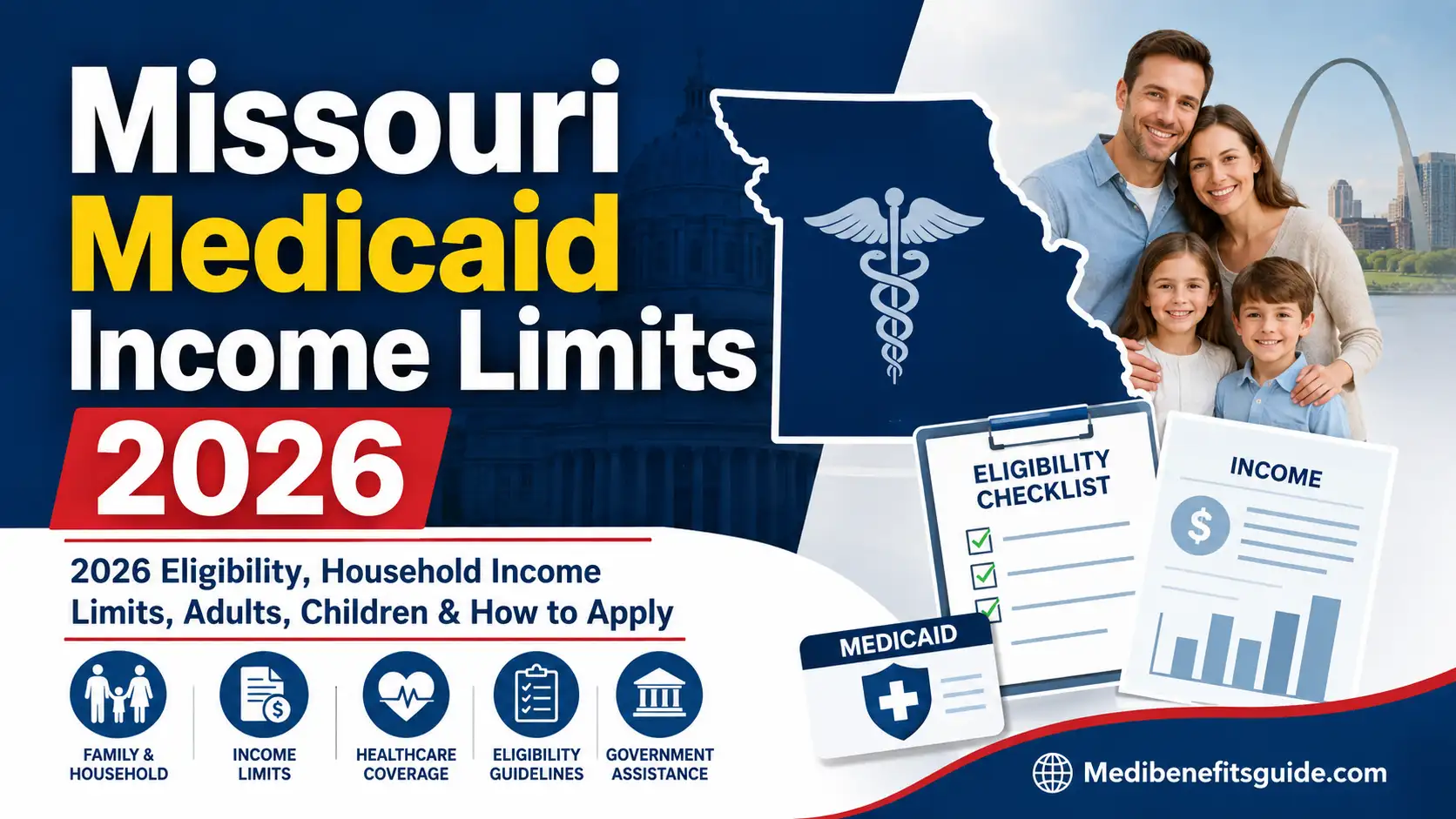
MO HealthNet is Missouri’s name for Medicaid, and it covers eligible residents based on income, age, household situation, pregnancy, disability, and a handful of other factors. There’s no single income number that decides everyone’s eligibility. Missouri runs several programs, each with its own rules.
For 2026, the figure most people search for is the Adult Expansion Group limit. Missouri’s April 1, 2026 income chart puts that standard at 133% of the Federal Poverty Level — $21,226 a year for one person, $43,890 for a household of four.
Missouri Medicaid Income Limits 2026 at a Glance
| Household | Adult Expansion: Annual Income* | Approx. Monthly |
|---|---|---|
| 1 person | $21,226 | $1,769 |
| 4 people | $43,890 | $3,658 |
*These are the Missouri-published Adult Expansion figures identified in the 2026 state income chart. Other Medicaid categories use different limits.
Why Do Some Websites Say 138% Instead of 133%?
This trips up a lot of people.
Missouri’s own program chart lists Adult Expansion at 133% FPL. Yet plenty of third-party sites quote 138%. Both numbers can be right — they’re just describing different stages of the same calculation. The federal Medicaid MAGI methodology applies a 5% income disregard, which pushes the effective threshold higher than the published state standard.
Run the math and you land around $22,025 for one person and $45,540 for a household of four.
So don’t treat these as competing programs. They’re the same standard, viewed before and after the federal adjustment. When you actually apply, Missouri’s Family Support Division works out your eligibility using current rules — you don’t need to reconcile the two numbers yourself.
Also See Medicaid Income Limits for Every State — Full 2026 Guide
How Much Can I Make and Still Get Medicaid in Missouri?
Depends entirely on which MO HealthNet category fits you. If you’re 19 to 64 and don’t have a qualifying disability, Adult Expansion is almost certainly your category. Missouri requires that you live in the state, meet citizenship or qualified non-citizen status, and fall under the applicable income standard.
But here’s where people get tripped up: the Adult Expansion number doesn’t apply to a pregnant woman, a child, a senior, or someone with a disability. Different programs, different math.
The Basic Decision Path
- Age 19–64 and not disabled? Check Adult Expansion.
- Pregnant? Check pregnancy-related MO HealthNet.
- Child under 19? Check children’s Medicaid and CHIP.
- Age 65 or older? Check aged Medicaid and Medicare-related programs.
- Blind or disabled? Check Non-MAGI/ABD programs.
- Medicare recipient with limited income? Also check Medicare Savings Programs.
Start with the category, not the income figure. Comparing your income against one generic Medicaid number is how people wrongly assume they don’t qualify.
Missouri Medicaid for Adults
Missouri expanded Medicaid to adults ages 19 through 64. To qualify under Adult Expansion, you generally need to:
- Live in Missouri.
- Be a U.S. citizen or qualified non-citizen.
- Meet the applicable income requirement.
- Not already qualify under a different Medicaid category.
- Meet whatever other program requirements Missouri sets.
The Missouri Department of Social Services describes Adult Expansion specifically as coverage for people ages 19–64 who meet these requirements.
Can I Get Missouri Medicaid If I Work?
Yes. A paycheck alone doesn’t disqualify you. What actually matters is your countable household income against the threshold for your category. Plenty of working Missourians qualify, especially in lower-wage households.
Missouri Medicaid for Children and CHIP
Kids qualify under entirely different income rules than adults. Missouri’s MO HealthNet materials break it down like this:
- Children under age 1: Medicaid threshold around 196% FPL.
- Children ages 1–18: Medicaid threshold around 148% FPL.
- Above the Medicaid threshold? CHIP picks up coverage up to roughly 300% FPL.
A parent whose income disqualifies them from Adult Expansion shouldn’t assume the same is true for their kids. It usually isn’t.
Can My Child Get Medicaid If I Don’t Qualify?
Yes — and this happens constantly. Children are evaluated under their own standards. A household well over the adult limit can still land a child in MO HealthNet for Kids or CHIP.
Missouri Medicaid Income Limits for Pregnancy
Pregnancy changes the math significantly.
MO HealthNet for Pregnant Women (MPW) uses a much higher income standard than Adult Expansion — 196% of the Federal Poverty Level for the household size, according to Missouri DSS. It also affects household size itself, since an unborn child can count toward that calculation.
There’s also Show-Me Healthy Babies, which covers pregnancy-related care when a woman doesn’t qualify for MPW because of income or other circumstances. Coverage for eligible unborn children extends up to the applicable program limit. If you’re pregnant and unsure, apply. Don’t talk yourself out of it before you’ve even checked.
Seniors and People With Disabilities
Applicants who are 65 or older, blind, or disabled fall under a different eligibility methodology entirely.
These fall under Non-MAGI rules, not the MAGI rules used for adults, children, and pregnant applicants. Which means an Adult Expansion income figure has no bearing whatsoever on whether a senior or disabled applicant qualifies.
Do Assets Count for Missouri Medicaid?
Sometimes. It’s category-dependent. Most MAGI-based categories skip the traditional asset test. Non-MAGI programs — aged, blind, disabled, certain long-term-care coverage — are a different story, and resources can matter there.
What counts as a resource?
- Bank accounts
- Investments
- Certain property
- Other countable assets
Don’t assume savings automatically knock you out, and don’t assume they’re irrelevant either. It comes down to which program you’re applying under.
MAGI vs. Non-MAGI Medicaid
This distinction explains most of the confusion around Missouri Medicaid income limits.
| Feature | MAGI Medicaid | Non-MAGI Medicaid |
|---|---|---|
| Common groups | Adults, children, pregnancy | Seniors, blind, disabled |
| Income methodology | MAGI | Program-specific rules |
| Asset test | Generally not used | May apply |
| Household rules | MAGI household methodology | Can differ |
| Common examples | Adult Expansion, children, pregnancy | Aged, Blind & Disabled |
MAGI stands for Modified Adjusted Gross Income — a federal methodology used across several Medicaid eligibility groups.
Non-MAGI programs run on separate rules. Seniors and disabled applicants comparing their income to the Adult Expansion figure are comparing apples to oranges.
What Income Counts for Missouri Medicaid?
What Missouri considers depends on the program, but typically includes:
- Employment wages
- Self-employment income
- Certain Social Security income
- Other taxable income
- Household income under whichever methodology applies
MAGI programs lean on federal tax-based rules with Medicaid-specific adjustments. Non-MAGI programs use their own income and resource rules — a separate track entirely. Income fluctuates month to month for a lot of people. Report it accurately, and provide verification if Missouri asks for it.
What Happens If You’re Slightly Over the Medicaid Limit?
Missing one threshold doesn’t mean you’re out of options.
You might still qualify for:
- Another MO HealthNet category
- Children’s Medicaid
- CHIP
- Show-Me Healthy Babies
- A Medicare Savings Program
- A disability-related Medicaid pathway
- Spend-down coverage where applicable
- Marketplace health insurance or financial assistance
Seniors on Medicare have a few more doors to check, too — Qualified Medicare Beneficiary (QMB), Specified Low-Income Medicare Beneficiary (SLMB), and Qualified Individual (QI) programs all exist for exactly this situation.
Honestly, the fastest way to know where you stand is to just apply. Missouri screens you across programs rather than making you guess which one fits.
How to Apply for Missouri Medicaid
Missouri’s Family Support Division (FSD) handles eligibility for most MO HealthNet programs. Here’s the process:
- Identify your category. Adult, child, pregnant woman, senior, or person with a disability — figure out which applies before you do anything else.
- Calculate household income. Use current income, not last year’s numbers.
- Prepare documentation. Identity, Social Security number, citizenship or immigration status, residency, household members, income — Missouri verifies these details before approving anything.
- Submit your application. Missouri offers application routes through the Family Support Division.
- Respond to verification requests. A missing document is the single biggest cause of delay.
- Review the decision. Disagree with the outcome? Missouri provides hearing and appeal rights.
How Long Does Missouri Medicaid Take?
Timelines vary by category, not by how busy your local office happens to be. Missouri’s published rights information lists 30 days for MO HealthNet for Families and Children, 15 days for pregnant women, 45 days for seniors, and up to 90 days for certain disability and blindness applications.
Complete verification upfront is the best way to avoid unnecessary delay. Missing paperwork is what stalls most applications.
Missouri Medicaid and Local Resources
Income standards are statewide. Living in St. Louis, Kansas City, Springfield, Columbia, Independence, Jefferson City, St. Joseph, Joplin, Lee’s Summit, or Cape Girardeau doesn’t change the underlying limit. Access, though, can look different depending on where you are.
You may need to track down:
- An FSD Resource Center
- A MO HealthNet provider
- A Medicaid dentist
- A managed-care plan
- Enrollment assistance
- A local healthcare provider
For anything eligibility or application related, go straight to Missouri DSS rather than a third-party local listing.
Missouri Medicaid Eligibility Checklist
Before applying, check these items:
- [ ] I live in Missouri.
- [ ] I know my household size.
- [ ] I know my current income.
- [ ] I identified the correct Medicaid category.
- [ ] I have Social Security information available.
- [ ] I can provide identity and residency information.
- [ ] I have income documentation if requested.
- [ ] I understand MAGI vs. Non-MAGI.
- [ ] I checked whether assets/resources matter for my category.
- [ ] I will respond promptly to FSD verification requests.
FAQs About Missouri Medicaid Income Limits
What is the Missouri Medicaid income limit in 2026?
For Adult Expansion, Missouri’s published standard is 133% FPL — $21,226 a year for one person, $43,890 for a household of four. Other categories use different numbers entirely.
What is the monthly Medicaid income limit in Missouri?
Roughly $1,769 a month for one person and $3,658 for a family of four, under Adult Expansion. Don’t rely on the monthly figure alone; methodology shifts by program.
Why do some sources say 138% FPL?
That’s the effective threshold after the federal 5% MAGI disregard gets applied to Missouri’s published 133% standard. Same number, later in the calculation.
Does Missouri Medicaid count savings?
Depends on the category. MAGI programs generally skip an asset test; certain Non-MAGI programs for seniors and disabled applicants do consider resources.
Can I get Medicaid if I work?
Yes. Employment alone never disqualifies you — it’s your countable income and category that decide eligibility.
Can my child qualify if I make too much for Medicaid?
Yes. Kids run on separate income standards, and CHIP picks up where MO HealthNet for Kids leaves off.
What is the Missouri pregnancy Medicaid income limit?
196% FPL for the household size under MO HealthNet for Pregnant Women. Show-Me Healthy Babies can cover additional situations.
What if I am slightly over the Medicaid income limit?
Keep looking. Another MO HealthNet category, CHIP, pregnancy coverage, a Medicare Savings Program, or spend-down coverage might still apply to you.
How do I apply for MO HealthNet?
Through Missouri’s Family Support Division. Expect to verify income, identity, residency, and Social Security information along the way.
Is Missouri Medicaid free?
Not universally. Costs, premiums, and copayments vary by program — don’t assume one category’s cost-sharing rules apply to another.
Conclusion
Missouri Medicaid isn’t one program with one income cutoff — it’s a set of overlapping categories, each built around who you are and what you need. Figure out which one fits you before you worry about the numbers. And if that first check comes back over-income, don’t close the tab. Apply anyway and let Missouri sort out which door actually opens for you.
Official Resources
- Check Your Eligibility — MO HealthNet (Missouri DSS)
- Apply for Benefits — Missouri Family Support Division
- Verify Federal Poverty Guidelines — U.S. HHS
- Get CHIP Eligibility Details — Medicaid.gov
Disclaimer: This article is for general informational guidance and is not legal, financial, or benefits-eligibility advice. Medicaid policies and income guidelines can change. Missouri DSS/FSD makes the final eligibility determination, so verify current requirements before applying.

About Naseer
Naseer has 10+ years of experience creating informative content and researching medicare topics. He focuses on simplifying Medicaid and benefits details to support readers find clear, reliable, and easy-to-understand guidance.