There’s no single number that tells you whether you qualify for Kansas Medicaid. That’s the first thing to understand, and it’s where most confusion starts. What you can earn and still qualify for KanCare depends on which category you fall into — your age, whether you’re pregnant, whether you’re a parent, and which specific program you’re applying under.
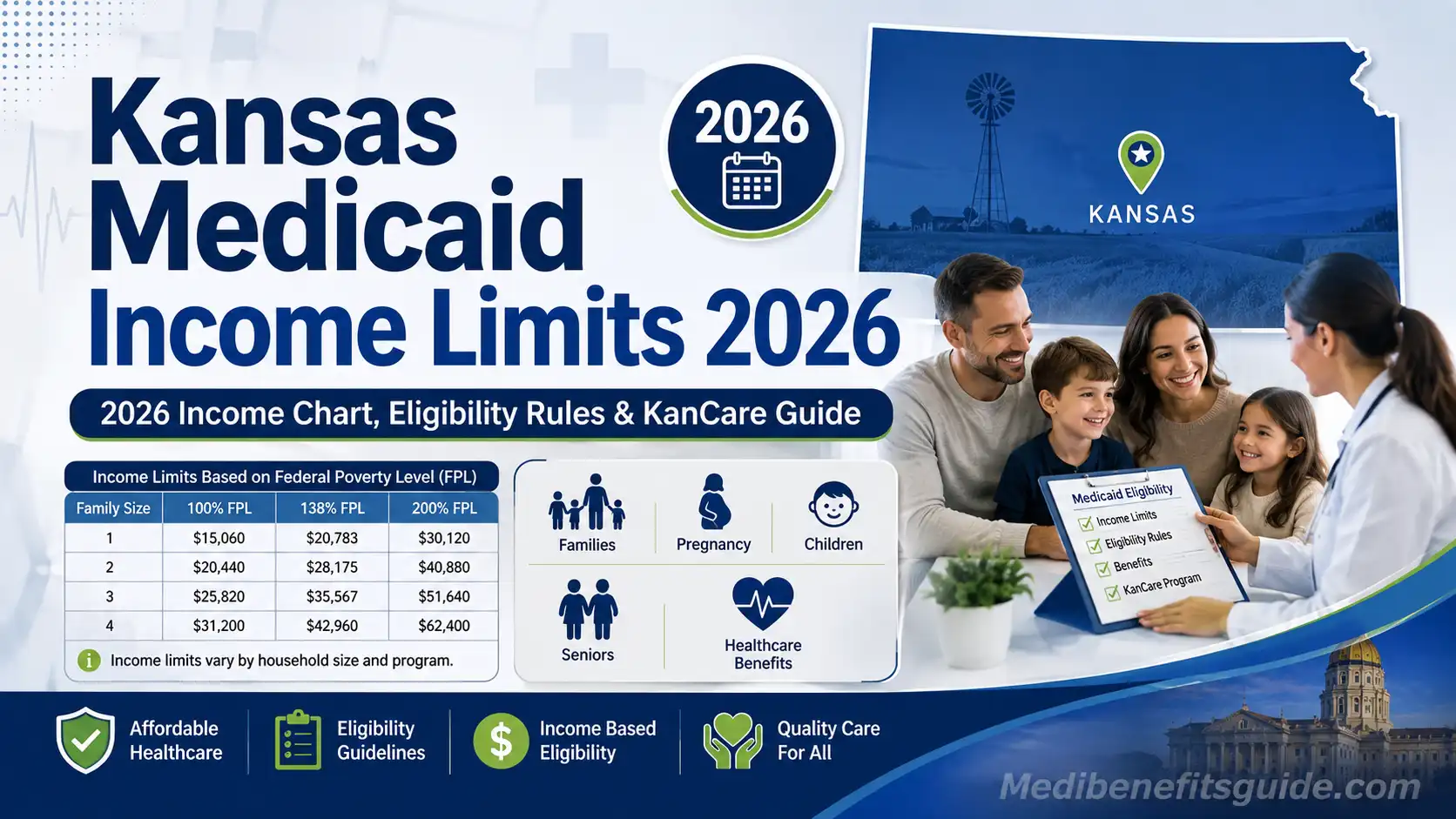
For 2026, Kansas policy sets the bar at 171% of the federal poverty guideline for pregnant women and children under age 1. Children ages 1–5 fall under 149%. Kids ages 6–18 are covered up to 133%. Parents and certain caretaker relatives face a much tighter limit — just 38%.
The 2026 federal poverty guidelines themselves start at $15,960 for a single person and reach $33,000 for a household of four.
Kansas Medicaid Income Limits 2026 at a Glance
Before anything else, figure out which Kansas medical assistance category actually applies to you. Everything downstream depends on it.
| Eligibility group | Kansas income standard |
|---|---|
| Pregnant women | 171% FPL |
| Children under age 1 | 171% FPL |
| Children ages 1–5 | 149% FPL |
| Children ages 6–18 | 133% FPL |
| Certain parents/caretaker relatives | 38% FPL |
| Seniors | Separate program rules |
| People with disabilities | Separate program rules |
| Long-term-care applicants | Separate financial rules |
These percentages come from Kansas policy. Don’t confuse them with the separate standards used for CHIP, Medicare Savings Programs, long-term care, or other KanCare programs — they’re not interchangeable.
You can also Compare Medicaid Income Limits with all States
What Does 100% of the FPL Mean?
The 2026 federal poverty guideline for a household of four is $33,000 a year. Bump that to five people and it’s $38,680. An eight-person household sits at $55,720.
Here’s how that plays out in practice: 133% of the 2026 guideline for a household of four comes to roughly $43,890 a year. That’s before Kansas applies its specific income-counting rules to your situation.
And that last part matters. The real eligibility decision comes from the applicable Kansas medical assistance standard combined with your countable income — not from you multiplying a percentage on your own.
Kansas Medicaid Income Chart by Household Size
Kansas uses the 2026 federal poverty guidelines for the 48 contiguous states.
| Household size | 2026 FPL | Approx. 133% FPL | Approx. 149% FPL | Approx. 171% FPL |
|---|---|---|---|---|
| 1 | $15,960 | $21,227 | $23,780 | $27,292 |
| 2 | $21,640 | $28,781 | $32,244 | $37,004 |
| 3 | $27,320 | $36,336 | $40,707 | $46,717 |
| 4 | $33,000 | $43,890 | $49,170 | $56,430 |
| 5 | $38,680 | $51,444 | $57,633 | $66,143 |
| 6 | $44,360 | $58,999 | $66,096 | $75,856 |
| 7 | $50,040 | $66,553 | $74,560 | $85,568 |
| 8 | $55,720 | $74,108 | $83,023 | $95,281 |
These percentage figures are mathematical references drawn from the 2026 HHS poverty guidelines. Treat them as a starting point, not a formal eligibility determination — that comes from Kansas’s Medical Assistance Standards.
For households larger than eight, add $5,680 to the annual poverty guideline for each additional person.
Kansas Medicaid for Children
Kids qualify under different thresholds depending on how old they are:
- Children under age 1 — 171% FPL
- Children ages 1 through 5 — 149% FPL
- Children ages 6 through 18 — 133% FPL
There’s also a special M-CHIP structure covering certain children ages 6–18 whose family income falls between 113% and 133% of FPL.
Worth knowing: plenty of websites are still running older figures. That’s how families end up with the wrong impression about whether their kids qualify.
Kansas Medicaid Income Limit for Pregnant Women
Pregnant women — including pregnant minors — can qualify for Medicaid without a spenddown as long as countable income doesn’t exceed 171% of the applicable federal poverty guideline.
Pregnancy changes the math. Someone who doesn’t qualify under any other category might suddenly qualify once pregnancy-related Medicaid enters the picture.
Kansas Medicaid Income Limit for Parents and Caretakers
Parents and caretaker relatives get hit with a much stricter income standard than children or pregnant women do.
Kansas sets Caretaker Medical at 38% of the federal poverty level for people who meet the applicable caretaker criteria. That’s a steep drop compared to the child and pregnancy categories above.
This is exactly why families sometimes see mixed results. A child in the household can qualify for Medicaid or CHIP while the parent, under the same roof and same income, doesn’t qualify at all.
Does Kansas Have Medicaid Expansion?
No. Kansas hasn’t adopted the ACA Medicaid expansion for low-income adults the way expansion states have.
So a low income alone won’t get an adult onto KanCare. Eligibility runs through specific categories — children, pregnancy, caretaker relatives, disability, age, former foster-care status, and a handful of other programs.
That leaves a real coverage gap for some low-income adults who simply don’t fit into any qualifying category.
What Income Counts for Kansas Medicaid?
Kansas works from countable income, and the exact rules shift depending on the program. Income sources that can come into play:
- Wages and salary
- Self-employment income
- Social Security
- Certain retirement income
- Other unearned income
- Other income specifically recognized under Kansas rules
Your gross paycheck is not automatically your countable income. Don’t assume the two are the same.
Kansas also splits its methodology by group. MAGI-based rules drive eligibility for most children, pregnant women, and family-related programs, while seniors and people with disabilities fall under a different set of financial rules entirely.
Do Assets Count for Kansas Medicaid?
There’s no universal asset rule across KanCare.
Poverty-level Medicaid eligibility runs on countable income under the applicable provision. Other programs bring resource or asset limits into the equation — which means seniors, people with disabilities, Medicare beneficiaries, and long-term-care applicants can all be judged by different financial yardsticks.
This distinction matters most when you’re comparing regular Medicaid against long-term-care Medicaid, HCBS, SSI-related coverage, or Medicare Savings Programs. Mixing those up leads to bad assumptions fast.
What If Your Income Is Too High?
Missing one Medicaid income limit doesn’t mean you’re out of options. Not even close. Depending on your circumstances, you might qualify for:
- CHIP
- Medically Needy coverage
- Medicaid spenddown
- Medicare Savings Programs
- HCBS programs
- Working Healthy
- MediKan
- Marketplace coverage
Kansas’s medically needy program lets certain people whose income exceeds the normal poverty-level standard qualify anyway, through a spenddown. That covers pregnant women, children, people 65 and older, and people who meet disability or blindness standards.
Kansas Medicaid vs. CHIP
CHIP exists for kids who meet program requirements but whose family income runs too high for Medicaid.
KanCare runs CHIP as its Children’s Health Insurance Program for uninsured children under 19 who don’t qualify for Medicaid.
| Medicaid | CHIP |
|---|---|
| Covers several qualifying groups | Primarily covers qualifying children |
| Lower income standards may apply | Higher child-income ranges may apply |
| Often little or no cost | Some families may have premiums |
| Includes specialized programs | Focused on children’s coverage |
CHIP income standards and premiums shift over time. Use the current Kansas standards — not whatever chart you found first.
How to Apply for KanCare
If you think you qualify, apply. Trying to nail down a final determination yourself before applying usually just wastes time.
- Identify your category — child, pregnant woman, parent/caretaker, senior, disabled person, or another program.
- Gather income information and household details.
- Prepare identity and residency information.
- Submit a KanCare application online or by another approved method.
- Respond to verification requests.
- Review your eligibility decision and complete any required managed-care enrollment.
Kansas runs online applications through its Medical Consumer Self-Service Portal. Need help instead? The KanCare Clearinghouse is reachable at 1-800-792-4884.
Medical assistance generally starts with the month of application. In some circumstances, coverage can reach back to the three preceding months if you request it.
Kansas Medicaid by City and Region
Kansas Medicaid income standards are statewide, full stop. There’s no separate limit for Wichita, Topeka, Overland Park, Olathe, Lawrence, Manhattan, Salina, Hutchinson, Garden City, Dodge City, or anywhere else in the state.
Where local differences actually show up is in application assistance, office locations, enrollment support, and which providers accept KanCare.
So whether you’re searching for KanCare in Wichita, Medicaid application help in Topeka, or just Medicaid assistance near me — the eligibility standards underneath it all don’t change.
Why You May See Different Kansas Medicaid Income Limits Online
Different sites show different numbers for a reason. Usually it’s one of these:
- An older year’s federal poverty guidelines
- Older Kansas eligibility policies
- CHIP limits instead of Medicaid limits
- Different eligibility categories
- MAGI versus non-MAGI rules
- Different household definitions
- Outdated third-party charts
Kansas’s current Family Medical Assistance Manual lists the 2026 thresholds discussed here — 171%, 149%, and 133% for the child and pregnancy categories. That’s the version worth trusting.
Bottom line: verify anything that matters against current Kansas policy, not a random chart from a few years back.
Common Kansas Medicaid Mistakes
Watch out for these:
- Using one income limit for everyone
- Confusing Medicaid with CHIP
- Using an old 2025 chart
- Assuming every adult with low income qualifies
- Treating gross wages as the final eligibility income
- Ignoring household-size rules
- Assuming assets are treated the same for every program
- Failing to report changes
- Giving up after being denied under one category
- Ignoring medically needy or spenddown options
Quick Eligibility Decision Path
Who needs coverage?
Child → Pregnancy → Parent/caretaker → Senior → Disability → Long-term care → Other qualifying category
Then work through: Household → countable income → applicable standard → other eligibility rules → application
FAQs About Kansas Medicaid Income Limits
What is the Kansas Medicaid income limit in 2026?
There isn’t one single limit. Current policy sets 171% FPL for pregnant women and children under 1, 149% for ages 1–5, and 133% for ages 6–18.
How much can I make and still qualify for Medicaid in Kansas?
Depends entirely on your category and household size. Children, pregnant women, parents, seniors, and people with disabilities all face different standards.
What is the Kansas Medicaid income limit for a family of four?
The 2026 federal poverty guideline for four people is $33,000 — but which percentage applies depends on who’s applying and under which category.
Can a single adult get Medicaid in Kansas?
Only through specific qualifying categories. Kansas doesn’t offer broad Medicaid expansion based on low income alone.
Does Social Security count as income for Kansas Medicaid?
It can, but the treatment varies by program and methodology. Don’t assume every dollar counts the same way across every KanCare category.
Does Kansas Medicaid have an asset limit?
Some programs do, some don’t. Poverty-level programs often use income alone; seniors, disabled applicants, and long-term-care applicants should check their specific program’s rules.
What happens if my income is too high for Medicaid?
You may still qualify through CHIP, medically needy coverage with a spenddown, Medicare Savings Programs, or another pathway.
Is CHIP available in Kansas?
Yes. KanCare administers CHIP for eligible uninsured children who don’t qualify for Medicaid.
How do I apply for Kansas Medicaid?
Apply through the official KanCare application system, or get help from the KanCare Clearinghouse at 1-800-792-4884.
Can I qualify for Medicaid if I work?
Working alone doesn’t disqualify you. Kansas looks at income and category — and programs like Working Healthy exist specifically for people who work.
Conclusion
Kansas Medicaid isn’t a one-size-fits-all system, and honestly, that’s the whole point of this guide. Your category, your household size, and the specific KanCare program you’re applying under all shape the answer — 171% FPL for pregnant women and children under 1, 149% for ages 1–5, 133% for ages 6–18, and 38% for qualifying parents and caretakers.
Don’t lean on an online calculator for a final answer. Check the current Kansas standards, and if there’s any chance you qualify, apply. Official KanCare application and eligibility information
Official Resources
- Apply for KanCare — Kansas KanCare Portal
- Check Federal Poverty Guidelines — U.S. HHS/ASPE
- Verify Medicaid Eligibility Rules — Medicaid.gov
- Get CHIP Coverage Details — InsureKidsNow.gov
Disclaimer: This article is for general informational purposes and is not legal, financial, or benefits-eligibility advice. Kansas Medicaid rules and income standards can change. Always verify your situation with KanCare/KDHE before making an eligibility or coverage decision.

About Naseer
Naseer has 10+ years of experience creating informative content and researching medicare topics. He focuses on simplifying Medicaid and benefits details to support readers find clear, reliable, and easy-to-understand guidance.