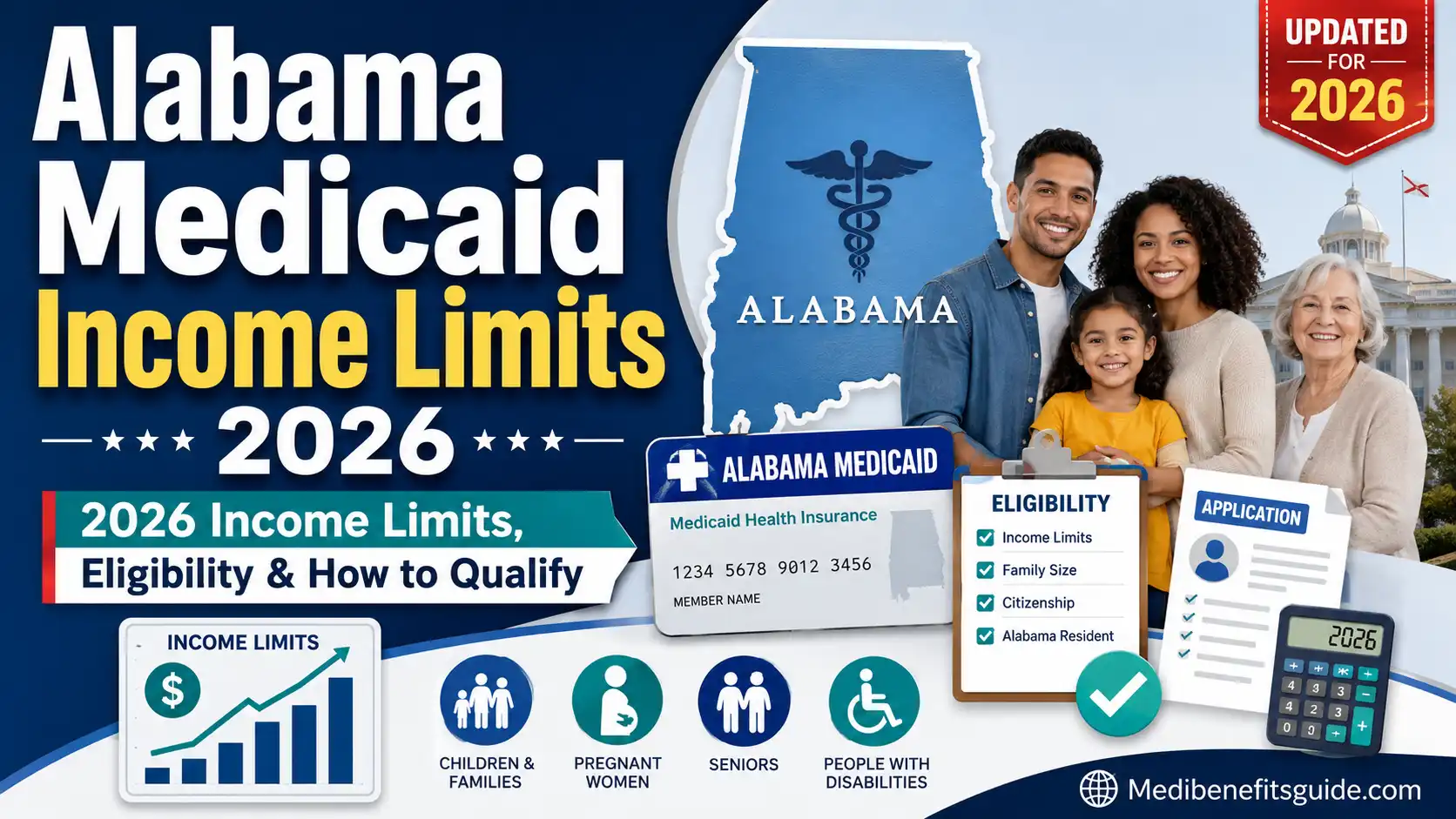
There’s no single Alabama Medicaid income limit for everyone. Alabama Medicaid has different eligibility groups, and the applicable income rule depends on factors like age, pregnancy, household size, disability, Medicare status and whether you need long-term-care coverage. Alabama Medicaid’s eligibility information was updated March 11, 2026.
That distinction matters because using one number for every applicant produces the wrong answer more often than not. A child, a pregnant woman, a parent, a senior receiving SSI-related Medicaid, a Medicare beneficiary, and a nursing-home applicant all face different financial rules — sometimes wildly different ones.
Which Alabama Medicaid Income Limit Applies to You?
Start with your situation rather than a dollar amount.
Your situation Program or pathway to check
Child under 19 Children’s Medicaid / ALL Kids
Pregnant Pregnancy Medicaid
Parent or caretaker of a child Parent/caretaker Medicaid
Age 65+ or qualifying disability Elderly & Disabled / SSI-related programs
Enrolled in Medicare QMB, SLMB or QI-1
Need nursing-home care Institutional/Nursing Home Medicaid
Need qualifying home-based care HCBS waiver programs
Former Alabama foster child Former Foster Care Medicaid
Family-planning services Plan First
Alabama Medicaid officially lists these as separate eligibility categories, each with its own requirements.
The Simplest Decision Path
Child → Children’s Medicaid or ALL Kids
Pregnant → Pregnancy Medicaid
Parent/caretaker → Parent/caretaker category
65+ or disabled → Elderly & Disabled/SSI-related rules
Medicare → Medicare Savings Programs
Nursing-home care → Long-term-care Medicaid
Family planning → Plan First
This approach beats hunting for one statewide “cutoff” that doesn’t actually exist.
Alabama Medicaid Income Limits by Program
Children, Pregnant Women and Parents
Children, pregnant women and eligible parents or caretaker relatives generally fall within Medicaid’s MAGI-based eligibility framework. MAGI stands for Modified Adjusted Gross Income — a household-income method used for many Medicaid categories.
The exact limit depends on the eligibility group and household circumstances. Alabama publishes current income-limit information rather than applying one universal percentage to every Medicaid applicant.
A family of four shouldn’t assume its income automatically qualifies or disqualifies every person in the household. Each member can land in a different eligibility bucket.
Also See Alabama Reimbursement Rates 2027 — Full Guide
Seniors and People With Disabilities
People who are elderly or have qualifying disabilities generally follow different financial rules than children and pregnant applicants.
SSI-related Medicaid ties back to federal SSI standards. Alabama’s 2026 eligibility grid lists SSI income limits of $1,014 per month for an individual and $1,511 for a couple under the applicable SSI-related category.
Other elderly and disabled programs can carry additional eligibility requirements, including resource rules.
Nursing-Home Medicaid
Nursing-home Medicaid is one of the biggest areas where people trip up.
For 2026, Alabama’s eligibility grid lists a $2,982 monthly nursing-home income limit. The state describes this under its institutionalized eligibility group and also references resource rules and the possibility of a Qualified Income Trust for individuals who meet applicable requirements.
Don’t use a children’s or pregnancy Medicaid income chart to determine nursing-home eligibility — the math simply doesn’t transfer.
Long-term-care eligibility can involve:
- Monthly income
- Countable resources
- Marital status
- Spousal protections
- Medical eligibility
- Nursing-facility requirements
- Home and Community-Based Services
- Qualified Income Trusts, sometimes called Miller Trusts
- Estate-recovery rules
These rules touch significant financial and family decisions, so applicants should verify their circumstances directly with Alabama Medicaid rather than relying on a general guide.
Alabama Medicare Savings Program Income Limits
You can have Medicare and Medicaid at the same time. Alabama runs Medicare Savings Programs that help qualifying Medicare beneficiaries with certain Medicare costs.
For 2026, Alabama’s eligibility grid lists these February 2026 income ranges:
Program Individual monthly income Couple monthly income
QMB Below $1,350 Below $1,824
SLMB $1,350.01–$1,616 $1,824.01–$2,184
QI-1 $1,616.01–$1,816 $2,184.01–$2,455
These are program-specific limits. The correct program depends on your Medicare status and income — not just one or the other.
QMB stands for Qualified Medicare Beneficiary. SLMB means Specified Low-Income Medicare Beneficiary, while QI-1 means Qualifying Individual. Alabama also identifies Qualified Disabled Working Individuals among its Medicare-related categories.
Also See Medicaid Income Limits for Every State
Does Alabama Medicaid Count Gross or Net Income?
There’s no universal answer, because Alabama uses different financial methodologies for different eligibility groups.
For many children, pregnancy and parent/caretaker categories, MAGI matters most. MAGI runs on tax-related household income rules rather than simply comparing a paycheck’s gross amount against one Medicaid number.
For SSI-related and long-term-care categories, different income and resource rules can apply instead.
What Income Should You Report?
Depending on your situation, Medicaid may need information about sources such as:
- Employment income
- Social Security
- SSI
- Retirement income
- Pensions
- Self-employment income
- Other countable income
Don’t assume a deduction or expense automatically makes income “net” for Medicaid purposes. It doesn’t work that way across every category.
Does Social Security Count as Income?
Social Security can matter when Medicaid determines eligibility, but how it’s treated depends on the program.
This is especially important for seniors, people with disabilities and Medicare beneficiaries. SSI-related Medicaid, Medicare Savings Programs and MAGI-based Medicaid don’t all use identical financial rules — treating them as interchangeable is a common misstep.
If you receive Social Security, provide accurate benefit information with your application rather than trying to exclude it yourself.
Does Alabama Medicaid Count Bank Accounts and Assets?
Again, it depends on the program.
Many MAGI-based Medicaid categories generally skip a traditional asset test. Resource rules, though, can apply to SSI-related Medicaid, nursing-home Medicaid and certain other programs.
Countable resources can potentially include financial assets, though Medicaid rules contain important exclusions and exceptions.
This is exactly why someone over an income guideline shouldn’t assume every Medicaid pathway is closed — and why someone under a guideline shouldn’t assume approval is automatic.
What If You Are Slightly Over the Income Limit?
Being over one Medicaid limit doesn’t necessarily mean you’re out of health-coverage options. Depending on your circumstances, consider:
- ALL Kids for eligible children
- Medicare Savings Programs
- Plan First
- Disability-related Medicaid categories
- Nursing-home or HCBS pathways when applicable
- Marketplace coverage and financial assistance
- Other specialized Medicaid programs
Alabama’s application system can be used to determine eligibility for applicable coverage options, and the state specifically advises applicants to provide the required information and complete the correct application.
Medicaid vs. ALL Kids
Feature Medicaid ALL Kids
Main population Multiple eligible groups Children
Income rules Depend on program Child-specific
Application Alabama Medicaid application routes Same health-coverage application can be used
Purpose Medicaid coverage Alabama’s CHIP program
Eligibility Income plus category-specific requirements Household size and income plus program requirements
Alabama confirms the same application can be used to determine whether a child qualifies for Medicaid or ALL Kids.
How to Apply for Alabama Medicaid
The application process depends on the program.
For Children, Pregnancy, Parents and Plan First
- Review the eligibility category that fits your situation.
- Gather household and income information.
- Complete the Alabama application online or use the appropriate paper form.
- Submit supporting information requested by Medicaid.
- Respond promptly if the agency requests verification.
- Watch for your eligibility determination by mail or through the applicable online system.
Alabama provides online and paper application options for children, pregnant women, parents/caretakers and Plan First.
For Elderly, Disabled or Nursing-Home Applicants
Different application routes apply here. Alabama provides Form 204/205 and online options for Elderly & Disabled programs, nursing-home care and home- and community-based waiver programs.
For help, contact the Alabama Medicaid Recipient Call Center at 800-362-1504, Monday through Friday, 8:00 a.m. to 4:30 p.m.
Alabama also has Medicaid district offices and outstationed workers at many county health departments, federally qualified health centers and some hospitals.
Documents You May Need
Prepare information such as:
- Household members’ names and dates of birth
- Social Security numbers when applicable
- Income information
- Employment information
- Social Security or SSI information
- Citizenship or qualifying immigration information
- Medicare information
- Insurance information
- Asset/resource information when required for your category
- Medical or disability information when relevant
The exact documentation depends on the Medicaid program you’re applying under.
Common Alabama Medicaid Mistakes to Avoid
Using One Income Limit for Everyone
This is the most important mistake on the list. Alabama has multiple Medicaid eligibility groups, and treating them as one is where most confusion starts.
Using an Old 2025 Chart
Income standards change. Alabama’s current eligibility information identifies an updated date of March 11, 2026.
Applying the Children’s Rules to a Senior
Children’s and MAGI-based rules aren’t the same as SSI-related or long-term-care rules — not even close.
Assuming Assets Never Matter
Resource tests can apply to certain Medicaid pathways, even when they don’t apply to others.
Assuming $1 Over One Limit Means No Coverage
Other Medicaid categories, ALL Kids, Medicare Savings Programs or Marketplace coverage may still be relevant.
FAQs About Alabama Medicaid Income Limits
What is the Alabama Medicaid income limit in 2026?
There’s no single limit. Alabama Medicaid uses different income standards for different eligibility groups, including children, pregnancy, parents, elderly or disabled applicants, Medicare beneficiaries and nursing-home applicants.
What is the Medicaid income limit for a family of four?
It depends on which Medicaid category the family applies under. Use the current Alabama income table for the specific applicant rather than a general Medicaid number.
Can a single adult get Medicaid in Alabama?
Eligibility for adults depends on the applicable Medicaid category. Alabama doesn’t use one general income-based Medicaid pathway for every childless adult, so age, disability, pregnancy, Medicare status and other circumstances matter.
Does Social Security count for Alabama Medicaid?
Social Security can be relevant income, particularly for SSI-related and Medicare-related programs. The exact treatment depends on the eligibility category.
Does Alabama Medicaid count bank accounts?
Some Medicaid categories have resource or asset tests, while many MAGI-based categories generally don’t use a traditional asset test. The answer depends on the program.
Can I have Medicare and Medicaid?
Yes. Alabama has Medicare Savings Programs including QMB, SLMB and QI-1 for eligible Medicare beneficiaries.
What is the 2026 Alabama nursing-home Medicaid income limit?
Alabama’s 2026 eligibility grid lists $2,982 per month for the nursing-home/institutionalized income limit. Long-term-care applicants must also satisfy applicable resource and other requirements.
What if my income changes after I qualify?
Report changes as required. Alabama provides Form 295 for reporting changes such as income, address or marital status.
Can children qualify if their parents do not?
Yes. Eligibility is determined by the applicable child and household rules — a parent being ineligible doesn’t automatically mean a child is ineligible.
What is ALL Kids?
ALL Kids is Alabama’s Children’s Health Insurance Program (CHIP). Children who don’t qualify for Medicaid may potentially qualify for ALL Kids depending on household income and other requirements.
Where can I get help applying?
Contact Alabama Medicaid at 800-362-1504. The state also has district offices and outstationed workers at many county health departments, FQHCs and hospitals.
Can I apply online?
Yes, online application options are available for several Alabama Medicaid categories. The appropriate application route depends on whether you’re applying for children, pregnancy, parents/caretakers, Plan First, elderly/disabled coverage, nursing-home care or another program.
How long does Medicaid approval take?
Processing time depends on the program and whether Medicaid needs additional information. Alabama states that applicants receive a letter about the eligibility decision and may be asked for additional information.
Can I appeal a Medicaid denial?
If you receive a denial, review the notice carefully for instructions about your appeal or hearing rights and deadlines. Don’t ignore the deadline stated in your official notice — it matters more than people realize.
Conclusion
Alabama Medicaid income limits in 2026 are program-specific, not one universal number. The right income standard depends on whether you’re applying for a child, pregnancy coverage, parent/caretaker coverage, elderly or disability-related Medicaid, Medicare Savings assistance, nursing-home care or another specialized program.
The safest approach is to identify your eligibility category first, use the current Alabama standard for that category, provide accurate income and household information, and apply even when you’re unsure. Uncertainty isn’t a reason to skip the application — it’s a reason to let Medicaid make the call.
For current rules, forms and application assistance, use the Alabama Medicaid Agency as the primary source. Alabama’s official eligibility grid was updated March 11, 2026.
Official Resources
- Apply for Alabama Medicaid Now — Alabama Medicaid Agency
- Check Your ALL Kids Eligibility — Alabama Department of Public Health
- Verify Medicare Savings Program Rules — Medicare.gov
- Find Marketplace Coverage Options — HealthCare.gov
Disclaimer: This article is for general information and does not guarantee eligibility. Medicaid rules can change, and final eligibility is determined by Alabama Medicaid based on your individual circumstances and the applicable program rules.

About Naseer
Naseer has 10+ years of experience creating informative content and researching medicare topics. He focuses on simplifying Medicaid and benefits details to support readers find clear, reliable, and easy-to-understand guidance.