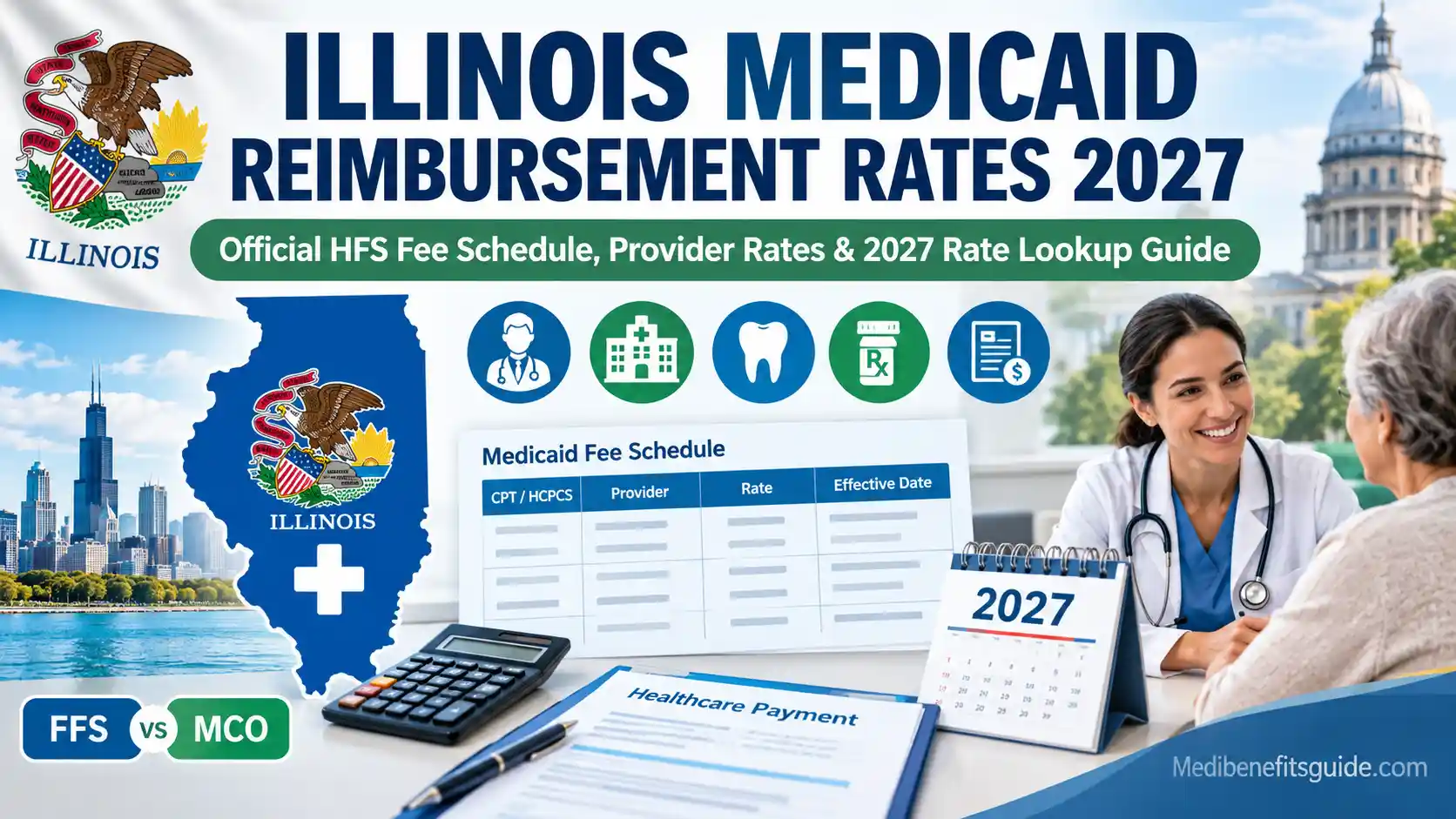
There’s no single number that answers “what does Illinois Medicaid pay?” Never has been. HFS doesn’t run one reimbursement schedule — it runs dozens, split out by provider type. What you actually get paid on a claim comes down to a stack of variables: the procedure code, your provider category, the effective date, any modifiers attached, units billed, coverage rules, and whether the claim goes through fee-for-service or a managed care organization.
If you’re a provider trying to bill correctly, here’s the rule that actually matters: match the service to the correct HFS schedule and effective date before you use any rate for billing or reimbursement estimates. Skip that step and everything downstream gets messy.
As of September 2026, HFS is still publishing current 2026 schedules across most categories, even while 2027 payment developments move forward in specific areas. Hospital reimbursement is one of them — HFS has already issued Rate Year 2027 procedures for Disproportionate Share Hospital (DSH) and Medicaid Percentage Adjustment (MPA) payments.
Does Illinois Have a 2027 Medicaid Fee Schedule?
Not as one statewide, all-provider spreadsheet. That’s not how HFS structures this.
HFS maintains a large Medicaid reimbursement directory covering practitioner services, dental, durable medical equipment (DME), home health, hospitals, long-term care, behavioral health, therapy, transportation, FQHCs, pharmacy, and a handful of other categories. So before you go searching for an “Illinois Medicaid fee schedule 2027,” figure out which service you’re actually billing.
| Provider or service | Typical rate resource |
|---|---|
| Physicians and practitioners | Practitioner Fee Schedule |
| Dentists | Dental Fee Schedule |
| DME suppliers | DME Fee Schedule |
| Home health | Home Health Fee Schedule |
| Hospitals | Hospital payment methodologies and notices |
| Nursing facilities | Long-Term Care reimbursement resources |
| FQHCs | FQHC rates |
| Rural health clinics | RHC rates |
| Therapists | Therapy Fee Schedule |
| Behavioral health | Applicable behavioral-health schedules |
| Transportation | Transportation Fee Schedule |
| Pharmacy | Pharmacy/NDC-related reimbursement resources |
HFS also keeps archived schedules on file. Worth knowing if you’re researching an older claim — the rate that applies today isn’t necessarily the rate that applied when the service was actually performed.
How to Find an Illinois Medicaid Reimbursement Rate
Need an exact rate by CPT, HCPCS, or another billing code? Work through it in order:
- Identify the provider and service category
- Find the correct CPT, HCPCS, CDT, NDC, or revenue code
- Pin down the date of service
- Open the HFS schedule that was effective on that date
- Review the fee-schedule key, if one’s provided
- Check modifiers, units, and place of service
- Confirm coverage and any prior-authorization requirements
- Determine whether the claim is FFS or managed care
- Compare the published rate against the remittance advice or the applicable MCO contract
Date of service trips people up more than anything else on this list. HFS updates schedules on its own timeline, not yours. The current practitioner page, for instance, lists a schedule effective July 1, 2026, updated September 15, 2026 — plus earlier 2026 versions and archived files going back further. Use the wrong one and your rate lookup is wrong from the start.
Illinois Medicaid Physician and Practitioner Rates
The practitioner fee schedule is where most physician, professional, and individual-practitioner billing starts.
Rates attach to CPT or HCPCS codes, and modifiers can shift what actually gets paid. HFS also publishes a Practitioner Fee Schedule Key that walks through what the rate file contains — genuinely useful if you’re staring at a spreadsheet of codes with no context.
Don’t assume one CPT rate covers every situation involving that code. Final payment comes down to the code itself, the modifier, units billed, provider eligibility, coverage rules, and which payment system processed the claim.
Illinois Medicaid Dental Rates
Dental reimbursement lives outside the general practitioner schedule entirely. Dentists, oral surgeons, and beneficiaries need to treat it as its own category.
Dental services typically run on CDT codes, while certain medical services tied to oral healthcare might use CPT or HCPCS coding instead — a distinction that catches people off guard.
Check the applicable HFS dental schedule, its effective date, coverage policy, and any managed-care requirements before you assume a generic Medicaid rate applies. If you’re also verifying whether a patient qualifies for coverage in the first place, the Illinois Medicaid income limits page is a useful cross-check before you go further down the billing path.
Illinois Medicaid Hospital Reimbursement Rates
Hospital reimbursement isn’t a simple CPT lookup. It’s a different animal.
Illinois uses payment methodologies involving APR-DRG, EAPG, hospital assessments, supplemental payments, directed payments, and other mechanisms layered on top of each other. For Rate Year 2027, HFS has already set data-collection procedures for DSH and Medicaid Percentage Adjustment payments — pulling from hospital cost-report periods to determine eligibility and calculate what’s owed.
HFS is also gathering Average Commercial Rate (ACR) information tied to hospital funding. Federal Medicaid requirements will affect managed-care payments starting January 1, 2027, and that includes directed payments specifically.
So treat an Illinois Medicaid hospital reimbursement figure as its own thing. It is not equivalent to a standard physician fee-schedule rate, and comparing the two directly will lead you astray.
Nursing Facility and Long-Term Care Rates
Nursing facility reimbursement in Illinois uses facility-specific payment methodologies. There’s no flat per-resident, per-service amount.
Long-term care payment involves per-diem concepts, separate nursing and support components, capital-related costs, and resident assessment data pulled from the Minimum Data Set (MDS). Layers on layers.
That’s exactly why a generic search for “Illinois Medicaid nursing home reimbursement rate” tends to produce misleading answers. What actually gets paid depends on facility characteristics, resident-specific information, cost-reporting factors, and the HFS methodology that applies to that facility.
DME, Home Health and HCBS Rates
HFS keeps DME and home health on entirely separate tracks, each with its own resources.
The current DME page shows a 2026 fee schedule effective January 1, 2026. Home health maintains its own schedule and its own historical files, updated independently of DME.
Home and Community-Based Services (HCBS) make up another major category — and a fast-moving one. HFS issued several September 2026 public notices covering HCBS waiver programs, including services for medically fragile and technology-dependent individuals, adults with developmental disabilities, children and young adults with developmental disabilities, and supportive living arrangements.
Each of these programs can carry its own service-specific reimbursement methodology. Verify any HCBS rate against the specific waiver program and the current HFS schedule — don’t assume one waiver’s rate structure carries over to another.
FFS vs Managed Care: Are the Rates the Same?
No. Not automatically, and not always.
An HFS fee-for-service rate isn’t the payment a provider will necessarily receive from every Medicaid managed-care organization. Under FFS, claims follow HFS payment rules directly. Illinois also runs Medicaid managed care through organizations like HMOs and Managed Care Community Networks (MCCNs), and those entities negotiate their own terms.
| Fee-for-Service (FFS) | Managed Care |
|---|---|
| HFS payment rules apply | MCO contract and plan rules may apply |
| HFS fee schedules are central | Provider-plan agreements may affect payment |
| Claims processed under FFS rules | Claims processed through the applicable MCO |
| Published rate can guide payment | Contract-specific reimbursement may differ |
Three different numbers, three different concepts: the published Medicaid rate, an MCO-negotiated rate, and whatever actually showed up on a historical claims payment. Don’t treat them as interchangeable.
What Can Change the Final Medicaid Payment?
The published rate is a starting point, not a guarantee of what lands on the claim.
Factors that can shift the final number:
- CPT, HCPCS, CDT, or revenue code
- Modifier
- Units
- Place of service
- Provider type
- Effective date
- Coverage rules
- Prior authorization
- Medical necessity
- FFS or managed-care status
- MCO contract terms
- Claim edits
- Corrected-claim processing
- Provider enrollment
- Remittance-advice adjustments
HFS provider handbooks go deeper than any fee schedule — they lay out payment and reimbursement rules that never show up in the rate file itself.
Illinois Medicaid Rates for 2027: What Is Changing?
Here’s the honest answer: 2027 changes are category-specific, not a blanket statewide increase. Anyone telling you otherwise hasn’t looked closely.
Hospital reimbursement shows the most visible 2027 activity right now, with DSH/MPA determinations and ACR-related requirements actively moving forward.
Plenty of other categories are still running on 2026 schedules until HFS gets around to updating them. The practitioner page, for example, currently displays 2026 schedules while other provider categories sit on entirely separate update cycles. If you’re comparing rates across states or trying to gauge where Illinois lands relative to its neighbors, the Medicaid reimbursement rates by state comparison is a solid reference point.
And when you’re reading about proposed legislation or future payment changes, know the difference between proposed, pending, approved, and effective. A proposal is not an enacted rate. Treating it like one will cost you.
Where Can You Find the Official Illinois Medicaid Fee Schedule?
Start with the Illinois Department of Healthcare and Family Services Medicaid Reimbursement directory — it links out to every provider-specific schedule and reimbursement resource HFS maintains.
For federal requirements, payment limitations, and broader Medicaid policy, CMS and Medicaid.gov fill in the gaps HFS doesn’t cover. For Illinois laws and enacted payment provisions specifically, the Illinois General Assembly is the source.
Third-party databases have their place too — normalized data, historical claims info, easier code searching. Just don’t let one replace the official HFS schedule when you need the controlling Illinois Medicaid rate. That distinction matters more than people give it credit for.
Common Mistakes When Checking Illinois Medicaid Rates
- Using the newest schedule without checking the date of service
- Treating one fee schedule as applicable to every provider
- Confusing FFS reimbursement with MCO reimbursement
- Treating a proposed law as an effective rate
- Assuming a listed code automatically means the service is covered
- Ignoring modifiers or units
- Using historical claims averages as if they were official fee-schedule amounts
- Forgetting to check archived schedules for older claims
FAQs: Illinois Medicaid Reimbursement Rates
What are Illinois Medicaid reimbursement rates for 2027?
There’s no single rate. HFS publishes different schedules and payment methodologies by provider and service category, and what applies depends on the code, the effective date, and the payment system involved.
Has Illinois released a 2027 Medicaid fee schedule?
Not one universal schedule covering every service. As of September 2026, HFS still displays 2026 schedules in several categories, while 2027-specific activity is already underway in areas like hospital reimbursement.
Does Illinois Medicaid have one fee schedule?
No. HFS runs separate reimbursement resources for practitioner, dental, DME, home health, hospital, long-term care, FQHC, therapy, and transportation services, among others.
How do I look up an Illinois Medicaid CPT rate?
Find the correct HFS practitioner or service-specific fee schedule, locate the CPT or HCPCS code, confirm the effective date, then check the fee-schedule key, modifiers, units, and any other applicable payment rules.
How much does Illinois Medicaid pay doctors?
No single figure exists. Physician payment varies by CPT or HCPCS code, provider circumstances, effective date, modifiers, and whether the service runs through FFS or managed care.
How much does Illinois Medicaid pay dentists?
Dental reimbursement varies by CDT or applicable procedure code, service type, coverage requirements, effective date, and payment arrangement. Use the HFS dental resources directly rather than assuming the general practitioner schedule applies.
What is the Illinois Medicaid DME fee schedule?
It lists reimbursement information for eligible durable medical equipment and supplies. HFS currently provides a 2026 DME schedule and fee-schedule key, with archived versions available for historical research.
Are Illinois Medicaid MCO rates the same as HFS rates?
Not necessarily. FFS payment follows HFS rules directly, while managed-care reimbursement depends on MCO contracts and payment arrangements. Always verify against the applicable plan.
Does an HFS fee schedule guarantee payment?
No. A listed amount doesn’t guarantee a specific claim gets paid. Coverage, eligibility, authorization, coding accuracy, provider enrollment, medical necessity, and claim-processing rules all factor in.
What date determines the Illinois Medicaid reimbursement rate?
The date of service. Always use the schedule that was effective on that date, and check whether later corrections or updates affect what applied.
How often does Illinois HFS update reimbursement rates?
There’s no single schedule for updates across every program. Different categories update on different timelines — practitioner schedules alone have seen multiple effective dates within a single year.
Conclusion
If you take one thing from this: stop looking for a single Illinois Medicaid number, because it doesn’t exist. What exists is a set of provider-specific schedules, each with its own effective dates and its own rules, and the only way to get a rate right is to work through the process — code, date of service, correct HFS schedule, FFS or managed care.
Heading into 2027, keep an eye on new HFS notices, hospital payment developments, and HCBS changes as they move from proposal to policy. When in doubt, go straight to the Illinois Department of Healthcare and Family Services. Everything else is a starting point, not the final word.
Official Resources
- Check Current HFS Fee Schedules — Illinois HFS
- Verify Federal Medicaid Rules — Medicaid.gov
- See CMS Payment Policies — CMS.gov
- Find Enacted Illinois Statutes — Illinois General Assembly
Disclaimer: Rates shift. Fee schedules get updated without much warning. So take this article as a starting point, not gospel — it’s not a substitute for the current HFS fee schedule, your provider handbook, an MCO contract, or whatever official notice actually governs your situation. Before you bill or budget around any number here, check it against the rate and payment rules for that specific service, on that specific date.

About Naseer
Naseer has 10+ years of experience creating informative content and researching medicare topics. He focuses on simplifying Medicaid and benefits details to support readers find clear, reliable, and easy-to-understand guidance.