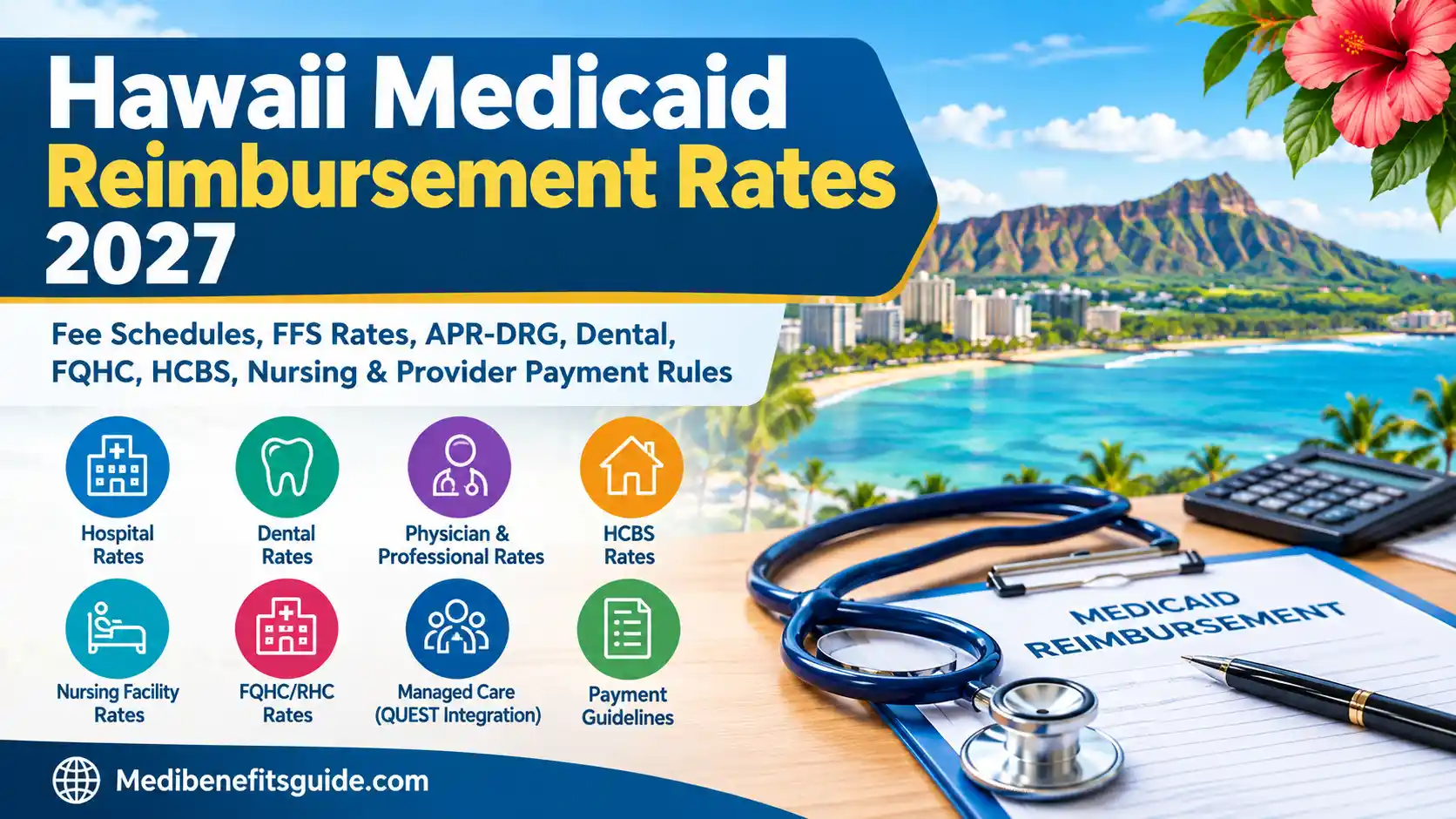
There’s no single number you can point to and call “the Hawaii Medicaid rate” for 2027. Ask that question and you’ll get a different answer depending on the service, the procedure code, the provider type, and whether the claim runs through fee-for-service Medicaid or a QUEST Integration managed care plan. Modifiers matter too.
For fiscal year 2027, the rate period runs July 1, 2026, through June 30, 2027. Med-QUEST’s QI-2614 is the memo doing the heavy lifting here — it’s the key FY2027 Medicaid FFS rate document you’ll want on hand.
Before diving into specifics, it’s worth checking how these rates compare to what other states pay. Our breakdown of Medicaid reimbursement rates by state puts Hawaii’s numbers in context.
Hawaii Medicaid Reimbursement Rates 2027 at a Glance
The Hawaii Department of Human Services runs the state’s Medicaid program through its Med-QUEST Division. Simple enough on paper.
Where it gets complicated is in how reimbursement actually gets calculated. Depending on what you’re billing, you might be dealing with:
- Medicaid fee-for-service rates
- CPT or HCPCS-based payment
- Separate dental fee schedules
- APR-DRG inpatient hospital reimbursement
- FQHC/RHC prospective payment system (PPS)
- HCBS service-specific rates
- Nursing facility rates
- Hospice rates
- Facility-specific payment methodologies
- QUEST Integration managed-care contracts
Ten different paths, ten different sets of rules. That’s the whole reason a single “Hawaii Medicaid rate” doesn’t exist.
Hawaii Medicaid FY2027 Rate Period
| Rate Information | Effective Period |
|---|---|
| FY2027 | July 1, 2026–June 30, 2027 |
| Calendar year 2027 | January 1–December 31, 2027 |
| FY2027 institutional FFS memo | QI-2614 |
| General FFS schedule available in 2026 | June 1, 2026 schedule |
| Hospice nursing-facility rates | Separate rate memorandum |
Fiscal year and calendar year aren’t the same thing here, and mixing them up is an easy mistake. A rate labeled “2027” might have already gone into effect back in July 2026.
Hawaii Medicaid Fee Schedule 2027
The FFS fee schedule is the first stop for most providers looking up what a service pays. It lists procedure codes, descriptions, and maximum allowable amounts.
That said — the general schedule doesn’t cover everyone. Before you trust a listed amount, run through this:
- CPT, HCPCS or CDT code
- Provider type
- Modifier
- Place of service
- Effective date
- FFS or managed-care status
- Authorization requirements
- Applicable provider memo
- Facility or geographic differences
- Whether another payment methodology applies
Treat any number on that schedule as a starting point. Not a guarantee.
Hawaii Medicaid FFS vs. QUEST Integration
This distinction trips up more providers than almost anything else on this list. Fee-for-service Medicaid and QUEST Integration managed care run on entirely different tracks.
Hawaii routes a large share of beneficiaries through QUEST Integration. If your patient is on one of those plans, your reimbursement may come from the health plan’s contract — not the state’s published FFS schedule.
| Payment Method | General Approach |
|---|---|
| FFS Medicaid | State-published fee or methodology |
| QUEST Integration MCO | Health plan/provider contract |
| Hospital inpatient | APR-DRG or applicable hospital methodology |
| FQHC/RHC | PPS methodology |
| HCBS | Service-specific rates and modifiers |
| Dental | Separate dental fee schedule |
Don’t substitute a general FFS amount for a contracted QUEST Integration rate. They’re not interchangeable, and assuming they are is how billing errors happen.
Hawaii Medicaid Hospital Reimbursement and APR-DRG
Hospital inpatient services under Medicaid FFS use the All Patient Refined Diagnosis Related Group system — APR-DRG for short. It’s been in place for applicable admissions since July 1, 2022.
Instead of paying line-by-line for every inpatient procedure, APR-DRG groups the entire hospital stay based on diagnosis and other clinical factors. One payment, built from several inputs:
- APR-DRG classification
- Severity of illness
- Resource requirements
- Hospital-specific factors
- Admission date
- Applicable payment rules
- Whether the hospital falls under an exclusion
Hunting for a single “Hawaii Medicaid hospital rate” is a dead end. It doesn’t work that way.
Hawaii Medicaid Physician and Professional Rates
Physicians and other eligible professionals typically bill using CPT and HCPCS codes. The Med-QUEST FFS fee schedule is where you’d start — but it isn’t the whole picture. Provider rules and payment memoranda round it out.
There’s also Hawaii’s Section 1115 QUEST Integration demonstration to consider, which includes provider-payment provisions for primary care, behavioral health, and obstetric care. This demonstration runs January 8, 2025, through December 31, 2029, and its documentation lays out payment requirements for those categories, often referencing Medicare-based comparisons.
Does Hawaii Medicaid Pay 100% of Medicare?
Not across the board. Hawaii’s FFS methodology leans on Medicare-related benchmarks for certain services, but that’s not the same as every Medicaid procedure matching the current Medicare rate dollar-for-dollar.
Check the actual Medicaid code, the effective date, and the payment methodology before you assume parity with Medicare.
Hawaii Medicaid Dental Reimbursement Rates
Dental runs on its own fee schedule entirely, separate from everything above. Med-QUEST’s dental resources include a 2026 Medicaid Dental Fee Schedule effective April 1, 2026, alongside the dental provider manual. What determines your reimbursement:
- CDT procedure code
- Provider requirements
- Benefit limitations
- Authorization
- Applicable location
- Current fee schedule
One more wrinkle: dental claims go through Hawaii Dental Service, not the standard Medicaid FFS claims process. Different pipeline, different rules. Always pull the newest published dental schedule before calculating a 2027 reimbursement figure.
Hawaii Medicaid FQHC and RHC Rates
Federally Qualified Health Centers and Rural Health Clinics don’t get paid the standard physician fee per encounter. They’re reimbursed under a Prospective Payment System instead — a different model built around the encounter, not the individual code.
Med-QUEST publishes separate FQHC/RHC PPS rate memoranda for this. Before using a reimbursement figure, confirm:
- Facility or provider name
- PPS rate
- Effective date
- Encounter type
- Applicable rate memorandum
- Services included in the encounter
A general CPT fee is not the complete FQHC or RHC payment. Don’t treat it as one.
Hawaii Medicaid HCBS Reimbursement Rates
Home and Community-Based Services have their own reimbursement structure entirely, covering things like personal assistance, self-directed services, adult day services, home-delivered meals, skilled nursing, case management, personal emergency response, and residential care.
Here’s what the published 2026 FFS HCBS schedule shows for a handful of services:
| HCBS Service | Published 2026 Amount | Unit |
|---|---|---|
| Self-directed chore | $4.00 | 15 minutes |
| Self-directed companion | $4.00 | 15 minutes |
| Self-directed personal assistance | $17.40 | Hour |
| Nurse-delegated personal assistance | $22.72 | Hour |
| Adult day health | $43.61 | Half day |
| Adult day health | $87.21 | Day |
| Home-delivered meal | $10.50 | Meal |
| Attendant care | $23.34 | 15 minutes |
| Home health aide/CNA | $12.17 | 15 minutes |
| RN home nursing | $23.51 | 15 minutes |
| LPN home nursing | $15.00 | 15 minutes |
| Case management | $14.60 | Day |
Worth repeating: these are 2026 figures, not locked-in 2027 rates. Check the current Med-QUEST schedule before you bill against them or build a revenue forecast around them.
Neighbor Island HCBS Rates
Geography plays into this too. For certain residential care services, Med-QUEST’s HCBS guidance builds in a neighbor-island differential — CCFFH and E-ARCH rates, for instance, include an additional amount for qualifying neighbor-island services.
If you’re providing services on Maui, Hawaii Island, Kauai, Molokai, or Lanai rather than Oahu, check whether that differential applies to you.
Hawaii Medicaid Nursing Facility Rates
No statewide CPT-style number covers nursing facility reimbursement. Med-QUEST breaks this out across several areas:
- Nursing facility rates
- Nursing facility acuity
- Acute PPS rates
- Critical Access Hospital rates
- Hospice nursing-facility rates
- Facility-specific reimbursement
For FY2027, pull the applicable rate memorandum and confirm the facility-specific effective period. Don’t use a reimbursement figure for financial planning until you’ve done that.
Hawaii Medicaid Hospice Rates
Hospice comes with its own payment rules, layered on top of everything else. Med-QUEST published QI-2615 for Medicaid FFS hospice inpatient nursing-facility rates, effective beginning July 1, 2026.
Some earlier Med-QUEST guidance used a formula of 95% of the applicable nursing-facility Medicaid FFS rate for certain hospice providers contracting with Medicaid nursing facilities. That percentage isn’t something to assume still applies — hospice reimbursement shifts with the facility and rate period, so check current guidance rather than relying on an older figure.
How to Look Up a Hawaii Medicaid Reimbursement Rate
Need the payment amount for a specific service? Here’s the process.
1. Find the Correct Code
- CPT code
- HCPCS code
- CDT dental code
- Revenue code
- APR-DRG
- HCBS procedure code
2. Identify the Provider Type
Is the service billed by a physician, therapist, dentist, FQHC, RHC, hospital, nursing facility, hospice provider, home health provider, HCBS provider, or another eligible provider type?
3. Determine the Payment Method
- FFS: Use the applicable Med-QUEST fee schedule or rate memo.
- QUEST Integration: Check the applicable health plan contract.
- Hospital inpatient: Determine whether APR-DRG applies.
- FQHC/RHC: Check PPS reimbursement.
- HCBS: Check the current HCBS rate and modifiers.
- Dental: Use the current dental fee schedule.
4. Check the Effective Date
Never mix an older 2025 or 2026 rate into a FY2027 calculation. Seems obvious, but it happens constantly.
5. Check Modifiers and Coverage
Modifiers can shift the reimbursement amount. And a $0.00 entry on the fee schedule doesn’t automatically mean the procedure isn’t covered — verify coverage, authorization, and payment separately through the applicable Medicaid or QUEST Integration resources.
If your patient’s eligibility status is also in question, it’s worth reviewing the Hawaii Medicaid income limits to confirm coverage before you get deep into rate calculations.
Common Hawaii Medicaid Billing Mistakes
Using an outdated fee schedule. Rates shift the moment a new schedule or provider memo goes into effect.
Assuming every claim is FFS. QUEST Integration managed-care payments can differ significantly from state FFS rates.
Ignoring modifiers. The base procedure code rarely tells the whole payment story.
Assuming Medicaid equals Medicare. Medicare-related methodology doesn’t mean matching payment.
Using one statewide reimbursement number. Hawaii runs different methodologies for professional services, hospitals, dental care, FQHCs, RHCs, HCBS, nursing facilities, and hospice — pick the wrong one and your numbers are off before you start.
Ignoring geographic differences. Neighbor-island or facility-specific differentials are easy to miss if you’re not looking for them.
Hawaii Medicaid Provider Rate Checklist
- Correct CPT, HCPCS or CDT code
- Correct provider type
- Correct modifier
- Correct place of service
- Current FY2027 rate
- FFS versus MCO payment method
- Authorization requirements
- Current Med-QUEST provider memo
- Applicable island or facility differential
- PPS or APR-DRG rules
- Current dental or HCBS schedule
- Current managed-care contract, when applicable
FAQs About Hawaii Medicaid Reimbursement Rates
What are Hawaii Medicaid reimbursement rates for 2027?
There’s no single rate. Payment depends on the service, procedure code, provider type, and payment methodology — FY2027 rates generally begin July 1, 2026.
When does Hawaii Medicaid FY2027 start?
July 1, 2026, running through June 30, 2027.
Where can I find the Hawaii Medicaid fee schedule?
Med-QUEST’s fee-schedule resources cover FFS rates and related payment information. Some services have separate schedules or provider memoranda on top of that.
Does Hawaii Medicaid use APR-DRG?
Yes, for applicable Medicaid FFS inpatient hospital services. The methodology has applied to admissions since July 1, 2022.
Does Hawaii Medicaid pay the same as Medicare?
Not necessarily. Hawaii uses Medicare-related benchmarks for some services, but Medicaid has its own payment rules and specialized methodologies layered on top.
Are QUEST Integration rates the same as FFS rates?
No — not necessarily. Managed care organizations negotiate their own provider contracts, which can differ from state FFS rates.
Does Hawaii Medicaid have separate dental rates?
Yes. Med-QUEST publishes a distinct dental fee schedule and dental provider resources, separate from the general FFS schedule.
Are FQHC and RHC reimbursement rates different?
Often, yes. They can fall under PPS methodologies with separate provider-specific rate information.
Are HCBS rates the same across Hawaii?
Not always. Some HCBS services carry geographic or neighbor-island differentials.
Does a $0 Medicaid fee mean a service is not covered?
No. A $0.00 entry doesn’t automatically mean exclusion. Verify coverage and payment through the applicable Medicaid or managed-care resources directly.
Conclusion
If you take one thing away from this: stop looking for a single Hawaii Medicaid number and start looking for the right pathway. The code, the provider type, the payment system — that combination decides what you actually get paid, not a flat statewide figure.
For FY2027, start with the current Med-QUEST fee schedule and whatever provider memo applies to your situation. Figure out whether FFS, QUEST Integration, APR-DRG, PPS, HCBS, dental, or hospice rules govern your claim, then verify the effective date before you bill or forecast anything against it. That last step is the one people skip, and it’s the one that costs them.
Official Resources
- Check Current Rates — Med-QUEST Division
- Verify State Medicaid Info — Medicaid.gov Hawaii
- Apply for Benefits — Hawaii DHS
- Get Federal Guidelines — CMS.gov
Disclaimer: Rates and payment policies can change. The information above is for general educational purposes and should be verified against the latest official Hawaii Med-QUEST guidance before billing, contracting, or financial planning.

About Naseer
Naseer has 10+ years of experience creating informative content and researching medicare topics. He focuses on simplifying Medicaid and benefits details to support readers find clear, reliable, and easy-to-understand guidance.