Searching for the Rhode Island Medicaid income limits 2026? Here’s the thing — there’s no single number that applies to everyone. Your household size, age, pregnancy status, disability, Medicare status, and which Medicaid category you fall under all shape the final answer.
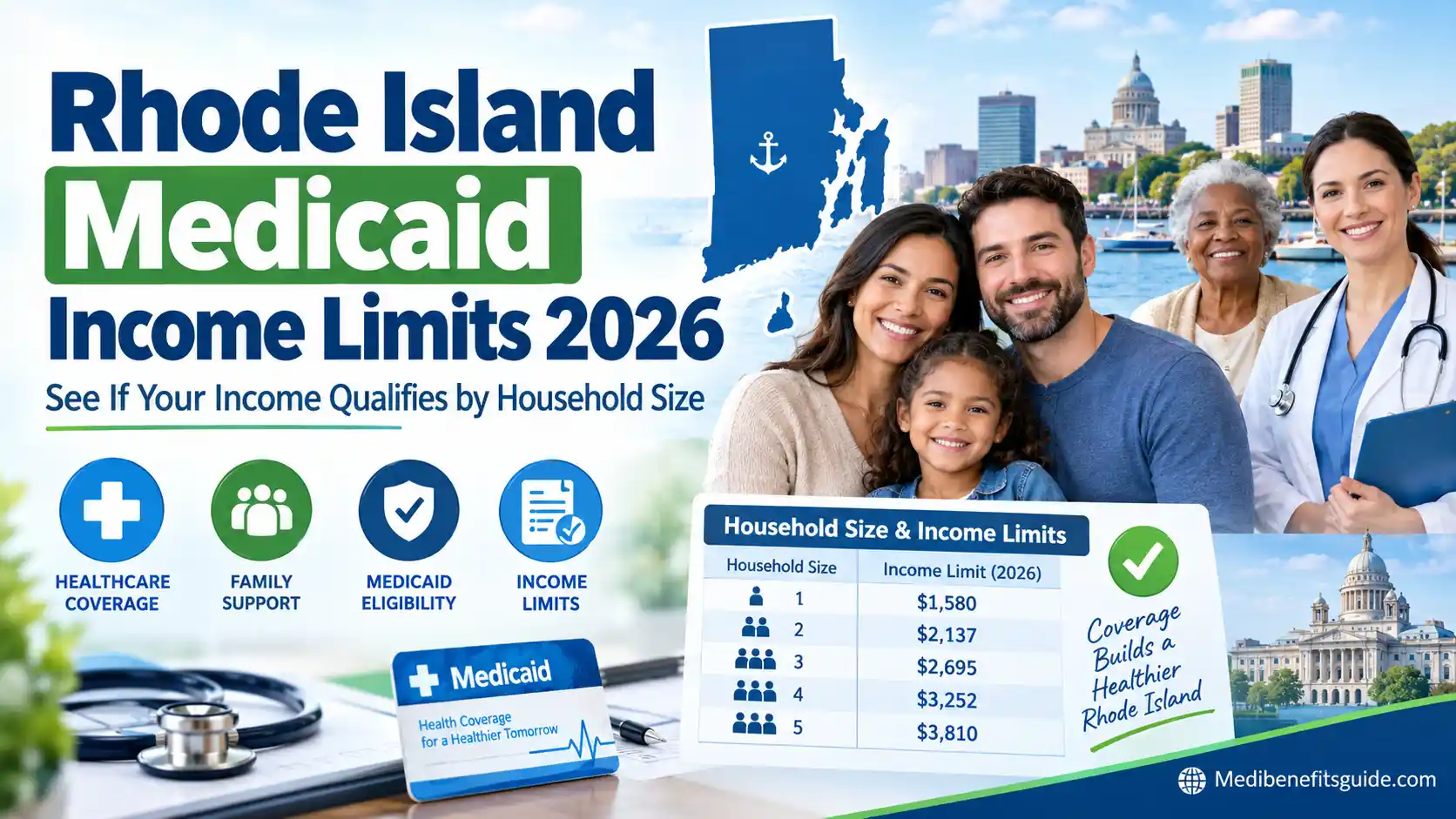
For adults ages 19–64, the main Medicaid expansion limit is 138% of the Federal Poverty Level (FPL). That’s $1,835 a month for one person, $3,795 for a household of four. Children and pregnant people qualify at higher income levels.
Rhode Island Medicaid Income Limits 2026
Rhode Island bases Medicaid eligibility on the federal poverty level. The 2026 FPL for one person sits at $15,960 a year — $1,330 a month. Add $5,680 annually, or $473 monthly, for each additional household member.
Here’s what the 138% FPL Medicaid expansion category looks like for 2026:
| Household Size | 138% FPL Monthly Limit |
|---|---|
| 1 | $1,835 |
| 2 | $2,489 |
| 3 | $3,142 |
| 4 | $3,795 |
| 5 | $4,448 |
| 6 | $5,101 |
| 7 | $5,755 |
| 8 | $6,408 |
| 9 | $7,061 |
| 10 | $7,714 |
These numbers come straight from Rhode Island’s official 2026 monthly poverty guideline chart.
Also Compare Medicaid Income Limits by State — Medi Benefits Guide
What Is the Medicaid Income Limit for One Person in Rhode Island?
For a typical adult ages 19–64 in the expansion group, that’s $1,835 per month at 138% FPL. Earning more than that doesn’t automatically shut the door, though. Other eligibility pathways run on different limits entirely.
2026 Medicaid Income Limits by Eligibility Category
Rhode Island runs several Medicaid pathways. Matching your circumstances to the right one matters more than memorizing a single percentage.
| Eligibility Group | 2026 Income Ceiling |
|---|---|
| Adults 19–64, Medicaid expansion | 138% FPL |
| Parents/caretakers in applicable MAGI category | 138% ceiling |
| Children under 19 | 266% FPL ceiling |
| Pregnant people | 258% FPL ceiling |
| Seniors/adults with disabilities | Separate non-MAGI rules |
| LTSS applicants | Income + resource + medical/functional rules |
| Medically needy applicants | May use spend-down rules |
Rhode Island’s MAGI categories apply a 5% income disregard. That’s why some official materials list underlying thresholds of 133%, 253%, or 261% — while the ceiling you actually qualify under lands at 138%, 258%, or 266%.
Adults Ages 19–64
Adults between 19 and 64 who meet Rhode Island’s Medicaid expansion requirements can generally qualify with income up to 138% FPL. A single adult earning $1,700 a month falls under the 2026 threshold of $1,835.
A household of four bringing in $3,700 a month stays under the $3,795 limit too.
Income alone doesn’t guarantee approval, though. Other requirements still come into play.
Parents and Caretaker Relatives
Parents and caretaker relatives don’t always follow the same rules as adults without dependent children.Rhode Island’s framework uses a 133% FPL underlying threshold, and with the 5% disregard applied, that becomes a 138% ceiling for the relevant MAGI category.
A 2026 federal State Plan Amendment adjusted the parent/caretaker income standard to 133% FPL, effective January 1, 2026.
That’s exactly why older websites show different percentages. Stick with current Rhode Island standards — not an outdated eligibility table someone forgot to update.
Rhode Island Medicaid Income Limit for Children
Kids qualify at a much higher income level than adults in the expansion category.
Rhode Island’s MAGI framework sets a 266% FPL ceiling for children up to age 19.
The 2026 DHS chart breaks down like this:
- Household of 1: $3,538
- Household of 2: $4,797
- Household of 3: $6,056
- Household of 4: $7,315
- Household of 5: $8,574
Worth remembering: a parent might not qualify while their child still does.
Rhode Island Pregnancy Medicaid Income Limit
Pregnant people get a higher ceiling than most other categories. For 2026, Rhode Island applies a 258% FPL ceiling for pregnancy Medicaid. The underlying threshold sits at 253%, and the 5% disregard pushes it up to the applicable 258%. One detail people miss — the unborn child counts toward household size when the state calculates eligibility during pregnancy.
How Rhode Island Counts Medicaid Income
Families, children, pregnant people, and expansion adults are generally evaluated under Modified Adjusted Gross Income (MAGI) rules. MAGI Medicaid looks at household composition and qualifying income. It’s not simply a matter of checking what’s sitting in your bank account.
Depending on your situation, countable income can include:
- Wages and salary
- Self-employment income
- Taxable Social Security income
- Unemployment compensation
- Certain retirement income
- Other countable taxable income
Income changes? Report them through the appropriate Rhode Island system. The state makes the final call on your eligibility.
Does Rhode Island Medicaid Have an Asset Limit?
Not one universal answer here. MAGI Medicaid generally skips the traditional asset test used elsewhere. Seniors, people with disabilities, and Long-Term Services and Supports (LTSS) applicants face a different story — separate income and resource requirements apply.
LTSS covers nursing-home care and home- and community-based services. Both income and countable resources come into play there.
A few other specialized pathways worth knowing: SSI-related Medicaid, Rhody Health Partners, Katie Beckett, Medicare Savings Programs, and medically needy/spend-down programs.
What If Your Income Is Over the Medicaid Limit?
Being slightly over one limit doesn’t mean you’re out of options. You may still qualify under:
- Another Medicaid eligibility category
- A child or pregnancy pathway
- Medically needy/spend-down rules
- LTSS
- A Medicare Savings Program
- RIte Share premium assistance
- HealthSource RI marketplace coverage
RIte Share can help eligible Medicaid members cover the cost of employer-sponsored health insurance, as long as the coverage meets state requirements.
Find the correct program before assuming you’re ineligible. That’s the real mistake people make.
How to Apply for Rhode Island Medicaid
Rhode Island residents apply and get their eligibility determined through the state’s Medicaid application systems. Here’s a practical way to work through it:
- Determine your household size.
- Estimate your current income.
- Identify whether you’re an adult, parent, child, pregnant, disabled, or Medicare beneficiary.
- Apply through HealthyRhode or the appropriate Rhode Island application channel.
- Provide requested income or eligibility documents.
- Review your eligibility notice.
- Keep your contact information updated and complete renewals when required.
The Rhode Island Department of Human Services also offers Medicaid information and application help through its customer service system.
Important Rhode Island Medicaid Changes in 2026 and 2027
A 2026 eligibility check won’t stay accurate forever. Rules are shifting.
October 1, 2026: Some Non-Citizen Eligibility Changes
Federal changes taking effect October 1, 2026 will end Medicaid eligibility for some non-citizens, according to Rhode Island. Specific groups remain eligible under the new rules.
January 1, 2027: Work Requirements
Certain adults receiving Medicaid through the expansion program will need to satisfy new community-engagement requirements. Qualifying activities can include work, volunteering, community service, education, or job training. Generally, 80 hours a month meets the requirement — though exemptions and alternative methods apply.
January 1, 2027: Six-Month Renewals
Some expansion adults will shift from annual Medicaid renewals to six-month renewals. This mainly targets adults ages 19–64 in the expansion group who aren’t pregnant, aren’t caring for a minor child, and don’t have Medicare. Not every Rhode Island Medicaid recipient will face work requirements or six-month renewals. These changes target specific groups.
Common Rhode Island Medicaid Eligibility Mistakes
Watch out for these:
- Using an old income table from a previous year
- Assuming every Medicaid program has a 138% limit
- Confusing 100% FPL with the actual Medicaid ceiling
- Ignoring household size
- Treating MAGI and non-MAGI Medicaid the same way
- Assuming every Medicaid applicant has an asset test
- Forgetting that children and pregnancy have higher limits
- Failing to report household or income changes
- Assuming being over one limit rules out every Medicaid pathway
Use the current Rhode Island figures. Identify the category that actually fits your situation. That’s the safest route.
FAQs About Rhode Island Medicaid Income Limits
What is the Rhode Island Medicaid income limit in 2026?
For adults ages 19–64 in the expansion category, it’s generally 138% FPL — $1,835 per month for one person, $3,795 for a household of four.
What is the Medicaid income limit for a family of four?
At 138% FPL, that’s $3,795 a month in 2026. Children and pregnancy categories can run higher.
What is 138% of the Federal Poverty Level in Rhode Island?
$1,835 per month for one person in 2026. It climbs from there with household size.
What is the Rhode Island Medicaid income limit for children?
Children up to age 19 can qualify under MAGI up to a 266% FPL ceiling.
What is the pregnancy Medicaid income limit in Rhode Island?
Generally 258% FPL for 2026, subject to applicable eligibility rules.
Can seniors qualify for Rhode Island Medicaid?
Yes — through different pathways. Don’t evaluate senior Medicaid using the standard 138% expansion rule. Income, resources, Medicare status, and medical needs all factor in.
Does Rhode Island Medicaid count savings?
Depends on the category. MAGI Medicaid skips the traditional asset test that applies to certain senior, disability, and LTSS pathways.
Can I get Medicaid if my income is slightly over the limit?
Possibly. Other categories, spend-down rules, LTSS, Medicare Savings Programs, or RIte Share may apply.
How often will Rhode Island Medicaid renew in 2027?
Certain expansion adults move to six-month renewals starting January 1, 2027, instead of annual renewal.
Will all Rhode Island Medicaid recipients have work requirements?
No. The new requirements target certain expansion adults, and exemptions apply.
Conclusion
One percentage won’t tell you the whole story here. Adults ages 19–64 generally work with 138% FPL, but children get a 266% ceiling and pregnant people 258%. Seniors, people with disabilities, LTSS applicants, and Medicare beneficiaries operate under entirely different rules.
Start with your household size and income. Factor in age, pregnancy status, disability, and Medicare status. Then find the pathway built for your situation — not the first number you find online. Check Rhode Island’s official 2026 FPL chart and current Medicaid guidance before making any decisions, especially with federal changes landing in late 2026 and 2027.
Official Resources
- Apply for Coverage — HealthyRhode
- Check Income Limits — RI EOHHS
- Verify Eligibility Rules — RI Department of Human Services
- See Federal Poverty Guidelines — HHS ASPE
Disclaimer: This article is for general information only and does not guarantee Medicaid eligibility. Rhode Island Medicaid determines eligibility based on your individual circumstances and current program rules. Always verify your situation with Rhode Island DHS/EOHHS before making decisions about coverage.

About Naseer
Naseer has 10+ years of experience creating informative content and researching medicare topics. He focuses on simplifying Medicaid and benefits details to support readers find clear, reliable, and easy-to-understand guidance.