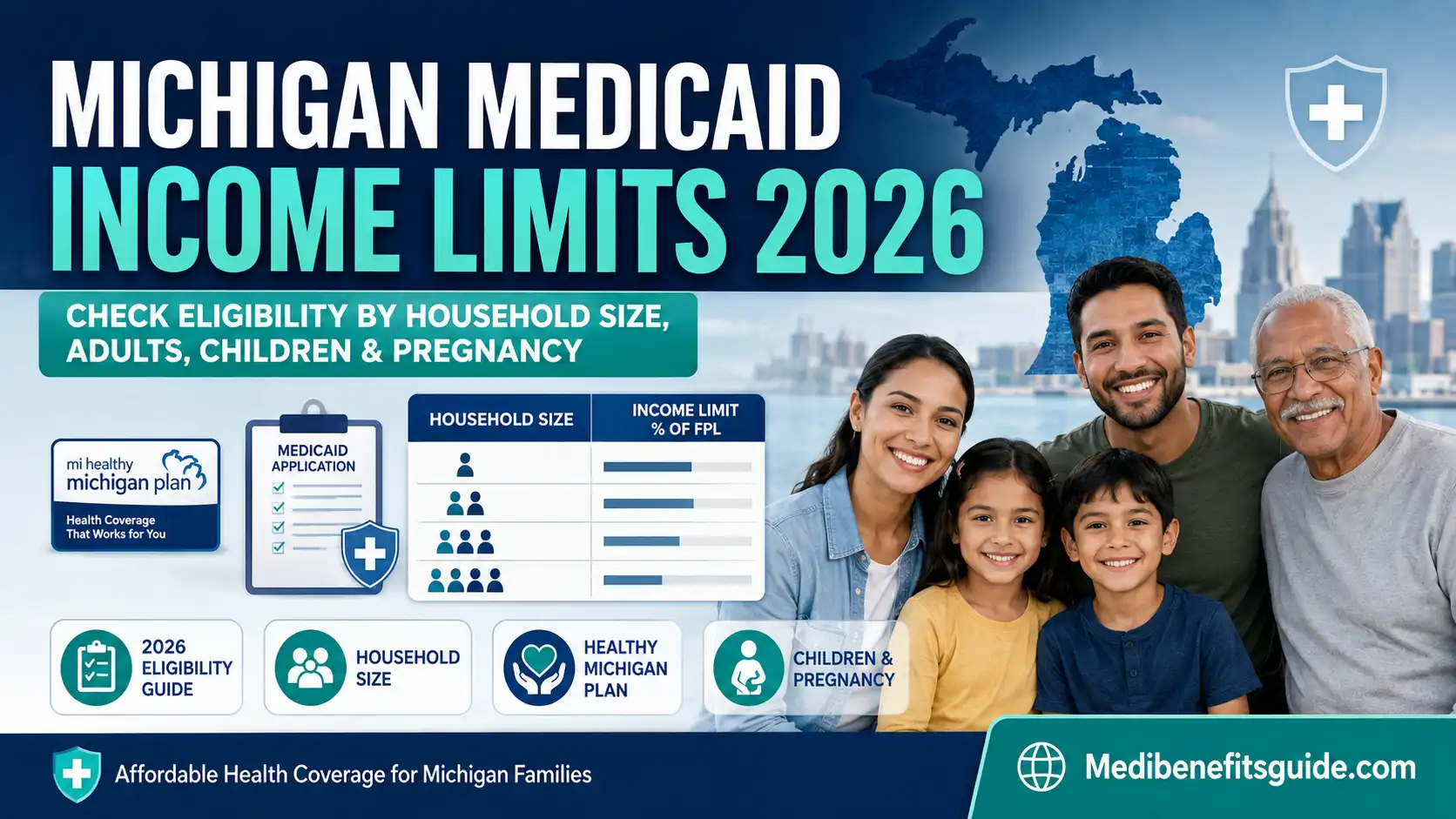
There’s no single income number that tells you whether you qualify for Michigan Medicaid Income Limits. Your age, pregnancy status, household size, disability status, Medicare enrollment, and the specific Medicaid category you’re applying under all change the math.
For adults ages 19–64, the Healthy Michigan Plan (HMP) sets the line at 133% of the Federal Poverty Level (FPL), using Modified Adjusted Gross Income (MAGI) rules. Michigan also applies a 5% MAGI disregard in certain circumstances — and that disregard is why the practical ceiling can land closer to 138% of FPL.
Children, pregnant women, seniors, people with disabilities, and people needing long-term-care Medicaid follow different financial rules entirely.
Michigan Medicaid Income Limits for 2026
The 2026 federal poverty guideline for one person in Michigan’s contiguous-state calculation is $15,960 a year. That number climbs with each additional household member.
Below are the major MAGI-related percentages Michigan programs use. Dollar figures are approximate annual amounts based on the 2026 federal poverty guidelines.
| Household | 133% FPL | 138% FPL* | 160% FPL | 195% FPL | 212% FPL |
|---|---|---|---|---|---|
| 1 | $21,227 | $22,025 | $25,536 | $31,122 | $33,835 |
| 2 | $28,781 | $29,863 | $34,624 | $42,198 | $45,877 |
| 3 | $36,336 | $37,702 | $43,712 | $53,274 | $57,918 |
| 4 | $43,890 | $45,540 | $52,800 | $64,350 | $69,960 |
| 5 | $51,444 | $53,378 | $61,888 | $75,426 | $82,002 |
| 6 | $59,999 | $61,217 | $70,976 | $86,502 | $94,043 |
| 7 | $66,553 | $69,055 | $80,064 | $97,578 | $106,085 |
| 8 | $74,108 | $76,894 | $89,152 | $108,654 | $118,126 |
*The 138% figure is best understood as a practical HMP ceiling when Michigan’s 5% MAGI disregard is required, rather than the basic HMP threshold. Michigan’s Bridges Eligibility Manual (BEM) explains the disregard equals 5% of FPL, applied only in specified circumstances.
These underlying 2026 FPL figures come from the U.S. Department of Health and Human Services. The annual guideline is $15,960 for one person, $33,000 for a household of four.
You can also Compare Medicaid Income Limits Nationwide — Medi Benefits Guide
Why Some Websites Say 133% and Others Say 138%
This trips up more people than almost anything else in Michigan Medicaid eligibility.
The official Healthy Michigan Plan page states HMP eligibility runs at or below 133% of FPL. But Michigan’s Bridges Eligibility Manual also describes a 5% MAGI disregard — and that disregard isn’t a simple 5% cut to your income. It’s an amount equal to 5% of the applicable FPL, applied to the highest MAGI income threshold when needed to establish eligibility.
So: 133% is the stated HMP threshold. 138% is the effective ceiling once that disregard kicks in. Worth remembering when you’re comparing sites or estimating your own eligibility.
Who Qualifies for Michigan Medicaid?
Michigan Medicaid isn’t one program — it’s several, covering different groups:
- Adults ages 19–64
- Children
- Pregnant women
- Parents and caretaker relatives
- Seniors
- People who are blind or disabled
- Medicare beneficiaries who qualify for Medicare Savings Programs
- People who need nursing-home or long-term-care services
- Certain former foster youth
The Michigan Department of Health and Human Services (MDHHS) runs all of it, but the eligibility methodology shifts depending on which group you fall into.
Healthy Michigan Plan Income Limit
The Healthy Michigan Plan is the state’s Medicaid expansion program, built for qualifying adults roughly ages 19 through 64.
The basic standard is 133% FPL, calculated under MAGI rules. Applicants generally need to be Michigan residents, not pregnant at the time of application, and not already eligible for or enrolled in Medicare or another Medicaid category.
Can I Qualify If I Work Full Time?
Possibly — working a full-time job doesn’t knock you out automatically.
What matters is your countable income under the Medicaid methodology that applies to you. A full-time worker earning modest wages might still qualify, while a household with a different income mix might not. If your income fluctuates, report the changes and let MDHHS run the numbers.
Michigan Medicaid Income Limits for Children
Kids get more room than adults do under the Healthy Michigan Plan. Michigan’s 2026 category structure breaks down by age:
- Infants under age 1: 195% FPL
- Children ages 1–19: 160% FPL
- MIChild: 212% FPL
MIChild covers people age 19 and under who don’t have other comprehensive health insurance. Bottom line: don’t check a child’s eligibility against the adult HMP number — it’s not the right comparison.
Michigan Pregnancy Medicaid Income Limit
Pregnancy opens a different Medicaid pathway entirely, separate from the standard Healthy Michigan Plan. The 2026 threshold for pregnancy-related Medicaid sits at 195% FPL — noticeably higher than the adult HMP limit.
If you’re pregnant, apply with accurate pregnancy information rather than measuring yourself against the HMP adult number. Michigan also runs MOMS, a program offering outpatient prenatal and postpartum services to certain pregnant or recently pregnant women who qualify for Emergency Services Only Medicaid.
Medicaid for Seniors and People With Disabilities
Skip the Healthy Michigan Plan limit entirely if you’re checking eligibility for a senior or disabled applicant. It doesn’t apply.
Aged, Blind, and Disabled (ABD) Medicaid categories run on different income and asset/resource tests. Medicare beneficiaries may also have access to:
- Qualified Medicare Beneficiary (QMB)
- Specified Low-Income Medicare Beneficiary (SLMB)
- Qualified Individual/ALMB programs
- Other Medicaid assistance categories
Which pathway actually fits depends on age, disability status, Medicare coverage, income, resources, and medical circumstances — all at once, not one factor in isolation.
Does Michigan Medicaid Have an Asset Limit?
Depends entirely on the category.
Healthy Michigan Plan eligibility runs on MAGI rules and skips the asset test used by certain non-MAGI Medicaid categories.
Other programs — particularly some senior, disabled, and long-term-care pathways — do include resource rules. Having money in the bank doesn’t automatically disqualify you; it might for one program and mean nothing for another.
Does Medicaid Count Gross or Net Income?
For MAGI-related Medicaid, Michigan uses Modified Adjusted Gross Income methodology. That’s not the same as your take-home paycheck amount.
Relevant income can include wages and certain types of unearned income, and the exact treatment depends on the source and the eligibility category involved.
Michigan’s system also cross-checks reported information against trusted data sources — the Bridges Eligibility Manual describes “reasonable-compatibility” procedures pulling from the IRS, Social Security Administration, wage records, and unemployment data.
A Simple Example
Say a Michigan resident gets a raise and assumes the new paycheck automatically knocks them out of Medicaid. That assumption may be wrong. The real question requires working through five things:
- Household size.
- Applicable Medicaid category.
- Countable income.
- Applicable income standard.
- Any permitted disregard or other eligibility rule.
What If Your Income Is Slightly Over the Limit?
Don’t assume you’re out of options just because one number came back too high.
Another Medicaid category might still apply. Some programs carry different income limits, asset rules, deductibles, or medical-expense provisions than the one you first checked.
Michigan, for instance, has deductible provisions for certain caretaker-relative Medicaid applicants whose income sits above the normal limit. If Medicaid genuinely isn’t an option, Marketplace coverage is the next thing to look at.
How to Apply for Michigan Medicaid
MI Bridges is where most people should start.
Application Steps
- Determine your likely eligibility category.
- Estimate your household size and income.
- Gather identification and income information.
- Apply through MI Bridges.
- Respond to MDHHS requests for verification.
- Review your eligibility notice.
- Report relevant changes and complete renewals on time.
MDHHS points applicants toward MI Bridges online, the Michigan Health Care Helpline, or a local MDHHS county office. For official application information, use Michigan MI Bridges.
Michigan Medicaid in Detroit, Grand Rapids and Other Cities
Michigan Medicaid income standards are statewide. Detroit, Grand Rapids, Lansing, Flint, Ann Arbor, Warren, Sterling Heights, Dearborn, Livonia, Kalamazoo, Saginaw, Muskegon, and Traverse City don’t get separate income limits just because of where they sit on the map.
Location matters more when you need help applying, not when you’re checking the numbers themselves. Someone searching “Medicaid application help near me,” “Medicaid office near me,” or “Medicaid eligibility help Detroit” usually needs a county MDHHS office, a community organization, a health center, or another enrollment assistance resource — not a different income threshold.
Relevant counties include Wayne, Oakland, Macomb, Kent, Genesee, Washtenaw, Ingham, and Kalamazoo, among others.
Michigan Medicaid Changes Coming in 2027
Anyone applying for or receiving Healthy Michigan Plan coverage should have January 1, 2027 circled on a calendar somewhere.
MDHHS says certain HMP adults ages 19–64 may need to meet new work or approved-activity requirements starting that date. Most HMP members will also shift to six-month eligibility renewals instead of annual ones.
Approved activities can include work, education, job training, and volunteering, with exemptions applying to some people. Keeping your contact information current, and responding when MI Bridges or MDHHS sends a notice, is about to matter a lot more than it used to.
Common Michigan Medicaid Mistakes
- Using one income limit for every family member
- Treating 133% and 138% as identical without understanding the disregard
- Applying adult HMP rules to children
- Using MAGI rules for seniors without checking the correct category
- Assuming every Medicaid program has the same asset rules
- Using outdated 2025 figures
- Forgetting to report significant changes
- Missing renewal or verification deadlines
- Assuming a city has a different Medicaid income limit
- Giving up after being over one program’s limit without checking alternatives
FAQs About Michigan Medicaid Income Limits
What Is the Michigan Medicaid Income Limit in 2026?
There’s no single statewide number. The Healthy Michigan Plan uses 133% FPL under MAGI rules, and a 5% FPL disregard can push the practical ceiling to roughly 138% in qualifying circumstances.
What Is the Medicaid Income Limit for One Person in Michigan?
The 2026 federal poverty guideline for one person is $15,960 — about $21,227 at 133% FPL and $22,025 at 138%. Which figure applies depends on your Medicaid category.
What Is the Medicaid Income Limit for a Family of Four?
$33,000 is the 2026 guideline for a household of four — roughly $43,890 at 133% FPL and $45,540 at 138%. Other categories run higher.
Does Michigan Medicaid Count Savings?
Depends on the program. HMP eligibility skips the asset test that certain non-MAGI categories use. Senior, disability, and long-term-care programs often have their own resource requirements.
Can I Get Michigan Medicaid If I Work?
Yes, potentially. A job alone doesn’t disqualify you — your income and category determine that.
Do Children Have Higher Medicaid Income Limits in Michigan?
Yes. Kids qualify under thresholds above the adult HMP limit, with different numbers for infants, children, and MIChild.
What Is the Michigan Pregnancy Medicaid Income Limit?
195% FPL for 2026. Report your pregnancy — it changes which pathway applies.
What Happens If My Income Goes Over the Limit?
Your eligibility may shift, but crossing one limit doesn’t mean you’re out of options. Another category, a deductible pathway, a Medicare Savings Program, or Marketplace coverage may still fit.
How Do I Apply for Medicaid in Michigan?
Apply online through MI Bridges, or reach out to your local MDHHS county office. The state’s health care helpline is also available for questions along the way.
Conclusion
Michigan Medicaid eligibility comes down to who’s applying and which category fits them — not a single number pulled off a search result. For Healthy Michigan Plan adults, 133% FPL is the number to know, with the 5% MAGI disregard occasionally stretching that ceiling to around 138%.
Children, pregnant women, seniors, disabled applicants, and long-term-care candidates each play by their own rules. Figure out your category first, run the income calculation that actually applies to you, and apply through MI Bridges.
Official Resources
- Apply Now — MI Bridges
- Check Medicaid Eligibility — Michigan.gov MDHHS
- See 2026 Poverty Guidelines — U.S. HHS
- Find Marketplace Coverage — Healthcare.gov
Disclaimer: This article is for general educational guidance only and does not guarantee Medicaid acceptability. Michigan Medicaid policies, income guidelines and federal requirements can change. For an official determination, check current MDHHS guidance or apply through MI Bridges.

About Naseer
Naseer has 10+ years of experience creating informative content and researching medicare topics. He focuses on simplifying Medicaid and benefits details to support readers find clear, reliable, and easy-to-understand guidance.