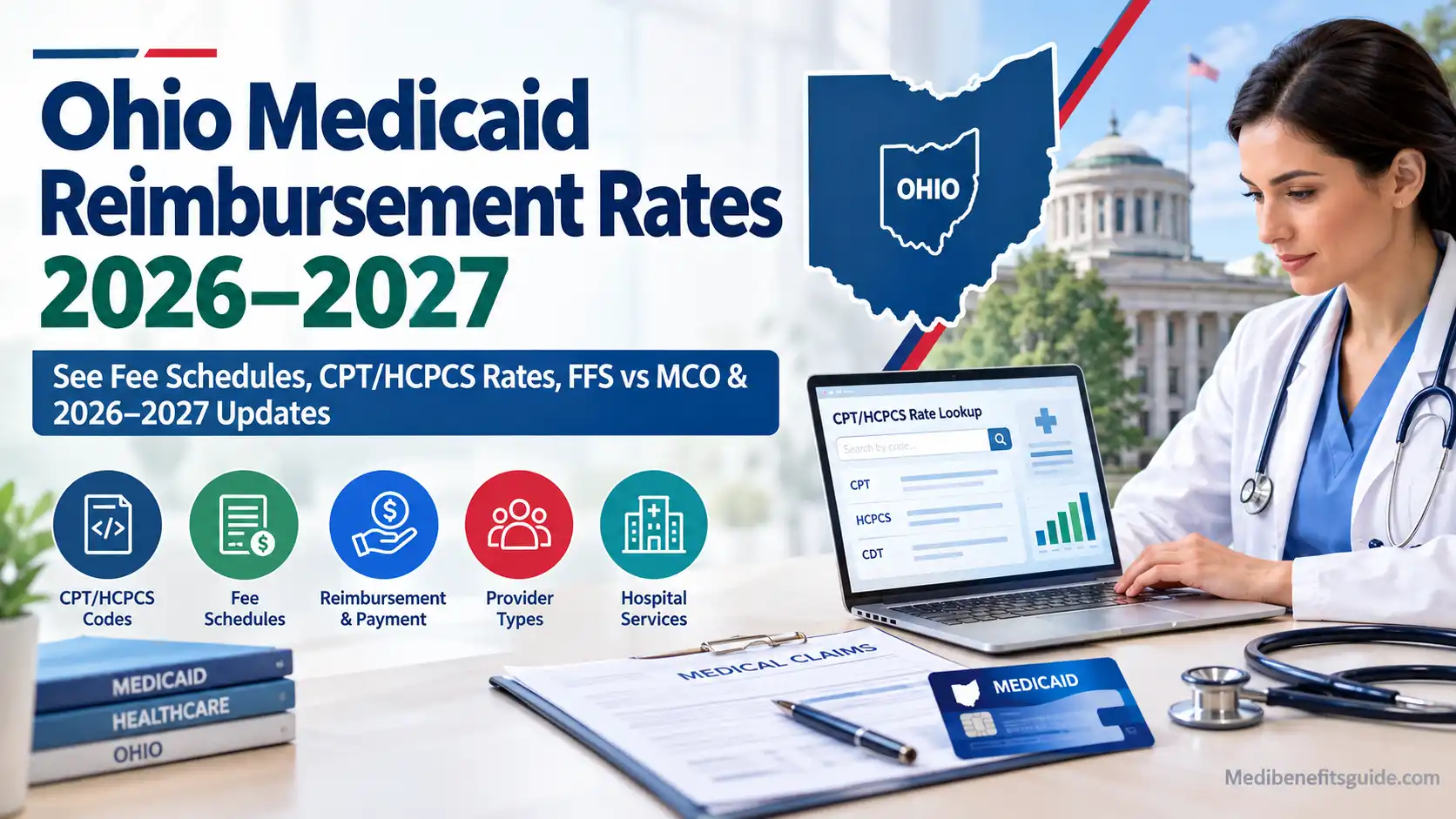
Ask ten people what Ohio Medicaid pays for a service. You will receive ten different answers. Ohio Medicaid reimbursement rates are not a statewide price list. The amount depends on the service code, provider type, payment method, effective date, place of service, modifiers, units, coverage rules and whether the claim goes through fee‑for‑service Medicaid or a managed care organization.
The Ohio Department of Medicaid (ODM) holds the fee schedules. Ohio Medicaid reimbursement rates are maintained in schedules and methods at the same time so confirm which schedule and its effective date before trusting any amount. Curious how Ohio Medicaid reimbursement rates compare with states? Our Medicaid reimbursement rates by state page lists the states for you.
What Are Ohio Medicaid Reimbursement Rates?
Ohio Medicaid reimbursement rates are the amounts that Medicaid pays providers for covered services either a set amount or a maximum. The source of that amount changes with the service. A traditional fee schedule applies to some services. Hospitals use a methodology. Pharmacy uses another system and MCO contracts add another layer.
The final Ohio Medicaid reimbursement rate is determined by the factors:
- CPT, HCPCS or CDT procedure code
- Provider type and specialty
- Service category
- Effective date
- Modifier
- Place of service (POS)
- Number of units
- Coverage requirements
- Prior authorization
- FFS versus managed care
- Applicable Ohio Administrative Code (OAC) rules
That is why searching for a single “Ohio Medicaid reimbursement rate” leads to confusion. There is no number to find.
Ohio Medicaid Fee Schedule: Where to Find Rates
Visit the Ohio Medicaid Fee Schedule and Rates information that ODM maintains. Be aware that the schedules are large and searching for a dollar amount will not help.
Make sure you have these seven items before you start:
- The exact CPT, HCPCS or CDT code.
- The provider or service category.
- The applicable fee schedule.
- The effective date.
- Any modifier or POS requirements.
- Prior authorization requirements.
- Whether the claim is FFS or managed care.
If an older third‑party table disagrees with ODM ODM is correct. That is final.
How to Look Up an Ohio Medicaid Reimbursement Rate
The lookup follows a sequence. Skipping steps causes mistakes: Code → provider/service category → official schedule → effective date → modifier/POS → coverage/PA → FFS or MCO → claim verification
If someone is researching an Ohio Medicaid CPT rate they cannot stop at the code. A physician, an APRN, a physician assistant and a hospital outpatient department may all have payment rules.
CPT and HCPCS Rates
CPT codes mainly describe medical services. HCPCS codes cover more, including services, supplies, drugs and equipment. For services the CDT codes are used.
Searches like Ohio Medicaid CPT reimbursement Ohio Medicaid HCPCS rates or Ohio Medicaid reimbursement rates by CPT code are helpful only after you have linked them to the provider and service schedule.
Ohio Medicaid FFS vs. Managed Care Rates
The main idea in this article is the difference between fee‑for‑service and managed care.
| Payment pathway | How payment generally works |
|—|—|
| FFS Medicaid | Payment follows ODM fee schedules and Medicaid rules |
| Managed care | Payment can depend on the MCOs contract and applicable Medicaid requirements
| Hospital payment | May use specialized methodologies rather, than a simple professional fee |
| Pharmacy | Uses pharmacy payment and coverage rules |
| Specialty services | May have dedicated schedules or methodologies |
Do not assume an FFS fee is what an MCO pays a contracted provider. Providers who forecast revenue negotiate contracts or review claims can be misled by that assumption.
Beneficiaries should know this too. It explains why a provider’s payment arrangement can differ greatly from the public fee schedule.
Does Ohio Medicaid Have One Fee Schedule?
No. Different services and provider categories have schedules and ways. You will find them in these areas:
- services
- Dental
- Behavioral health
- ABA
- DMEPOS
- Home health
- HCBS
- Laboratory and imaging
- Pharmacy
- Ambulance and transportation
- Nursing facilities
- FQHCs and RHCs
- Inpatient hospitals
- Outpatient hospitals
The Ohio Administrative Code adds more payment rules for specific providers and services.
Ohio Medicaid Physician Reimbursement Rates
Ohio Medicaid physician payment receives searches than almost anything else in Ohio Medicaid. It is also complicated. Professional services involve CPT and HCPCS codes, provider qualifications, modifiers, place of service and many billing rules.
What people type into search:
- Ohio Medicaid physician fee schedule 2026
- Ohio Medicaid physician reimbursement rates
- Ohio Medicaid office visit reimbursement
- Ohio Medicaid CPT 99213 reimbursement
- Ohio Medicaid CPT 99214 reimbursement
- Ohio Medicaid E/M reimbursement rates
- Ohio Medicaid nurse practitioner reimbursement rates
- Ohio Medicaid physician assistant reimbursement rates
Whatever the CPT code check it against the Ohio Medicaid schedule. A rate you found on a page is not a source.
How Do Modifiers and Place of Service Affect Payment?
A code only tells part of the story. Modifiers explain how or under what circumstances a service was performed. Place of service says where it happened and that can change the payment rules too. Units, provider type and telehealth requirements all matter.
So look at the billing picture during an Ohio Medicaid reimbursement lookup. Copying a rate from a code list is a shortcut that costs money.
Ohio Medicaid Hospital Reimbursement Rates
Hospitals follow rules than most professional services.
Inpatient Hospitals
For applicable inpatient hospital services, Ohio depends on APR-DRG, which stands for All Patient Refined Diagnosis Related Groups. A stay gets sorted by its resource-use characteristics, and that grouping sets the payment. Billing a professional fee for each individual service? That isn’t how it works here.
Outpatient Hospitals
Outpatient hospital services that apply use EAPG methodology or Enhanced Ambulatory Patient Groups. It groups related outpatient services together for payment.
The point is, a hospital reimbursement question is not answered by a physician CPT fee schedule.
Ohio Medicaid Dental Reimbursement Rates
Dental stands apart with its payment rules and fee schedule structure. Ohio Medicaid dental reimbursement can involve CDT codes, provider requirements, service limits and coverage rules.
A listed rate does not promise that every beneficiary qualifies for the service or that every claim gets paid. Qualifying is a question and our rundown of Ohio Medicaid income limits answers it.
Ohio Medicaid Behavioral Health and ABA Rates
Behavioral health has its payment category too. Ohio Administrative Code Chapter 5160-27 contains the behavioral-health reimbursement rules, including payment requirements tied to providers and services.
- Ohio Medicaid behavioral health reimbursement rates
- Ohio Medicaid ABA reimbursement rates
- Ohio Medicaid 90837 reimbursement
- Ohio Medicaid mental health fee schedule
- Ohio Medicaid behavioral health fee schedule
For a service verify the current rule the provider type and the billing requirements. A generic percentage or a historical rate will not hold up.
Ohio Medicaid DMEPOS Rates
DMEPOS covers medical equipment, prosthetics orthotics and supplies. Ohio Medicaid DME reimbursement can involve HCPCS codes, purchase or rental rules, limits, documentation and prior authorization.
The rules are separate from physician reimbursement. A general Ohio Medicaid CPT rate is the yardstick.
Pharmacy Reimbursement
Pharmacy operates in its world. Payment goes through the Single Pharmacy Benefit Manager (SPBM). Applicable Medicaid pharmacy rules.
Pharmacy research usually involves drug reimbursement, pharmacy billing, National Drug Codes, prior authorization, drug coverage and dispensing guidelines. Take those questions to Ohio Medicaid pharmacy resources. A professional services fee schedule cannot answer them.
Does Ohio Medicaid Pay the Same, as Medicare?
Not necessarily. Two programs, two sets of payment rules different ways and eligibility structures. Some Medicaid rates borrow from Medicare information or methods. That does not mean every Ohio Medicaid service pays the Medicare amount. Use a Medicare comparison as a reference point. It proves nothing about what Ohio pays.
Why Is the Actual Medicaid Payment Different From the Published Rate?
A published fee schedule and an actual claim payment are not the same. Think of three layers:
Published Medicaid maximum → payer or contract rules → actual claim payment
The gap between the first and the last comes from:
- Fee‑for‑service versus Managed Care Organization (MCO)
- Provider contracts
- Coverage status
- Modifiers
- Units
- Place of service
- Prior authorization
- Claim edits
- Third‑party liability
- Provider eligibility
- claim‑specific requirements
Claims databases can make things even more confusing because the average payments they show may not match the published fee‑schedule amounts. Different data sets. Do not mix them up.
Does a Published Rate Mean the Service Is Covered?
No. A rate on the schedule isn’t a promise of payment. Plenty of claims with a listed fee still get denied, because the member’s coverage, the provider’s eligibility, a missing prior authorization or a service limit got in the way. Medical necessity can sink one too. So before you submit, look up the rate and the coverage rules together. Skipping the second check is how a “covered” service ends up unpaid.
What Does the Medicaid Rate Mean for Patients?
If you are a patient the reimbursement rate is about what the provider acquired. It is not a bill that will come to you. Ohio Medicaid payment policies usually defend patients from having to pay the difference between what Medicaid pays and the providers charge for a service except in certain situations.
When a provider says they cannot accept Ohio Medicaid they are usually referring to matters such as network participation, managed care agreement, credentialing or other program policies. The figure shown on a public fee schedule rarely determines the payment.
Ohio Medicaid Rates 2026–2027
The year 2026 introduced changes: new payment rules, updated hospital methods and the start of Next Generation MyCare. Ohio launched Next Generation MyCare on January 1 2026. The state‑wide rollout occurred in stages throughout 2026.
Approach 2027 rates with caution. A third‑party website that labels a figure as “2027” does not guarantee it is accurate. Rely on the official ODM schedule, rule, provider bulletin or other trusted source and check the effective date yourself.
How Providers Can Verify an Ohio Medicaid Rate
Work down this checklist before you bill:
- Determine the CPT, HCPCS or CDT code.
- Confirm the provider’s type.
- Locate the ODM fee schedule or payment method.
- Check the date.
- Review any modifiers. Place‑of‑service rules.
- Confirm the number of units and any service limits.
- Check coverage status and prior authorization needs.
- Find out if the claim is paid via FFS or through an MCO.
- Review the Ohio Administrative Code provisions.
- Verify the payment rules before trusting the amount.
It may take longer than an internet search but it is the only method that will stand up under scrutiny.
FAQs About Ohio Medicaid Reimbursement Rates
What are Ohio Medicaid reimbursement rates?
Ohio Medicaid reimbursement rates are the payment amounts or maximums that Ohio Medicaid sets for services. The code, the provider’s type the service category, the date the billing situation and the payment route all affect the number.
Where can I find the Ohio Medicaid fee schedule?
You can find the Ohio Medicaid fee schedule on the Ohio Department of Medicaid website in the payment Schedule and Rates section. Some services may also be governed by Ohio Administrative Code policies and special payment systems.
How do I check an Ohio Medicaid CPT rate?
First identify the CPT code, the provider’s kind and the service category. Then look up the ODM schedule and its effective information. Also review any modifiers, the place of service, coverage policies and whether the claim is paid via FFS or MCO.
What is the Ohio Medicaid reimbursement rate for CPT 99213 or 99214?
There is no universal figure. Confirm the schedule the provider’s type, the date and the billing situation then read the number from the most recent official fee schedule not from an old online source.
Does Ohio Medicaid pay doctors the same as Medicare?
No. Ohio Medicaid and Medicare use payment systems. Medicare can serve as a point of comparison. It does not set Ohio Medicaid rates.
Does the Ohio Medicaid fee schedule apply to managed care?
Not always. A fee set, for FFS does not automatically become the rate in a contract. Verify the managed‑care agreement and the Medicaid rules.
What are Ohio Medicaid hospital reimbursement rates based on?
Inpatient hospital services use the APR‑DRG method. Outpatient hospital services use the EAPG method. Neither method works like a professional fee schedule.
What are Ohio Medicaid reimbursement rates?
Ohio Medicaid dental reimbursement rates are set in the dental fee schedule. Vary by procedure type and provider.
Dental practice follows Ohio Medicaid rules and fee schedules usually using CDT codes provider rules, coverage rules and limits on services.
What are Ohio Medicaid DME rates?
DMEPOS reimbursement follows Ohio Medicaid policies and HCPCS payment information. Guides about buying or renting, paperwork, limits and prior approval may also apply.
Does a published Ohio Medicaid rate guarantee payment?
No. Whether a provider is eligible if authorization is given, modifiers, number of units, payer process and other claim details can all change the payment.
Conclusion
The useful habit you can develop is to question any single number. Ohio Medicaid system is a mix of schedules and methods and the number that really matters is the one linked to your code your provider type and the effective date. Begin with ODM check it against the Ohio Administrative Code. Keep the state‑by‑state view ready through our Medicaid reimbursement rates by state guide.
Official Resources
- Check Current Ohio Fee Schedules — Ohio Department of Medicaid
- Verify Payment Rules in the Code — Ohio Administrative Code
- Apply for Ohio Medicaid Today — Ohio Benefits
- See Ohio’s Medicaid Program Details — Medicaid.gov
Disclaimer: Ohio Medicaid rates and payment policies can change. This article is, for informational purposes and should not replace the current official ODM fee schedule, Ohio Administrative Code, provider guidance, MCO contract or claim‑specific verification.

About Naseer
Naseer has 10+ years of experience creating informative content and researching medicare topics. He focuses on simplifying Medicaid and benefits details to support readers find clear, reliable, and easy-to-understand guidance.